
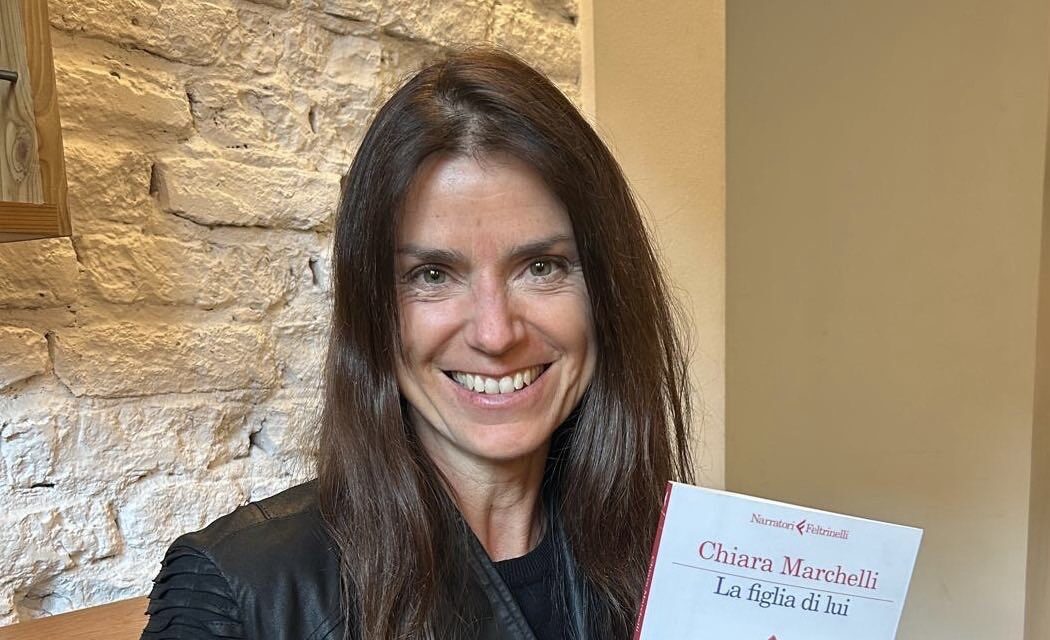
The daughter of him is a novel that takes a very common situation and treats it without shortcuts: an adult woman, without children, who falls in love with a separate man and finds himself, together with him, having to deal with the total presence of a child. Livia is 40 years old, is Italian, lives in New York and works in the world of books; When he meets Arno he immediately feels a rare proximity, but the relationship never arises in an empty space, because Arno has a small daughter, Emma. And that’s enough to change everything: their love can’t be just a matter of two, because there is a third person who has chosen nothing, and that’s why he takes every emotional room.
Marchelli recounts this triangulation with a choice that, in my opinion, is the true force of the novel: does not “explain” the characters to make them sympathetic, lets them be human. Emma can be hostile, possessive, spying; Livia can be generous and immediately after irritated, fragile and hard together. The point is not to establish who is right, but to look at what happens when love enters a family already begun, with roles that seem written by others. Tension grows almost physical, from seemingly minimal everyday life to an episode that puts everyone in front of what they were avoiding: One cannot pretend that balance is simple, nor that pain always remains educated.
Style is also consistent with this matter. The writing is measured, clean, devoid of complacency, and for this reason it knows how to be sharp when needed. The rhythm, then, has something feverish: seems like a book written of momentum, with a tight step that drags you into the urgency of the scenes. It is not a novel that loves great speeches; prefers the precision of the details, the phrases that never raise the voice and for this come closer. The effect is that of an agile reading, which flows, but which leaves you uncomfortable questions.
If we put it next to the other novels of Chiara Marchelli, you immediately notice one thing: she often changes shape, but retains a recognizable nucleus. In Angels and dogs the center is trauma and memory, with a protagonist returning to an event of the past and crossing it as you cross the places of origin, between New York and Valle d’Aosta. It is already present its inclination to treat the plot as an inner path: It doesn’t matter only what happened, it counts how that happened continues to work under skin. The daughter of him moves in the same direction, but with a more contemporary and domestic energy: here the wound is not a distant memory, it is everyday life, the way you greet, you expect, you feel out of place.
In Piemme novels, Involuntary Love and My Words for You, Marchelli explores differently the same emotional territory. In Involuntary love the family relationship is a mined field: a coma writer, a brother who carries her on an undetected accusation, a mourning that deformed the very language of affection. It is a story where love has nothing harmonious: It remains, it persists, sometimes it even imposes itself when you want to reject it. In My words for you the movement is more openly sentimental: a woman with an orderly life in New York, built with precise choices and so much daily discipline, is forced by a meeting to question what she believed definitively. In both cases, as in The Daughter of him, Marchelli is not interested in the coup itself: is interested in the moment when a character understands that he can no longer tell himself the same version of himself.
Blue nights brings this clarity on a long wedding. Here the pain is not a vampire, it is a climate: an experience that regulates gestures, changes words, moves silences. The writing is made even more precise, almost surgical, and the couple becomes a laboratory where we observe how the secrets form, how they defend themselves, and how sooner or later they ask for account. Compared to his daughter, there is less immediate friction and more sedimentation, but the tension is the same: love as a place of care and together as a place of difficult truths.
With The memory of the ashes Marchelli works on another kind of breakage: the fragility of the body and memory after a sudden event, and the need to start again elsewhere, in a landscape that becomes metaphor. Auvergne, with its volcanic presence, is almost a character: a constant reminder of the fact that under the quiet appearance there may be movement, heat, matter ready to rise. Here too, as in The Daughter of Him, the protagonist is not “adjusted”; is shown in an attempt to redesign.
And then there is the apparent deviation of the noir, with Redemption and Mother Earth. Apparently, because if you change the genre, it doesn’t change the substance. In Volterra the plot is more investigative, more linked to the case and suspicion, but Marchelli remains faithful to its best obsession: understand how people react when the social balance falls, how a community protects itself, how a guilty person builds. Commander Nardi, with his attention to detail and his melancholy, is not so far from his most intimate protagonists: He is also an adult on the threshold, moving between what he has to do and what he feels, between the discipline of role and private vulnerability.
The places, in all this, count a lot. New York returns as a city of adult life, where relationships are complex recesses and loneliness is never romantic. The mountain of the Aosta Valley, when it appears, is the language of origin, of the return, of the memory that does not stop calling. The Tuscan province in noir is the territory of the unsaid, perfect to tell how truth, in certain contexts, is always a fact of power. And Auvergne is the landscape of slow transformation, which forces you to look at what bubbles under the surface.
We then arrive at Livia, who is one of the most successful protagonists of Marchelli because he does not seek consent. It is built as a working woman, desires, mistakes, shames, tries to do the right thing and not always succeeds. The novel gives it a rare complexity: it does not transform it into a mother to make morality square, but does not even leave it in the laying of the eternal victim. Rather, she puts it in an ambivalent territory, where love is true and exhausting, where instinct to care lives with instinct to defense.
As for the final, the daughter of him chooses a closure consistent with all this: does not try to calm the reader with an easy peace, but brings the characters in front of an emotional truth that cannot be ignored. It is a way to conclude that Marchelli often uses, even when he writes very different stories: the plot comes to a turning point, of course, but what really remains is the inner track, the consequence, that residual that makes you think that the characters will continue to live beyond the last page, not necessarily happier, but more aware.
If you want a common line between the protagonists of his novels, it is there: they are almost always adults crossing a threshold. They are not learning to live, they are learning to live again. There is a first that no longer holds and one after that does not yet have form. And in the middle, Marchelli puts his favorite subject: relationships that do not allow to be reduced to right or wrong, families that do not coincide with the idea of family, loves that ask for a price. In this sense the daughter of him is one of his sharpest books: because it has the courage to tell a zone of daily shadow and to make, without emphasis, a great novel about identity and belonging.
The article Life in transit between New York and Italy: <i>The daughter of him</i> and the novels of Chiara Marchelli comes from IlNewyorkese.
