
by Vincenzo Petrone
ROMA (ITALPRESS) – The real originality, if so can be defined, of Trump’s intervention in Venezuela is not at all in the cyber weapon that paralyzed the computer systems of the Venezuelan government a few hours before the Delta Force removed from the world of the living the Cuban escort of Maduro. It is probable that the high Venezuelan officers that the CIA had for months enlisted were more decisive than the weapon that President Trump boasted of having used to blind the Caracas Government.
The peculiarity of the American approach lies in the “after” Maduro. In the concept that liberalizes the economy of the country subject to the military coup, it opens up to the business for the oil companies Texane but does not minimally loose the grip of the Bolivarian dictatorship, even if it was beheaded. All the other: it is left untouched, and it replaces only the summit with the insiders chosen among the non-star actors, the comprimari. And the latter is given the task of managing the country as considered more appropriate to ensure the recovery of the economy and the repositioning of this in harmony with the interests of the United States.
Some 200 political prisoners were released in Caracas, including two of our countrymen. Other or more, however, are the opposition representatives who took their place in the infamous “El Helicoide”, the spiral structure designed to be a mall and transformed by Maduro in the headquarters of the Servicio Bolivariano de Inteligencia Nacional.
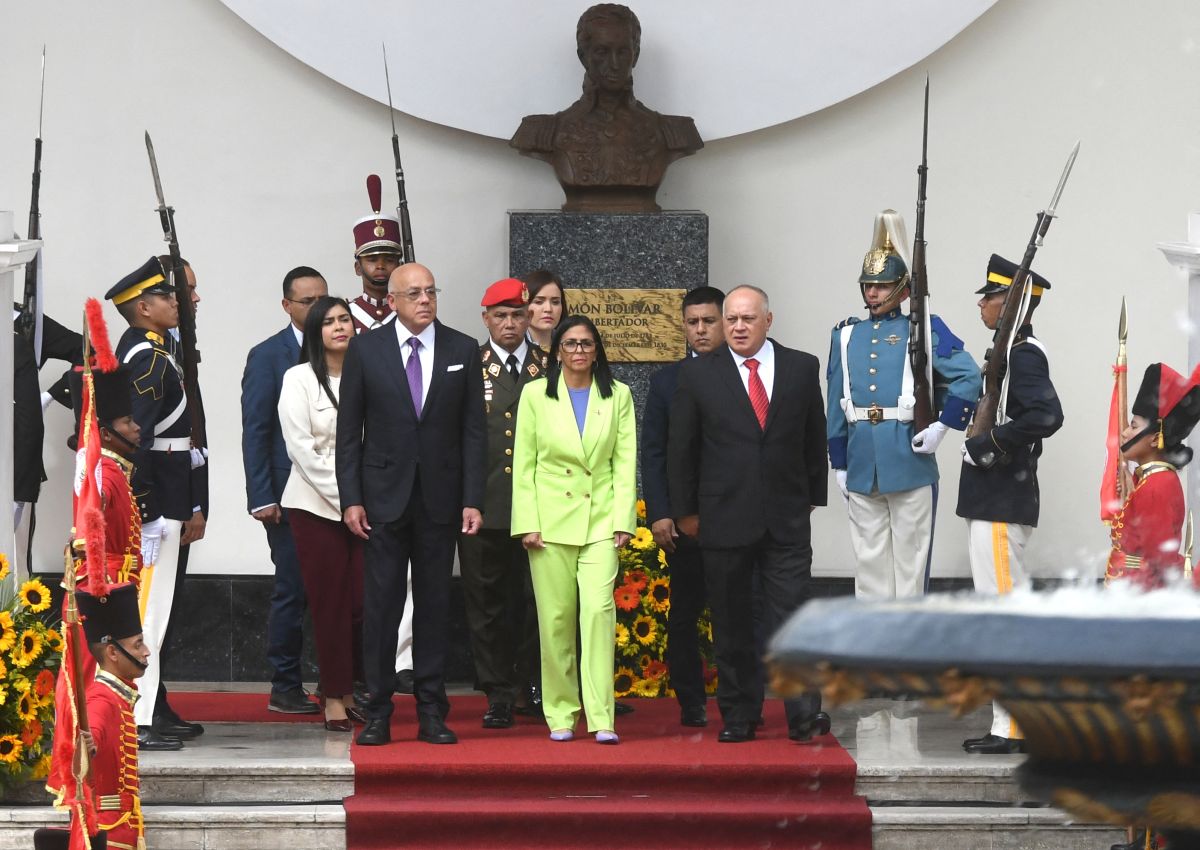
Vice-President Delcy Rodríguez, who replaced Maduro in control of the country, dismissed some faithful of the deposed president and some generals, but left intact the police and secret services. And it has left that among the protagonists of the new repressive wave there are also this time the “colectivos”, those ceffi in motocicletta that everyone saw on television to load the crowd of demonstrators. They collaborate with the “Bolivarian Civil Guard”. Let’s talk about militiamen hired by the regime, who supplied them with automatic weapons and means of transport. While these gentlemen dispelled the expectations of Venezuelan freedom, Vice-President Rodríguez sent 300 million oil to the United States, which would have paid much less than market prices. The proceeds of the sale were entered in the internal commercial and monetary circuit.
The expectation is that American sanctions will inevitably be dismantled in a few months, as long as Delcy Rodríguez does not mind making his own head. And so, for days in the country you see the first American managers coming to visit mines, factories, companies. Everything can be bought and costs little or nothing after a quarter of a century of chavista demagogy, or bolivarian if it sounds better. It is taking shape a first, timid wave of relative optimism in the country and international finance, which begins to hope that at least one part of the credit titles boasted towards the state and the state companies of Venezuela may be worth a tomorrow more than the card they are printed on. Even the Stock Exchange began to give the first signs of life.
The political bet is that the recovery of economic and entrepreneurial activities can quickly improve living conditions and lead to a political climate favourable to the government of Rodríguez. In the assumption that the latter, regardless of his statements of the other yesterday (“we are tired of the diktats of the United States”), follows the line dictated by Washington and immediately redirects the country towards the North, so far from Beijing, Moscow and Tehran on the plane of oil exports and the reception of foreign investments.
The CIA has filtered out today that it is about to open a “annex” in Caracas, outside the building of the U.S. embassy, in order to be able to easily move without noise in the Venezuelan ministries, to advise and monitor who has to implement the directives. In Washington, intelligence agencies are discussing in great secret how to disassemble the solidarity networks of Venezuelan leadership with Russians, Chinese and Iranians, without having to reveal sources and intelligence procedures that allowed the CIA to map collusions, connivencies and corruption.
Ultimately, Trump and his are trying to experiment on the ground, starting from Caracas, a new model of “regime change”, forced change of regime, without militarizing and for a long time in the country. The experience of Iraq and Afghanistan and political and military failures lasting twenty years have left an indelible mark in the memory of politics, the Pentagon and the CIA.
To look well, in some ways the Venezuelan project of liberalization of the economy without dismantling the structures of governance of political repression brings a little imprinted a trademark of intellectual property. And it is the brand that leads to the small, great man of modern China, Deng Xiaoping, who through the reforms launched with the famous speech of 1978 ended the authoritarian madness of Mao Tse Tung and launched the program of liberalization that made China the unstoppable giant we know. Deng Xiaoping did not even touch with a finger the apparatus of the Chinese Communist Party and its fierce grip on all structures of Chinese society. With the massacre of Tian’anmen Square, eleven years later, Deng reiterated the concept. And Xi Jinping, since 2013, has given new strength to this political steel clamp, extending it and refining its instruments thanks to digital technology, just what we believed in the West would destroy communism.
The leader of another great communist country, Mikhail Gorbacev, instead tried to reform economy and politics at the same time. But he failed within a few years and prepared the end of Soviet communism and the dissolution of the Soviet Union itself.
Today it would be unwise to predict the success or failure of the hybrid interventionist model that Trump is experiencing in Venezuela. Two things, however, seem obvious. The first is that the political exponent that the people have chosen but not obtained as their leader, Corina Machado, does not enter the political equation of Trump in Venezuela. The second is that repression in Venezuela is not over, anything else. It is conceivable that neither of the two Turkish things the sleep of the President of the United States.
The next country in which CIA and White House might want to use the Venezuela format could be Cuba, as soon as the chastist regime falls due to lack of chavista oil supplies. However, if in these hours Trump was meditating on applying such a hybrid even in Iran, then he might start suffering from insomnia for some time. By size, traditions and sophistication, Iran is another story.
* ambassador a.r.
– Photo IPA Agency –
(ITALPRESS).
