
ROMA (ITALPRESS) – In the European agricultural landscape, marked by a gradual reduction in the use of agropharmaceuticals, the integration of living organisms and natural substances becomes a fundamental pillar to respond to the challenges of environmental sustainability and food security. Bioprotection, within the framework of European reference, fits, in particular, into a production system that already boasts safety standards among the highest in the world. The most recent data confirm, in fact, the solidity of the Italian model with the EFSA analyses that highlight indexes of conformity to the limits of law close to 100%, placing Italy above the European average thanks to capillary control systems and the rigorous application of the security protocols.
However, although these technologies are already in part available, their use requires an important boost through targeted policies and incentives that favour large-scale adoption. The objective is clear: to support the ecological transition also in agriculture by enhancing the quality and health of the productions allowing the adoption of biocontrol solutions for an integrated response to the climate crisis and the increasing pressure of pathogens and environmental stress, without penalizing the competitiveness of European farmers. A vision that sees Bayer engaged in the development of natural solutions that can also be used in biological systems, thus expanding the tools available to an ever more modern and resilient agriculture.
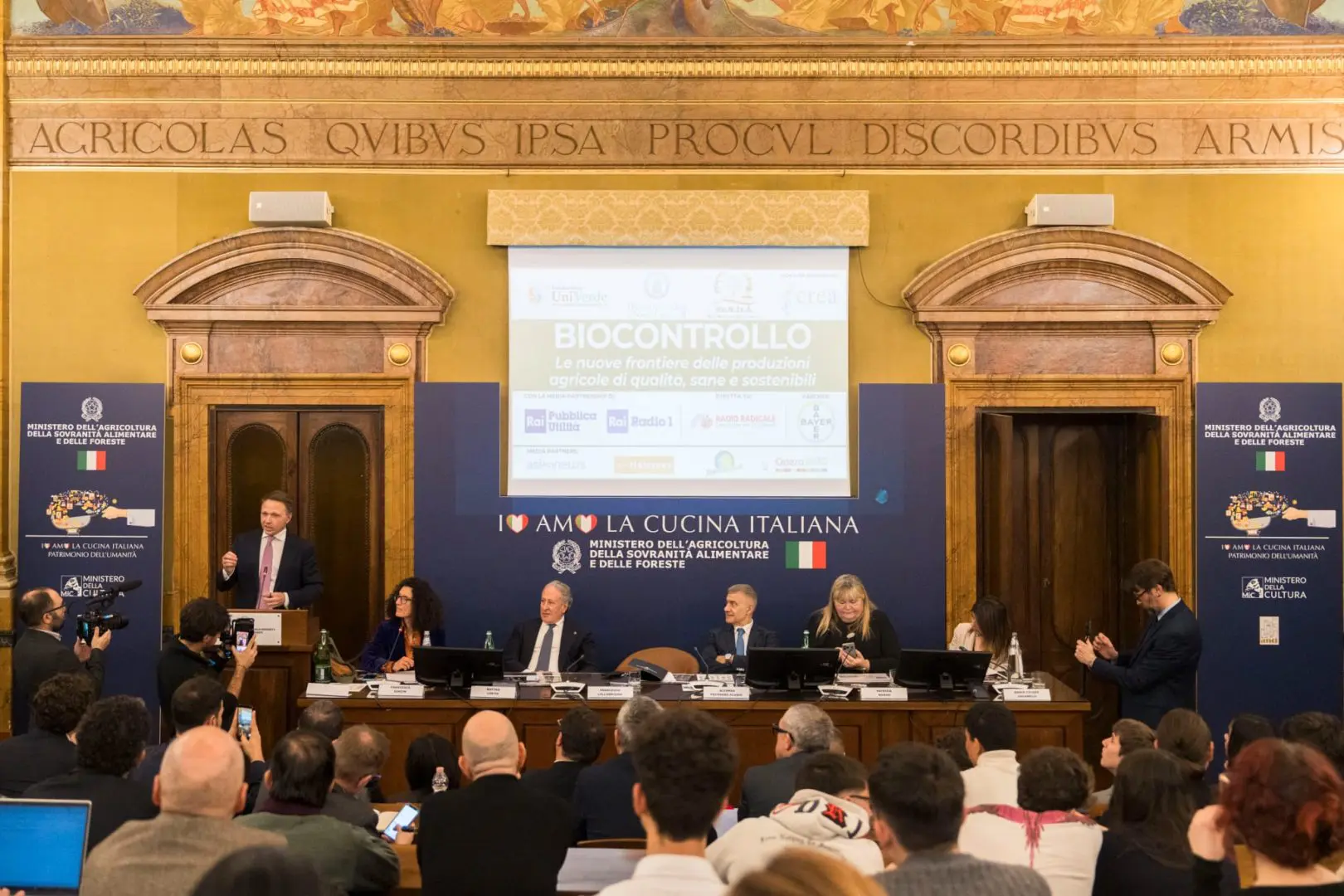
These are the major evidence from the conference ‘Biocontrollo. The new frontiers of quality agricultural productions, healthy and sustainable – promoted by UniVerde Foundation, University of Naples Federico II and National Network Agricultural Institutes – Re.N.Is.A. with the sponsorship of the CREA (Council for Research in Agriculture and the analysis of the agrarian economy) – which took place this morning in Rome, at the Parlamentino Cavour of the Ministry of Agriculture, the Sovereign.
The event was opened by the introductory interventions of: Alfonso Pecoraro Scanio (President of the UniVerde Foundation): ‘Promoting organic farming is one of my personal priorities to relaunch a quality Italy, capable of reconciling environmental protection and consumer welfare. It is no coincidence that the Minister of Agriculture signed on 9 August 2000, the ministerial decree introducing the contribution (tax) on synthetic pesticides and fertilizers. These funds, which are still paid by producers, are intended to finance food security and, in particular, the sector of organic agriculture, supporting national production, the protection of trademarks and research programmes. The event today takes on a particular value: demonstrates that the main realities of the chemical industry are investing in innovative biological solutions with the aim of reducing the use of products that could have an impact on ecosystems.
Matteo Lorito (Rector of the University of Naples Federico II): ‘Organic control of plant pathogens is both an opportunity and an absolute necessity. The opportunity comes from the availability of new technologies developed by major PNRR projects, such as the National Agritech Centre, which provides real alternative or integration to the use of chemistry, in line with the results achieved in recent years in Italy, the most virtuous nation in Europe for reduction of phytochemicals in agriculture. The need is given by the new phytosanitary challenges due to climate change, which are causing an increase of some dangerous pathogens for our crops, in pre and post-harvest, and the arrival of new species for which there is not always effective prevention or therapy. The Agritech Centre, with 30 Universities, CNR and CREA, ensures quality productions protecting environment and economy in agriculture, public health, work, export, typicality of our products and value of made in Italy, also pursuing the objectives of the European Green Deal.
Patrizia Marini (President Re.N.Is.A.): ‘In agrarian institutes you must learn those notions and acquire those skills that enable our students, at the end of their studies, to have European frameworks: GreenComp, DigiComp and EduComp. We need to teach boys and girls to have an important impact to reduce the use of pesticides by 50% by 2030. To do this we can make it clear how important it is, for example, to increase organic farming even more. Surely biocontrol techniques are an important turning point in our sector and allow us to defend plants with organic products, starting from the use of useful insects for the purpose: predators or parasitoids, then microorganisms, natural substances and pheromones, for example. In integrated agriculture, however, we can also use chemical products specially designed. It is in practice to know and implement strategies useful for the development of increasingly sustainable agricultural productions to promote human and environmental well-being. In Italy we have 16% organic crops, we are absolutely a state-of-the-art country compared to the rest of Europe, but we should reach 25%.
Maria Chiara Zaganelli (General Manager of CREA): ‘As a National Institute of Reference for Plant Protection, CREA coordinates the National Biocontrol Plans since 2020. From the biological struggle to the Asian bug, which has allowed to safeguard the orchards thanks to the use of the samurai wasp, up to the new interventions against the cochiniglia of the pine, CREA has demonstrated how public research can offer concrete answers. With the state-of-the-art CUSTOS PLANTIS – Guardian of Plants, the CREA today takes a strategic step towards prevention, anticipating plant protection risks and strengthening the country’s biological security, for a more sustainable environment and production chains.”.
Francesco Lollobrigida (Minister of Agriculture, Food Sovereignty and Forestry) said: ‘We must rely on research and innovation to make our agriculture increasingly sustainable and resilient. We have often talked about sustainability in ideological terms, when we really need to be pragmatic: sustainability means ensuring the environment but also the productivity and income of farmers, these elements must travel together. Biocontrol is an essential element on which we are discussing with the world of school research and training, universities, industry, who over time has evolved its production model, with the aim of reducing the use of agropharmaceuticals and at the same time guaranteeing the production and income of those who work. Young people in this context have a central role, and for this reason we must guarantee them a high level of training and a solid prospect of future even with working days like this.
Following, the specific session was held on Techniques and Biocontrol Strategies, edited by Patrick Gerlich (Delegant Bayer Crop Science Italia): ‘In a constantly evolving scenario, Bayer plays an active role in the development and implementation of new technologies, while at the same time promoting the dissemination of knowledge and good practices. Italy is a strategic asset for us thanks to infrastructure of excellence, such as our research and experimentation centers, which contribute to agricultural innovation also international. Biocontrol is an integral part of a broader vision, based on an integrated approach in which biological and conventional solutions, genetics and digital tools operate in synergy. It is on these grounds that we promote a model of regenerative agriculture, able to strengthen over time the resilience of agricultural ecosystems.’.
At the panel ‘Sustainability, quality and health of agricultural productions’, they discussed: Luca De Carlo (President of the Permanent Commission Industry, Commerce, Tourism, Agriculture and Food Production, Senate of the Republic): ‘When we talk about sustainability, we certainly talk about the environment, but also about economics and social aspects. Sustainable agriculture is the one that balances and takes into account all these aspects: this is the attention to the environment – which sees Italian agriculture among the most sustainable in Europe with 30 million tons of CO2 equivalents issued every year, far from 39 of Spain, 66 of Germany and 76 of France – is alongside the economic role of the primary sector, which sees Italy in the first place in Europe for added value of agriculture with 44,4 billion euros (from the Report on the agro-food economy Bancare 2025 210 thousand those led by women, equal to 28% of the total). To the awareness and knowledge of our farmers, who from 2011 to 2018 have reduced the use of agropharmaceuticals of 20%, we are flanking science and research, with the extension to all 2026 – waiting for the approval of the new European regulation – of the experimentation in the field of TEA – Techniques of Assisted Evolution, which will allow us to have productions more resistant to diseases and climate change; to this we add the novelty of the use of drones for targeted spraying, protecting the soil and further reducing the use of phytochemicals. The quality of Italian production is known: it demonstrates the ‘weight’ of the agri-food chain that records a turnover greater than 676 billion euros and an export of 69 billion (+7.5%); certifies the huge number of protected products, with 305 Dop/Igp specialties recognised at Community level, 524 Dop/Igp wines and 5155 regional traditional products. This government is what most, in the history of the Republic, has invested in agriculture, with over 16 billion euros in three years: not only PNRR funds, but also contracts of supply chain, tax credits, ColtivaItalia. The goal, in front of a growing world population, must be one: to feed it with good and safe products. No therefore to the food built in the laboratory, to bring on our tables the products of our history, our culture, our tradition, obtained thanks to the introduction of science, research and technology. A simple phrase: we must produce more and better.
-Photos press office Fondazione UniVerde-
(ITALPRESS).
