
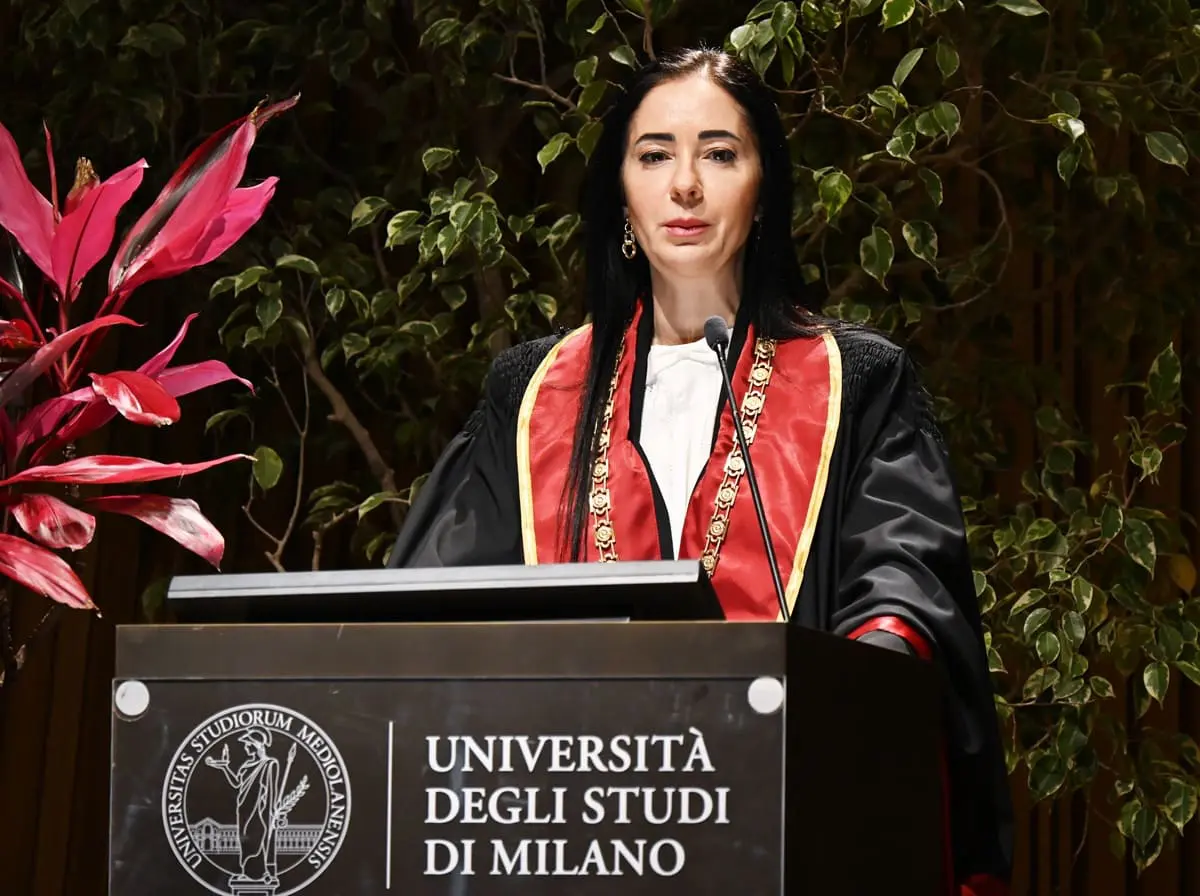
MILAN (ITALPRESS) – From energy efficiency to sustainable mobility, from the promotion of sustainable use of water resource to plastic reduction: at the State University of Milan was presented this morning the Sustainability Report 2025, the document drafted, for the fourth consecutive year, by the University according to the guidelines established by the RUS (University Network for Sustainable Development) and inspired by the 17 Objectives of UN Agenda 2030. At the heart of the ecological transition policies of the University energy saving with two important interventions. The first concerns the project of energy requalification of the historical complex of Ca’ Granda, central pole of the State University of Milan, which will be realized in the three years 2026-2028 with a total investment of 15 million euros. Since it is not possible to install photovoltaic panels in the historic headquarters of via Festa del Perdono, which is still bound, the intervention involves the complete remaking of the thermo-fridge plants, the replacement of half of the Air Treatment Units, the introduction of a new intelligent management system of buildings (Building Management System – BMS) and the installation of new electrical transformers with medium and low voltage, to ensure the use of the most efficient and sustainable energy.
The two new thermo-frigoriferous plants are an integrated system that combines district heating, heat pumps and geothermal wells (4 heat pumps and 6 geothermal wells of grip and restitution in progress surface water) which will result in an annual reduction of the emissions estimated in approximately 1,140 tons of CO2 equivalent. A second strategic intervention concerns the Lodi Veterinary Medicine Pole, where to reduce the use of fossil fuels and increase production from renewable sources a photovoltaic system consisting of two sections was installed: one at the service of the hospital for small animals, and one at the service of the department of Veterinaria. The total power is 256 kWp, for an estimated production of approximately 250,000 kWh (250 MWh) per year, equal to approximately 4% of the total electricity consumption of the Lodi pole. Considering an electricity cost of 0.35 euro/kWh, you will have an estimated annual savings of approximately 87,000 euro. Campus MIND, the new university centre dedicated to scientific research and articulated on five nZEB buildings (Nearly Zero Energy Building), will be equipped with photovoltaic systems with a total production of 1,000 MWh/year. The campus will also be served by a state-of-the-art technology plant “zero carbon emission”, with a mix of multipurpose generators, heat pumps and chillers, with a wide use of groundwater geothermal, consisting of four outlet wells and four yields.
The Sustainability Report 2025, illustrated this morning during “Sustainable State. The university as an innovation engine for the ecological transition”, a meeting opened by Rector Marina Brambilla and Alessandro Banterle, Proctor for sustainable development and ecological transition, also contains other important strategies to promote a culture of sustainability. Numerous initiatives activated by the University to encourage sustainable mobility and reduce the use of the private vehicle, promoting public and collective solutions, including sharing and pooling, with zero-emission means. These include contributions to the purchase of subscriptions with local public transport companies and private companies (ATM-STIBM, Trenord, I travel everywhere in Lombardy, Trenitalia), and agreements with services of bike sharing, electric scooter sharing, car sharing, electric scooters, collective transport through bus and parking. In 2024, the University contributed 3.582 ATM subscriptions and 433 Trenord subscriptions, totalling 665,471 euros, alongside these measures to smart working, rationalization of parking areas and participation in industrial and territorial tables dedicated to sustainable mobility.
With regard to the sustainable use of water and plastic reduction, the university has four houses and 68 drinking water dispensers, subjected to chemical and microbiological controls, available to staff and student population. Thanks to this system, between 2022 and 2024 for the only four houses were distributed altogether 1,779,000 litres of water, with an estimated savings in the production of more than 3.5 million bottles of plastic, avoiding the production of more than 32,000 kg of PET and the emission of more than 114,000 kg of CO2, with data growing in the three years (+0,05%). The University manages the separate collection in all locations, including hazardous special waste and not, with standardized procedures and collaboration with authorized operators such as AMSA to ensure a sustainable cycle of waste also for hazardous special waste (chemicals, sanitary ware, veterinary, alkaline batteries, waste toner cartridges etc.). It also continues its commitment to the census and care of green spaces and areas similar to urban green, promoting the protection of biodiversity through Botanical Gardens and Agricultural Companies, integrating them into redevelopment projects as will happen in the MIND Campus, where the green area is estimated at about 7.500 square meters. Microbiological tests of canteen foods are also carried out to ensure food safety.
“To be a public university means taking responsibility not only to our students, but also to the context in which it operates, in a global dimension. In this context, our contribution lies in the challenges of climate emergency, global health, environmental and social sustainability. Much remains to be done but we are sure that together, with the support of our community, with the contribution of ideas and desire to make our students, our researchers, our administrative partner, thanks to a continuous connection with the institutions of the territory, we will know to continue to develop more and more widely the commitment of the State in this really crucial area for our future” said the Rector Marina Brambilla. “With the Sustainability Report 2025, the State University of Milan consolidates a path of transparent reporting and programming that integrates infrastructure, community services and organizational practices, measuring impacts and results to guide future choices towards an increasingly effective and shared ecological transition,” concluded Alessandro Banterle.
– photo IPA Agency –
(ITALPRESS).
