
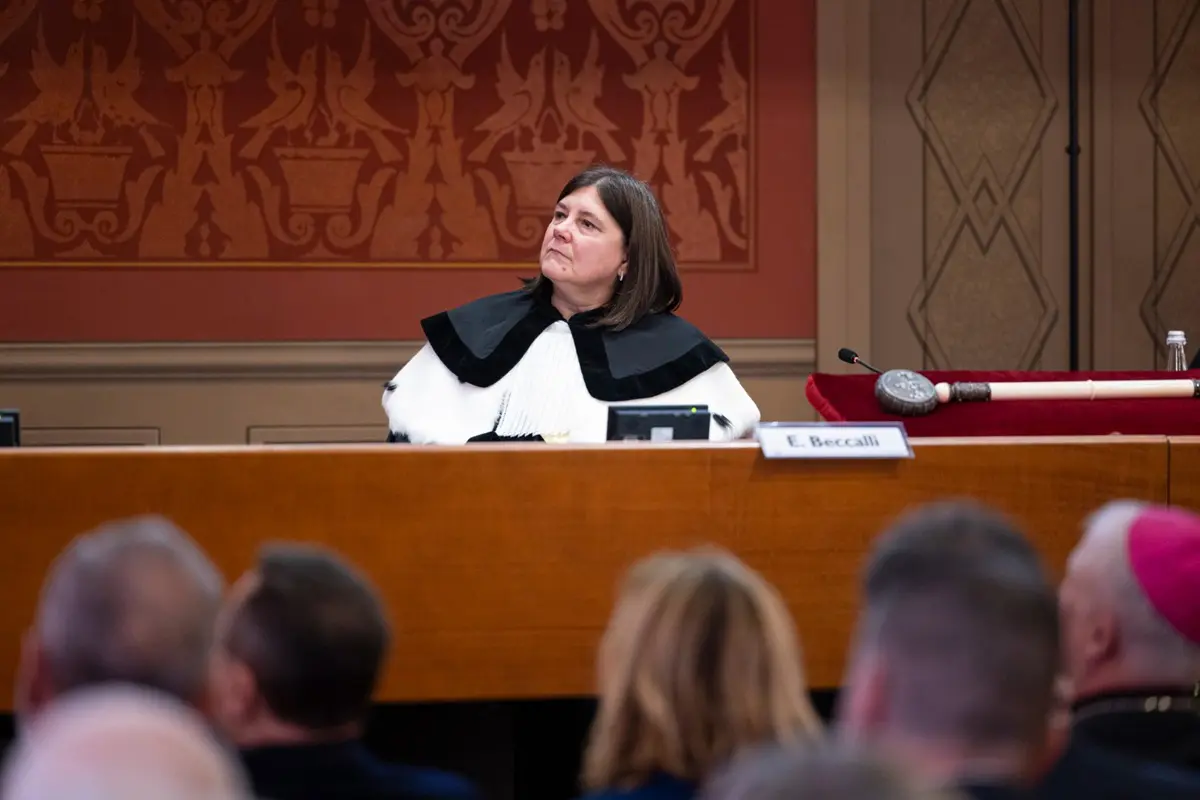
BRESCIA (ITALPRESS) – The alliance between generations is the theme chosen also for the Dies of the seat of Brescia of the Catholic University of the Sacred Heart. Declined, this time, in the socio-political perspective, ‘from always to the heart of the scientific and educational tradition of our University and, in Brescia, particularly developed for over a decade’ as explained Thursday, February 12 by Rector Elena Beccalli in the inaugural speech. An intervention that, before dedicating itself to the theme that makes fil rouge to all the Dies of the current academic year, highlighted the innovations and strengths of the Brescia headquarters. Starting with the new profiles: “Educator in Educational Services for Childhood” and “Socio-Pedagogical Professional Teacher” in the three-year degree of Education and Training Sciences; “Climate change and management of environmental risk” in the master’s degree in Physics and “We live the sport: the intervention of the psychologist” in the master’s degree Psychology of clinical interventions: groups, organizations, communities. ‘All paths designed to respond to the emerging demands of the world of work, to provide innovative skills and to foster qualified and border education’ said the Rector. Also for teaching an initiative that denotes the specificity of the seat of Brescia is service learning, which has involved from 2022 three hundred students in 15 projects.
A pedagogical proposal that concretely translates the idea of universities as a ‘place of knowledge experience’ – as demonstrated, in his speech, the student of Physics Andrea Negrini – and involves the student community in active citizenship paths and social participation. ‘A concrete example of what it means to be the best university for the world’. But the Brescian campus demonstrates that it is also a global microcosm, with 62 international students enrolled with a foreign title, which sums up to those born outside the national borders, who completed their studies in Italy, constitute a total of 130, ‘number that says so much about the attractiveness of the headquarters for second generation young people’. On the other hand, with the praiseworthy positioning of our University certified by QS World University Rankings: Europe 2026’ so ‘we are the first in Italy for student mobility both in and out’. On the research front, the Rector welcomed the funding of more than a million euros obtained by the very young physics Giada Bianchetti in Bando FIS 3 (Italian Science Fund) for a study, with a very high impact, on the metabolism of brain tumors, realized thanks to a multidisciplinary project involving the expertise of the I-Lamp research centre in the field of quantum technologies.
Returning to the narrative thread of this academic year, the Rector noted that at the basis of the alliance between generations, the ‘necessary and indispensable pillar to ensure social cohesion and the development of our country’, there is the ‘intergenerational justice’. This, said Rector Beccalli, ‘founds on principles enrolled in our Constitutional Charter, on the promotion of broad-based policies for the common good, on real social and economic sustainability. The Brescia campus of the Catholic University of the Sacred Heart can continue to offer an essential contribution to make this design concrete. To do so, its glocal dimension must be strengthened and kept up with the times.’ The method to be adopted? ‘The recent proposal of the European Commission for a new pact between generations’, which represents “a real strategy for intergenerational equity (Intergenerational Fairness Strategy) with resources intended. A mechanism which in Italy and Europe serves to prevent public policies from having disproportionately negative effects on younger generations. This shows that effective collaboration between generations is favoured within the European horizon. ‘A well-present relief to teachers who teach on the Brescia campus, where a tradition of studies is now consolidated attentive to the international dynamics, which in the immediate future must be brought to full maturity’.
‘When more than ten years ago we decided to activate in this campus courses of the Faculty of Political and Social Sciences we were inspired by the conviction that to understand the global dynamics we needed to train young people with a critical and constructive piglio, able to orientate in transversal areas, such as political, legal, economic and social. It was – and it is still today – a far-sighted choice, fully in the ropes of our university. Entering the theme, the prolusion of Enrico Giovannini, economist, co-founder and scientific director of the Italian Alliance for Sustainable Development (ASviS), explained that sustainable development is not only an environmental issue, but it is a question of justice and in particular of intergenerational justice. ‘This is the definition of sustainable development: a development that meets the needs of the present without compromising the possibility of future generations to satisfy their own’. Giovannini, citing a report by Asvis with Oxford Economics, revealed worrying data if climate change is not opposed. Looking at the scenarios at 2035 and 2050, it emerged that in the middle of the century the increase in average temperature will reach 2.4 degrees: ‘We know that Europe warms more than the rest of the world and Italy more than the rest of Europe’. We must be aware that ‘retracing is a bad choice for economic reasons not only environmental. The decarbonization alone determines a cost in the short term, advantages in the long term. If we operate a large investment in innovation as well as in decarbonization the positive results can also arrive soon.
The good news is that according to Istat ‘Italian manufacturing companies with more than 10 employees who have invested in sustainability earn compared to those who have not invested 16.7% of added value: therefore it is not true that sustainability is a cost’. According to Giovannini, Europe is ahead of all on intergenerational justice, both to have introduced Youth check, on the counterfeit of the Evaluation of Generation Impact adopted in Italy since 2025 on the initiative of the Asvis, with the aim of “charging the costs” of today’s choices on who will come next; both to have appointed a commissioner dedicated to generations, the Maltese Glenn Micallef. ‘Europe that we criticize so much is the most sustainable place in the world and the most advanced from the point of view of the legislation, the more rules can avoid, for example, 300,000 premature deaths a year because of pollution, many of which are in Italy, about 67,000, many of which are in the Po Valley, the most polluted area of Europe’. That is why we need a pact on the future. A paradigm shift that imposes the recognition of the rights of future generations.
In closing his speech the Rector indicated a bright figure of reference for the university community, that of the Brescian Laura Bianchini, mother constituting, parliamentary, teacher and twice graduated in the University founded by Father Gemelli, whose seat of Brescia will dedicate a classroom on June 2. “In his words – Professor Beccalli concluded – we find the heart of the alliance between generations and our educational method: to accompany each student and student to discover his vocation and, at the same time, to recognize his responsibilities towards others, aware that all this matures within a network of authentic and shared relationships.” The mayor of Brescia, Laura Castelletti, Bishop Pierantonio Tremolada, President of the Brescian Higher Education Authority (Ebis) Alessandro Azzi and Regional Councillor for Education, Training and Work Simona Tironi
– photo press office Catholic University of the Sacred Heart –
(ITALPRESS).
