
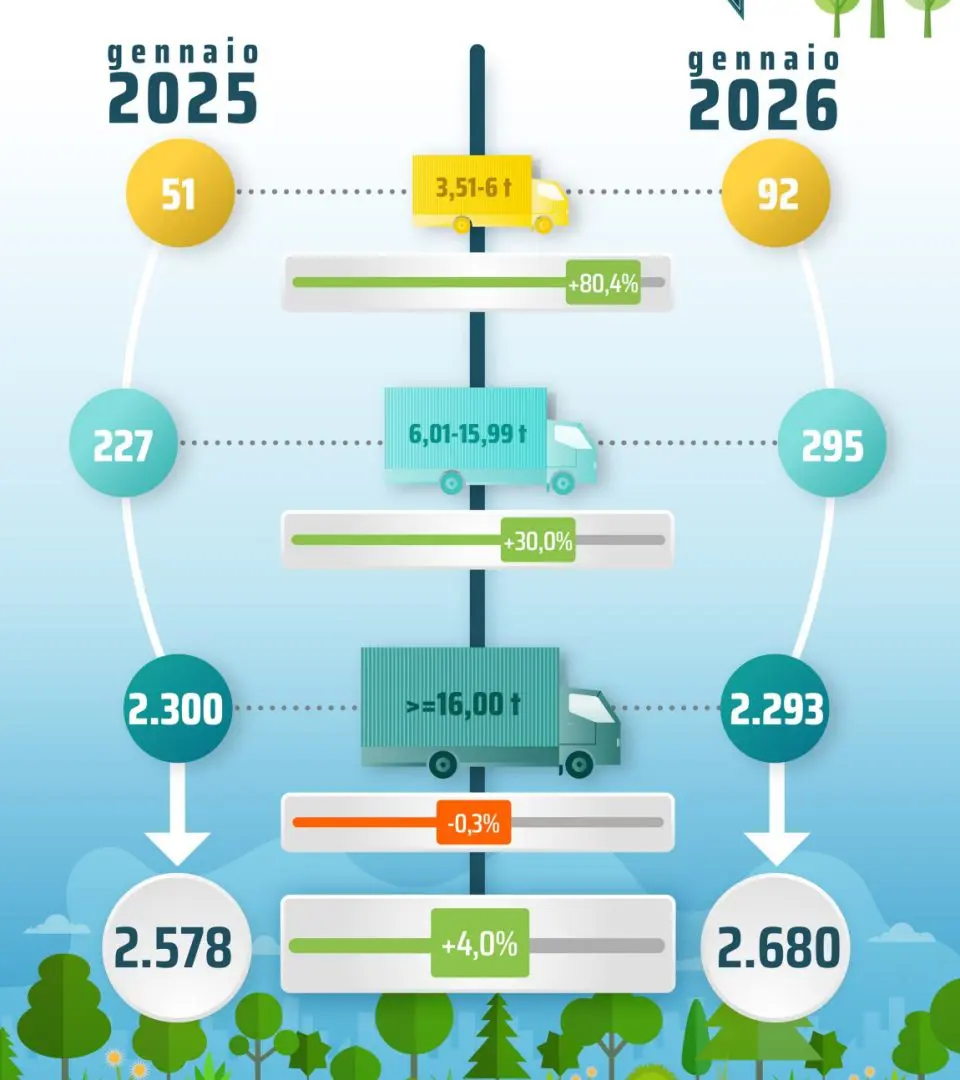
ROMA (ITALPRESS) – In January, the industrial vehicle market closes with a surplus of 4.0%, with 2.680 registrations compared to the 2.578 registered in 2025. The heavy vehicle segment, with a mass of 16 tonnes, is substantially stable, marking -0.3% on a monthly basis.
The result of vehicles with a mass of 6.01 to 15.99 tonnes is definitely positive, making an increase of 30%. Even more marked the growth of light vehicles up to 6 t, in increase of 80.4%, driven by the registration of models of light commercial vehicles with alternative traction that, due to the greater weight, exceed the threshold of 3.5 t.
“To accelerate the renewal of the park and stimulate the competitiveness of the road haulage in a perspective of sustainability, UNRAE has long stressed the need for a coordinated set of enabling conditions. There are fundamental incentive and tax instruments, regulatory simplifications and facilitations for the use of new generation vehicles,” says the President of UNRAE’s Industrial Vehicles Section, Giovanni Dattoli.
“In this regard, we welcome the establishment of the Multiannual Fund promoted by MIT as a concrete signal to support the modernization of the sector and appreciate the constructive dialogue initiated with the Ministry. However, the use of the additional 19 million euros already allocated for the decarbonization of the circulating park remains to be cleared,” adds Dattoli.
At the same time, the regulatory review currently underway in Brussels under the Automotive Package, which also affects emissive standards and support instruments for the technological transition of heavy vehicles.
“The transition to more efficient and low or zero emissions requires a pragmatic and systemic approach, starting from the definition of clear regulatory targets and calibrated supports on the real needs of enterprises. This is even more necessary in the light of the high investment costs, the still limited availability of recharge and hydrogen supply infrastructures and the persistent regulatory uncertainties that make the planning complex by the transport and logistics companies”, concludes Dattoli.
-Photos Unrae-
(ITALPRESS).
