
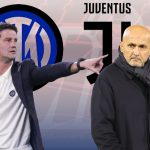
Spalletti decided not to speak, sending Locatelli to the press conference instead. Chivu’s response was subtly polemical…
That Inter–Juventus is not a match like any other was already well known: the Derby d’Italia has always set fans’ emotions alight, and since the post-Calciopoli era the rivalry has unquestionably intensified.
The buildup to the clash at the Meazza has already foreshadowed the skirmishes we’ll see today, on the pitch and in the stands. The two managers have taken center stage.
On one side, the great ex Luciano Spalletti, whose relationship with the Inter world (and especially with Marotta) ended on lukewarm terms, sacrificed on Conte’s altar just after he had brought the Nerazzurri back to the elite of European football, into the Champions League.
It’s easy to imagine that, for someone like Spalletti, who sees ghosts everywhere, such a snub left a wound that has been hard to heal.
On the other side, the rookie coach Chivu, who played under Spalletti at Roma (and knows him very well), before becoming a pillar of Inter’s treble-winning side.
The buildup for the two, who will face each other for the first time as opposing managers (in the first leg Juventus were still coached by Tudor), has been highly unusual.
Spalletti, surprisingly, abdicated the (usually cherished) throne of the pre-match press conference, handing the floor to Juventus captain Locatelli. A strange decision, given there were no midweek fixtures to justify a desire to avoid media exposure at such short notice.
A silence that invites interpretation, which by its very nature can be either illuminating or misleading.
Spalletti’s last public appearance, after Juventus–Lazio 2–2, sparked significant debate, so much so that it has been referenced again in recent days during other coaches’ press conferences.
Spalletti spoke about the need to reform the refereeing system by making it fully professional, and he complained about a penalty not awarded by the referee and not flagged by VAR.
The VAR debate, recently opened by De Rossi, fueled by Gasperini and then relaunched by Spalletti and Conte within a few days, is particularly intense in this period, both in the media and in the corridors of power of Italian football.
Allegri, in the pre-match press conference ahead of Pisa–Milan, was asked to weigh in on referees and VAR, with specific reference to the proposed “Spalletti-style reform.” The same was asked of Chivu.
This shows how, nearly a week later, the words of the Juventus coach are still echoing. I start from this echo to offer you a possible reading of yesterday’s silence.
It’s easy to imagine that, in the pre-match press conference, journalists would have pressed Spalletti to return to the referees–VAR issue, as they have done elsewhere, and in my view this was precisely why the coach chose not to speak.
But make no mistake: the way I see it, this was a shrewd decision, anything but conciliatory. With his silence, Spalletti didn’t try to dampen the controversy he himself had ignited; instead, he allowed it to keep echoing, letting it feed itself once again, in his silence.
And then there’s Chivu, who had the difficult task of responding to that silence. The Nerazzurri coach, in my opinion, masterfully disguised—behind the unsuspecting filter of a low profile, complete with calm tones and a smile—a series of jabs at his former manager.
Chivu administered his own antidote to Spalletti’s poisonous silence, indirectly responding in his press conference to the echo of Spalletti’s post-Lazio barbs.
It’s merely an interpretation, but several clues from Chivu’s press conference could point in this direction. When Chivu states bluntly, “I don’t see ghosts,” everyone immediately thinks of his upcoming opponent who, as mentioned, does see ghosts everywhere (and often he’s right, in my view).
In the football world, from insiders to journalists, this perception is fairly widespread, also due to some rather enigmatic public remarks from the coach from Certaldo: just think of the famous line about the “little mice at Trigoria” from his first stint at Roma. And there would be many other examples.
In my view, Chivu’s line about “not seeing ghosts” is exactly the programmatic manifesto of his press conference.
Chivu then adds: “I’ll talk about referees when I hear a coach admit after a match that he benefited from a refereeing decision; instead I only hear complaints…” It sounds like a generic statement, but then Spalletti’s words about that unawarded penalty against Lazio come back to mind.
Journalists in the room read between the lines and ask Chivu whether he’s worried that referees might be influenced by the protests of those who complain, penalizing those who, like him, keep a low profile. He replies: “I’m concerned about seeing where I can help my players improve; I was chosen to find solutions, not to complain.”
Reading between the lines, Chivu seems to answer point by point everything Spalletti didn’t get the chance to say on the eve of the match because he didn’t speak, but which has been echoing for days in national football debates.
Not to mention the only direct reference to the coach from Certaldo, right at the start of the press conference: “I also tried to send Lautaro to the press conference, but they wouldn’t let me…”
All said with a smile, of course. And with a firm, calm tone.
If Spalletti, in his last post Juve–Lazio appearance, had said that “referees are too important on the pitch; it’s not possible that they’re the only non-professionals,” Chivu calmly replies that “the problem of Italian football isn’t the referees…”
I can’t be certain that Spalletti’s silence was strategic and that Chivu’s words yesterday were a direct response to those of his former coach on Sunday, but I like to think that Inter–Juventus has already begun, with a virtual yet fiery back-and-forth, a prelude to yet another epic clash, like the one in the first leg. When, finally, the pitch will do the talking.
L’articolo It’s Inter–Juventus Day: the strange pre-match buildup of Chivu and Spalletti proviene da Soccer Made In Italy.
