
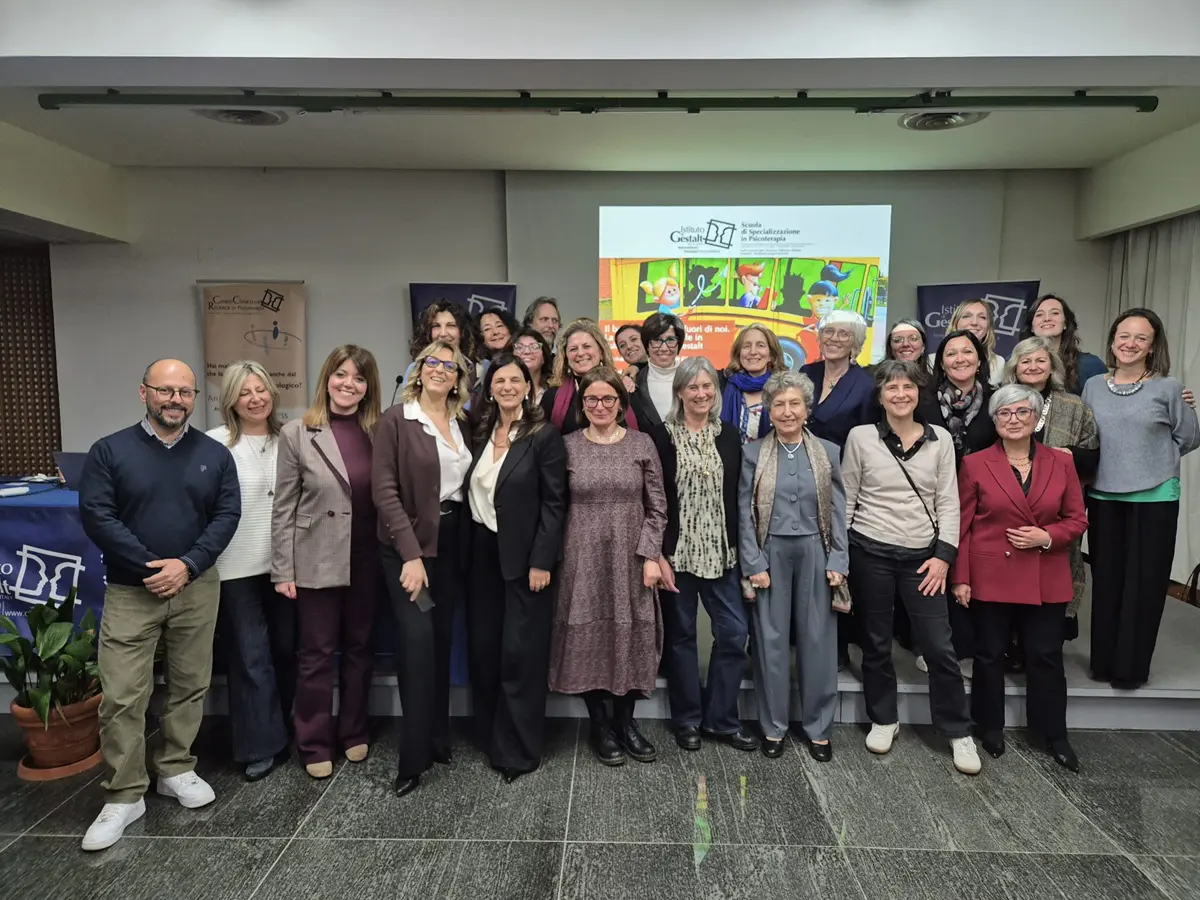
PALERMO (ITALPRESS) – “To raise a child it takes a village”: citing this African proverb, the Director of the Institute of Gestalt HCC Italy, Margherita Spagnuolo Lobb, explained the purpose of the conference “The child inside and outside us. The care of the essential in Psychotherapy of the Gestalt”, organized by the School of specialization in psychotherapy of the same Institute, which took place at the Hotel La Torre di Mondello, Palermo.
Under the guidance of a group of didactics and teaching students of the Institute, the meeting created a “village” that made it possible to “stop to return to the child as a place of the essential, to explore our way of remaining rooted in the body and in the relationship, supporting human sensibility towards ourselves and towards each other”, these are the words of Rosanna Militello, dated to the Institute of Gestalt HCC Italy.
To open the two days were the institutional greetings of the President of the Order of Psychologists of the Sicilian Region, Vincenza Zarcone, and the Guarantor for the childhood and adolescence of the Sicilian Region, Giovanna Perricone, who stressed how clinical work with childhood and adolescence is primary prevention, psychological health protection and an investment on the future of the community.
The seminar, which involved about 230 participants, was dedicated to an experiential journey from the first moments of life until the age of the young adult, in which each participant was able to trace parts of himself, his experience, in an individual and professional growth perspective. In this context, it was fundamental to the contribution of the speakers who provided sensory and emotional ideas and stimuli, useful for working groups.
During the first day, Margherita Spagnuolo Lobb put the relationship between mother and child at the centre of her intervention, described as a delicate relational dance: “A complex system of interaction in a phenomenological field, in which it is essential to grasp reciprocity, to move one another in a shared dance.”
Susanna Marotta, Director of Psychologist at AOOR Villa Sofia – Cervello, and Maria Maddalena Di Pasqua, didatta at the Institute of Gestalt HCC Italy, led the audience in the first moments of intrauterine life, explaining how human experience deepens its roots in an original time, often silent but densely inhabited by presence, rhythm and relationship.
Finally, Cettina Polizzi, Associate Professor at the University of Palermo, and Serena Iacono Isidoro, Researcher at CNR-IRIB, presented a report dedicated to two research projects: Co.Re. in NICU and Dance Steps. These are contributions that interweave research with the everyday life of neonathology departments and neonatal intensive therapy, with a significant and immediate clinical relapse, as they offer an integrated take-up perspective. Both projects share the purpose of promoting, supporting and protecting early co-regulation relations between caregiver and child, recognised as an essential foundation for promoting and protecting health and development.
The second day opened with the intervention of Silvia Tosi, directed at the Institute of Gestalt HCC Italy, and Sara Genny Chinnici, psychologist and psychotherapist, who accompanied the audience through the clinical history of a small patient, narrating the path and therapeutic evolution. Their contribution highlighted how the attention of the psychotherapist is directed to grasp, with sensitivity, the quality of contact between caregiver and child, recognizing that psychological suffering does not belong exclusively to the individual, but emerges in the relational field that unites them. In this perspective, the therapist not only works on the child, but on the co-created and co-regulated field of the relationship, considering the symptom as a language through which the child expresses its adaptation to a complex family environment.
In the afternoon, Veruska Schillaci, the institute’s firm, accompanied the participants, through an experiential moment, to get in touch with the adolescent dimension, a place where the sense of self redefines and takes shape in the living confrontation with each other and the world.
Finally, Stefania Benni and Alessia Repossi, the Institute’s didactic, led the audience towards the conclusion, through the theme of the young adult, phase of life in which previous experiences find new forms of integration and the sense of self is confronted with the choices, responsibilities and possibilities of the future.
“The seminar – read in a note – was an important occasion for comparison and updating for mental health professionals, confirming the value of a clinical approach attentive to relational dimension and early development as the foundation of psychological care.”.
– photo press office Istituto di Gestalt HCC Italy –
(ITALPRESS).
