
MILAN (ITALPRESS) – The Italian university system is dynamic and strategic for growth and innovation, but remains strongly polarized. The excellence in terms of patents and spin-offs are mainly concentrated in the North and the great universities, while territorial and structural differences persist. Environmental progress is still limited in the face of growing consumption and positive social contributions, particularly for inclusion and gender equality.
This is what emerges in summary from the 5th Report of the MHEO Observatory (Milan Higher Education Observatory) “The University Factor – Economic impact and sustainability of tertiary education and university”, presented today at the University of Milan, promoted in collaboration with HEYE Center (Higher Education and Youth Employability) of the University of Bergamo, and MEIEC (Milan Economic Impact Evaluation Center) of the University of Milan. The report, edited by Giovanni Barbato, Carlo Fiorio and Matteo Turri of the University of Milan, and by Michele Meoli and Stefano Paleari of the University of Bergamo, aims to explore the economic and social impact of universities, taking into consideration the growth of patenting activities, the development of spin-offs, links with the territory and sustainability. “The analyses conducted by the MHEO Observatory demonstrate how universities are a determining factor in the development of Milan and Lombardy.
The reading of the data allows us to look to the future with confidence, since it offers the basis to address with awareness the profound changes currently in progress”, explained Matteo Turri, professor of Business Economics of the University and scientific manager of MHEO. “The V MHEO Report once again confirms the value of data and analysis based on the evidence of our Observatory, to understand the dynamics of education, the socio-economic system and the labour market, identifying criticality but also opportunities, in particular in the Lombard and Milanese context. The transformations that are investing the labour market and our society as a whole, under the push of the digital transition, of the AI, of the demographic and social changes in place, in fact emerge on the one hand the demand for new skills and on the other impose to the universities a profound update of the formative models and learning strategies – our University is for example improving new training paths and an innovative teaching precisely to respond to this challenge. On this path, the dialogue with the territory and the contribution of the MHEO Observatory of the State of Milan represent fundamental strategic resources,” added Rector Marina Brambilla. University patent: in Italy only 8% of European patents, of which 47% in Lombardy. Among the causes, limited patent culture and misalignment between university research offer and industrial demand.
In Europe, between 2000 and 2020, the share of university patent applications has grown from 6.2% to 10.2% of the total European applications submitted by European applicants. The Italian institutions contribute to 6.6% of total academic patent applications, while from Germany comes the largest number of questions (about 24%, followed by France (17.9%) and the United Kingdom (12.1%). In Italy, university patenting constitutes 8% of the total patents deposited by Italian applicants, a share higher than the German 5.8% but less than the other major European countries. In view of the significant increase in patent applications from Italian universities in recent years – from 186 applications in 2000 to 1.235 in 2022 – the number of patents granted has stabilized, with a downward success rate and an increase in patents not granted or declined. The Italian system of university patenting is strongly polarized: in Northern Italy, in particular, 47% of university patents are concentrated, with Lombardy in the first place (29%), followed by Piedmont and Emilia-Romagna, which overall cover about 65% of the national total. These activities are mainly developed in pharmaceuticals, medical technologies and biotechnology.
Limited patent culture and misalignment between university research and industrial demand help explain why many universities do not translate quality research into intellectual property. Spin-off university: constant reduction of their number, prevailing location in Northern Italy and engineering focus with low failure rate. There is a significant and constant reduction in the number of university spin-offs, from 86 in 2018 to 20 in 2024, a trend influenced by the uncertainty generated by the pandemic of 2020, by the introduction of more restrictive rules and structural fragility related to the small size, the poor attractiveness of capital and the limited international growth. The territorial distribution of spin-offs follows the trend already highlighted for patenting, with the North that collects 47% of the initiatives. The majority of these spin-offs were born within large and mega-sized universities and predominantly within a single university, indicating a limited inter-university collaboration. Spin-offs are largely monodisciplinary (83%), with a prevalence of engineering disciplines (46%).
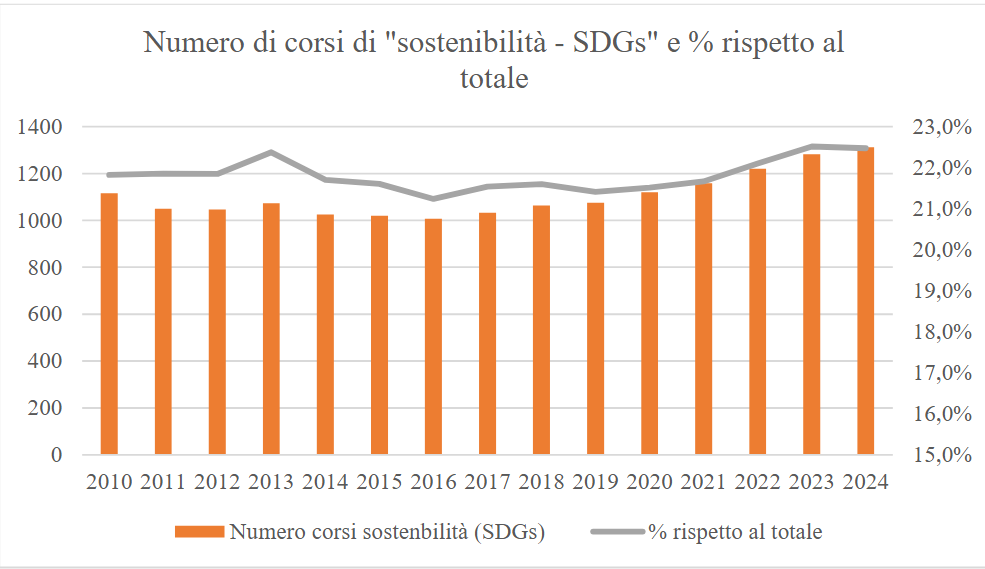
The greater creation of spin-offs in large universities is favoured by the broadest basin of teachers, researchers and students, by the presence of structured Technology Transfer Offices and specialized services, from localization in metropolitan areas or industrial districts that facilitate links with enterprises, investors and incubators, as well as a greater reputation and visibility, capable of attracting industrial partners, talents and high profile research projects and strengthening innovative and entrepreneurial capacity. Despite critical issues, university spin-offs have a low failure rate: only 1% closes within the first year and 7% within five years. Finally, the report dedicates a section to the sustainability of the Athens, analyzed from the environmental, social and economic-financial point of view. With regard to environmental sustainability, between 2015 and 2021 the energy consumption of the Italian universities increased by 24.1%, while the expenditure rose by 22.6%: self-production, although grown by about 300% and covering only 2% of the requirements, has contributed to the increase of expenditure and indicates a wide potential for development towards greater energy self-sufficiency. On the front of social inclusion and sustainability, among the registered persons, there is a good gender balance, with a predominance of women. There remain differences between disciplinary areas: women prevail in the humanities and educational sectors, while men in engineering and ICT.
But there are signs of rebalancing, with increasing female presence in technical-scientific and male disciplines in humanities. In 2022-2023 students exempt from payment of fees were 37.6% of enrolled, over three times compared to 2010-2011. A section of the V Report is also dedicated to a survey conducted on a sample of 2,500 students from the State University of Milan (May and October 2025) on economic-financial well-being and impacts on academic career. The rent emerges as the main item of expenditure for autonomous students, although 62.6% reside in households of family property; 25.6% choosing housing support important charges that affect the quality of university life. 57.6% of students do not work and depend on family support, while about one third of the students workers face significant hourly loads, resulting in a compulsory choice between work and teaching continuity. A third of the students manages to cover up to 100 euros with their own resources, reporting a structural vulnerability to economic shocks and a strong dependence on the family network. -Finally, 55% saves without resorting to dedicated tools.
– Graphical Photo “The University Factor – Economic impact and sustainability of tertiary education and university” –
(ITALPRESS).
