
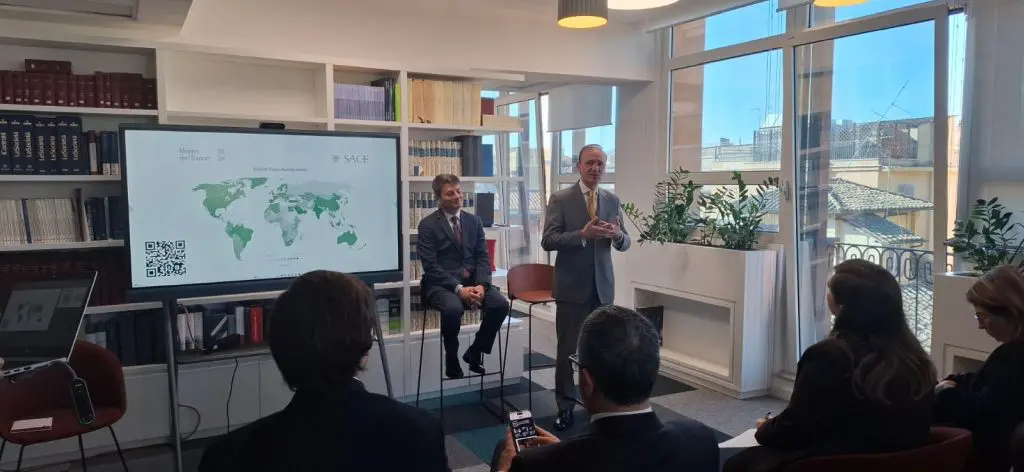
ROMA (ITALPRESS) – Despite the persistence of recurring geopolitical shocks, world trade continues to show a capacity to hold higher than expected thanks to the anticipation of imports, the technological cycle linked to investments in artificial intelligence and the ability of enterprises to reorganize the supply chains. In 2025, in fact, the volume of international trade of goods increased at a surprising pace, close to 5%, and in the three-year forecast 2026-28 is expected to advance of +2.3% on average, in line with the growth rate recorded in the period 2022-24. These data emerge from the Map of Export 2026, the SACE tool that, this year at its 19th edition, traces the ways of growth of companies that export and invest in the world. According to the photograph taken by the Map, presented today by the president of SACE, Guglielmo Picchi and Alessandro Terzulli, Head Economist of SACE, global economic activities live today with averagely stable risk levels, but structurally higher than the past. These include geopolitical and commercial tensions such as the end of the stock effect, the entry into force of new American duties and the growth of non-tariff barriers; another unknown is represented by the possible attenuation of investments in artificial intelligence that hauled growth in 2025. The Map shows a substantial stability of the average levels of credit risk, although with a high heterogeneity between geographical areas and countries: scores remain unchanged in 93 markets (which weigh for 24% of Italian exports); decrease in 63 (equal to 35% of export); and increase in the remaining 38 (equal to 41% of export). To be monitored also the political risk, present not only in the countries concerned with conflicts but also in those characterized by complex governance or particularly fragile socio-economic contexts: for example, in the countries at high level of debt the pressures on the independence of central banks, the discretionary use of fiscal policy and the postponement of structural reforms are all elements that can result in greater financial volatility and in crisis of trust with impacts on business security. “In an international context marked by recurrent geopolitical shocks, fragmentation and increasingly strategic use of trade as an economic competition lever, knowledge of markets is indispensable to orientate business growth strategies – Terzulli said. The Map of Export SACE 2026 responds to this requirement by offering a ‘bussolà for those who export, thanks to an integrated reading of risks and opportunities Country by Country, in choosing the most suitable insurance tools for each context to manage criticality and uncertainty’, added. According to President Picchi, the real driver is the export and “SACE will have to support businesses more and more” thanks also to the huge resources that the government has made available. “We have all the tools to do well and accompany growth. Despite everything, from energy prices to duties, to geopolitical uncertainties, the ability of Italian entrepreneurs to conquer new markets is extraordinary. There are markets that have high potential and going on these new markets will be a possibility of growth, they are goals within the reach of the country, determination in many areas there is and commitment on the Mattei Plan where SACE is the protagonist, is an element that can really develop the Plan and bring true added value to the Country”, concluded Picchi. Competitiveness of enterprises also goes from geographical diversification: today 45% of Italian companies export to one market, a concentration that increases exposure to localized shocks and makes more vulnerable to regulatory, geopolitical or macroeconomic changes. North America remains a reference area per l’export italiano, albeit in a context of growing commercial fragmentation. The United States continues to offer opportunities thanks to the solidity of domestic demand, technological leadership and the propensity to consume premium goods. Canada presents business opportunities related to investments in infrastructure, green technologies, digital and artificial intelligence, also supported by commercial integration with the European Union. Latin America is interested in a renewed position in global balances, linked to the availability of critical raw materials, the dynamics of nearshoring and the strengthening of trade ties with the European Union, including the EU-Mercosur agreement. Balkans and Turkey are important markets of proximity. In the Balkans, the path to entry into the European Union of some countries is leading to a strengthening of macroeconomic fundamentals and governance, which is widely reflected in risk scores, which remain altogether of medium-level. In 2026, the Middle East is one of the most dynamic areas globally driven by the Gulf countries continuing in economic diversification programmes, supported by large public investments, in a complex geopolitical context but with differentiated risk profiles. As for Africa, the Mattei Plan represents both a growth engine and therefore stability, through targeted investments and high impact on local communities and a catalyst for new opportunities for our enterprises. Italy plays a strategic role in the major infrastructure projects that will applaud tomorrow’s Africa. The Asian economies, finally, have reported good results thanks to solid exports and a favourable technological cycle, despite risks such as the increase of global protectionism, weak domestic demand and a stagnation of consumer confidence. Infrastructure investments and regional cooperation strengthen the growth of the area, which is confirmed among the main beneficiaries of the transformation of global supply chains. In China, reforms, investments in technology and innovation maintain the country a significant destination for Italian companies, thanks also to the Italian-China 2024-27 Action Plan which aims to strengthen cooperation in strategic sectors; however, it is necessary to adopt risk management strategies linked to the aging of Chinese leadership, the personalization of power and the growing global geopolitical competition.
– photo press SACE –(ITALPRESS).
