
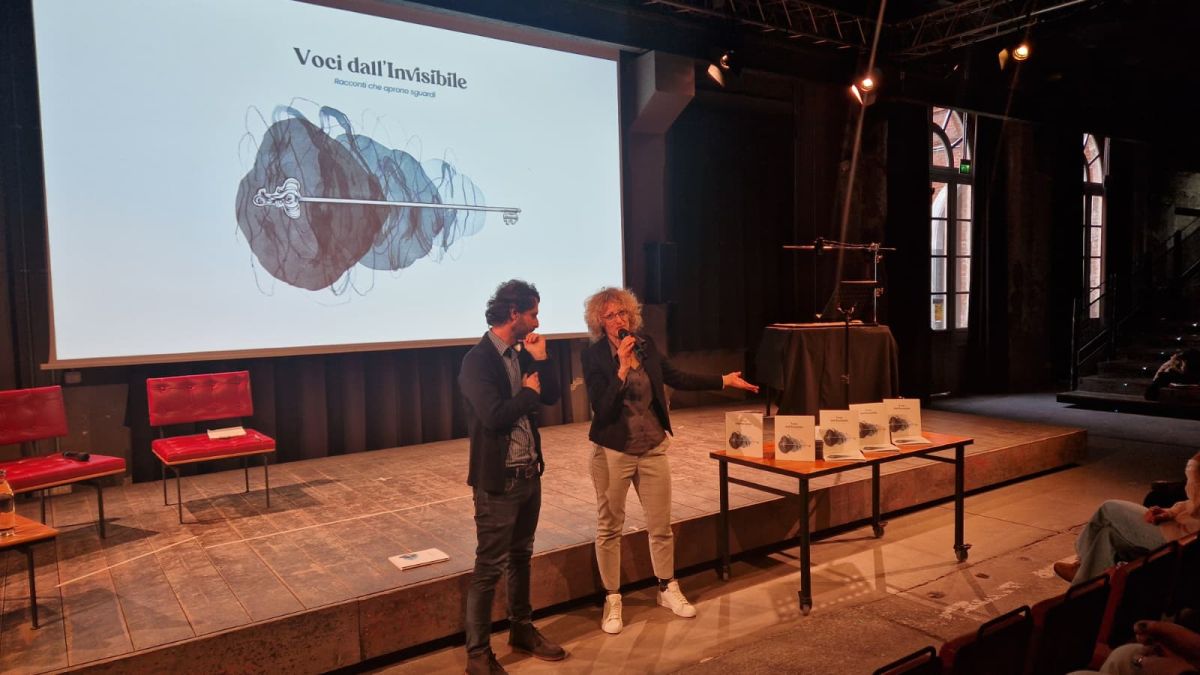
TORINO (ITALPRESS) – On the occasion of the World Day of Rare Diseases, the Scuola Holden hosted the presentation of “Voci dal Invisibile. Tales that open up looks”, the book born from the path of narrative medicine “Recognize the invisible”, realized by Scuola Holden with the non-conditional contribution of Ascendis. Not only the presentation of a book, but the public return of an experience that focuses on the relationship of cure in rare diseases. The event brought together doctors and patients who took part in the project at a time of return and comparison dedicated to the value of narrative within the care report. The meeting was divided into a dialogue between clinicians and participants in the laboratories, alternating reflections on the experience experienced in readings of some pieces taken from the volume. An opportunity to share not only the results of the path, but also future insights and perspectives of application of narrative medicine in everyday clinical practice. The project involved people who live with hypoparathyroidism, rare and chronic pathology that has no visible symptoms but deeply affects the life of those affected. They also participated in the caregivers and clinics that follow them in the therapeutic path, through a series of writing workshops that involved three Italian hospitals (Santa Maria della Misericordia Hospital of Udine, Poliambulatorio LARC di Pinerolo e Policlinico Universitario Campus Bio-Medico di Roma). Through the language of the fairy tale, patients and caregiver explored together lived, fears, transformations and internal resources often absent in traditional clinical narrative. Filippo Losito, teacher of Scuola Holden, was the curator of the workshops: “In these laboratories, through the power of narrative, we gave voice to the invisible that accompanies a pathology such as hypoparathyroidism, transforming living into a shared word.” Dating in which the narrative dimension intertwined with the relational dimension of the people involved. “In this safe space, the metaphor and the symbol become instruments of openness and care,” continues Losito. “This is how patients, in a group that was womb, illuminated shadows with their own light.” The aim of the project was not to replace the scientific rigour of medical practice, but to integrate it with a structured space of listening and reworking. In fact, narrative medicine is an approach supported by evidence, able to support the technical-clinical dimension with a deeper understanding of the subjective experience of the disease. As pointed out by Antonio Stefano Salcuni, head of Endocrinology at the Hospital Santa Maria della Misericordia in Udine, “the clinical data and examinations tell us a lot about the disease, but they tell very little about how the disease fits into the everyday life of the person”. The narrative, he adds, “allows to understand the disease as part of a wider experience and this also changes the way I, as a doctor, perceive the patient: I no longer have only a pathology or a set of exams, but a person with a story, fears, adaptation strategies.” Also for Andrea Palermo, Medico Patologie osteo-metaboliche e della thyroide at Fondazione Policlinico Universitario Campus Bio-Medico in Rome, the route represented an opportunity to enlarge the look: “It helped patients to bring out aspects of their lives and when I interact with a patient who has greater emotional awareness and condition, it also improves therapeutic adherence and becomes easier to manage the path of care in the daily life.” Especially for people with hypoparathyroidism: “In the case of chronic diseases, in fact, the point is not only the care in the strict sense, but the overall management of the patient’s life”. If diagnosis, exams and youturnips remain indispensable tools, writing has allowed to shape what often does not find space in the limited time of the visit: the sense of loss, the redefinition of its identity, the management of chronicity, the need for recognition. To tell through metaphors and symbolic characters allowed participants to express themselves authentically, building a shared ground of dialogue. “The fairy tale has worked because it is a symbolic and protective language, which allows to tell without exposing itself completely, has given the possibility to attribute a different meaning to the pathology, less exclusively linked to the symptoms and more intertwined with its own personal experience”, says Marco Barale, medical manager at the division of Oncological Endocrinology of the Molinette hospital in Turin. “I have seen even the most introverted patients open up with pleasure, sharing very deep parts of their lives. This also changes the way we doctors listen to them, helping us to be more attentive and receptive to certain words that patients use in the clinic, as well as to what they often say indirect, or do not say at all.” For this reason, according to the doctors involved, the path has had a significant impact not only on the human plane, but also on the professional one: a greater attention to the language of patients, silences, implied meanings; a more symmetrical relationship and founded on trust; a taking into account that considers the person in his entirety and not exclusively pathology. The book “Voci dal Invisibile” returns, through thirteen original fairy tales, a collective experience that allowed participants to leave the dominant narrative of the disease and to reappropriate their voice. In this sense, the word becomes part of the path of care: not alternative to therapy, but complementary; not substitute for science, but allied in the construction of a medicine more attentive to the human dimension. The project “Raccontare l’invisibile” is part of a broader path of reflection on the centrality of the relationship in clinical practice and the possibility of integrating narrative tools in health contexts, helping to strengthen awareness, therapeutic adhesion and quality of communication between doctor and patient.
– Photo xb4/Italpress –
(ITALPRESS).
