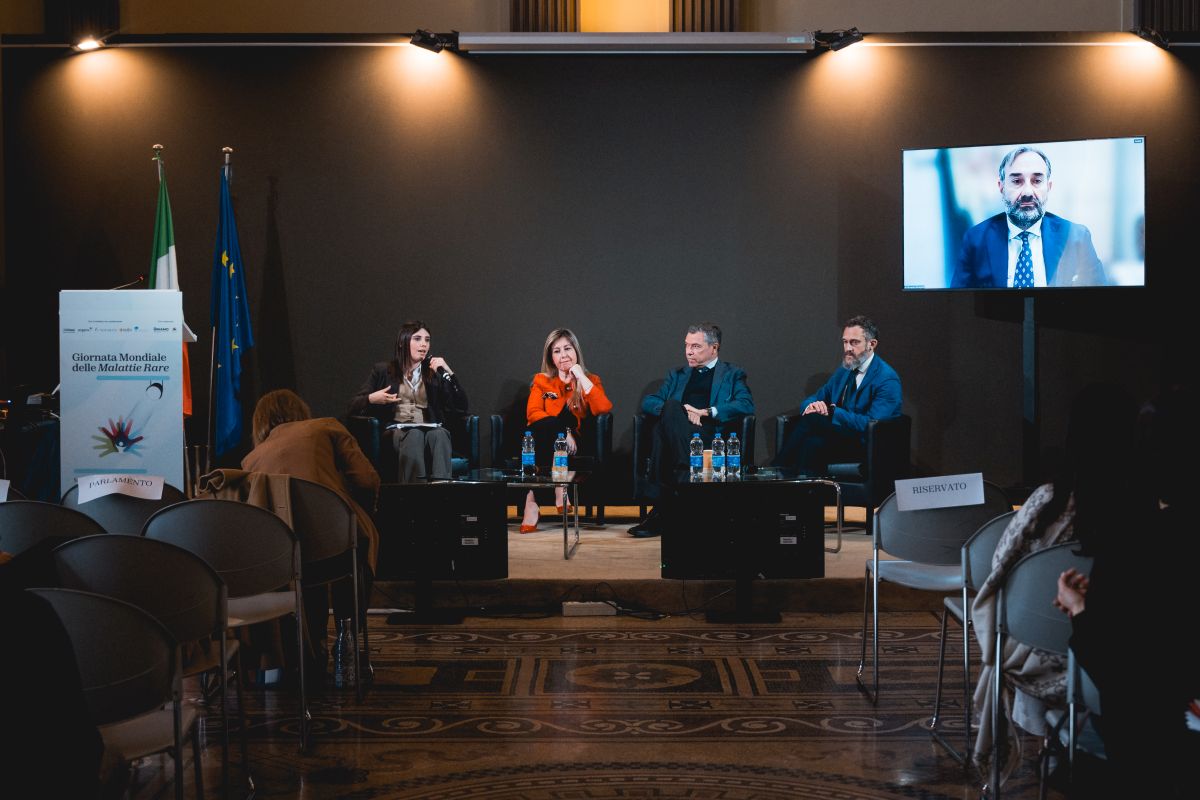
ROMA (ITALPRESS) – “To date, only for 5% of the approximately 8000 rare diseases there is a cure, and for most of them there is currently no treatment. For this reason it is necessary to invest in research and development of innovative therapies that can give hope to patients, always taking into account the economic sustainability of the National Health Service”. Annalisa Scopinaro, President of UNIAMO – Italian Federation of Rare Diseases, at the opening of the institutional event organized on the occasion of the World Day of Rare Diseases 2026, at the Salone Angiolillo of Palazzo Wedekind in Rome. The initiative, realized with the patronage of UNIAMO – Federazione Italiana delle Malattie Rare, and with the non-conditional contribution of Chiesi Global Rare Diseases, Argenx Italia, Novartis Italia, Sobi, Otsuka Pharmaceutical Italia, represented a moment of concrete confrontation on the state of the art of national policies and the main challenges related to rare diseases. The first topic addressed was the early diagnosis, a determining factor in changing the course of many rare diseases, especially in pediatric onset, such as SMA. “First we can identify the pathology and treat a child and more possibilities we have to improve the quality of life and the future of this child in terms of days. Therefore it is of fundamental importance to have an early diagnosis, through the Newborn Screening Esteso, because it means improving the quality of life of our patients” explained Maria Carmela Pera, Associate Professor of Neuropsychiatry of Infantile University of Parma. Diagnosis timeliness is closely linked to the subsequent effectiveness of treatments, as explained by Loreto Gesualdo, President of the Italian Federation of Medical and Scientific Societies, who argued “A correct diagnostic framework allows correct therapy for the patient at the appropriate time. This also applies to rare kidney diseases, which involve extremely impatient treatments for patients’ lives. In this context, diagnosis and early intervention means avoiding an advanced stage for these diseases.” In addition, the consolidation of the multidisciplinary takeover for these diseases requires special integration between hospitals, territory and social services. “Rare pathologies are not so unusual, that is why it is important to insist on the value of research, but even more on the guarantee of fair access to therapies, which passes above all through the territorial health and the network of Reference Centres” – said Giuseppe Limongelli, Director Center of Coordination Disease Rare Region Campania. In addition to the clinical dimension, the meeting also highlighted the fundamental aspect of promoting public-private collaboration, as an enabling factor for the study of innovative therapies: “The collaboration we have with private funding in research is a virtuous example – Luca Battistini, Director of Laboratory of Neuroimmunology, Fondazione Santa Lucia IRCCS – I think about research in neuro-immunology: thirty years ago for many of these diseases there were no authorized therapies and specific drugs, now instead, treatments exist and are effective.” Moreover, the need to strengthen national and regional registers has emerged strongly, enhancing epidemiological data and promoting awareness-raising and dissemination actions for pathologies that are still unrecognized as hereditary angioedema. “The hereditary angioedema, like so many other pathologies, is still underdiagnostic and underestimated – explained Francesco Arcoleo, National Secretary of Italian Network for Hereditary and Acquired Angioedema – This is why it is essential to promote attention to this disease managed by divesrse specialist figures, including allergologists, immunologists and interiorists.” The World Day of Rare Diseases confirms an appointment that recalls all the actors involved – institutions, health professionals, associations and companies – to the responsibility of translating commitments into measurable actions, to build a National Health System increasingly inclusive, fair and oriented to the quality of life of patients and their families. -photo press office Esperia Advocacy – (ITALPRESS).