
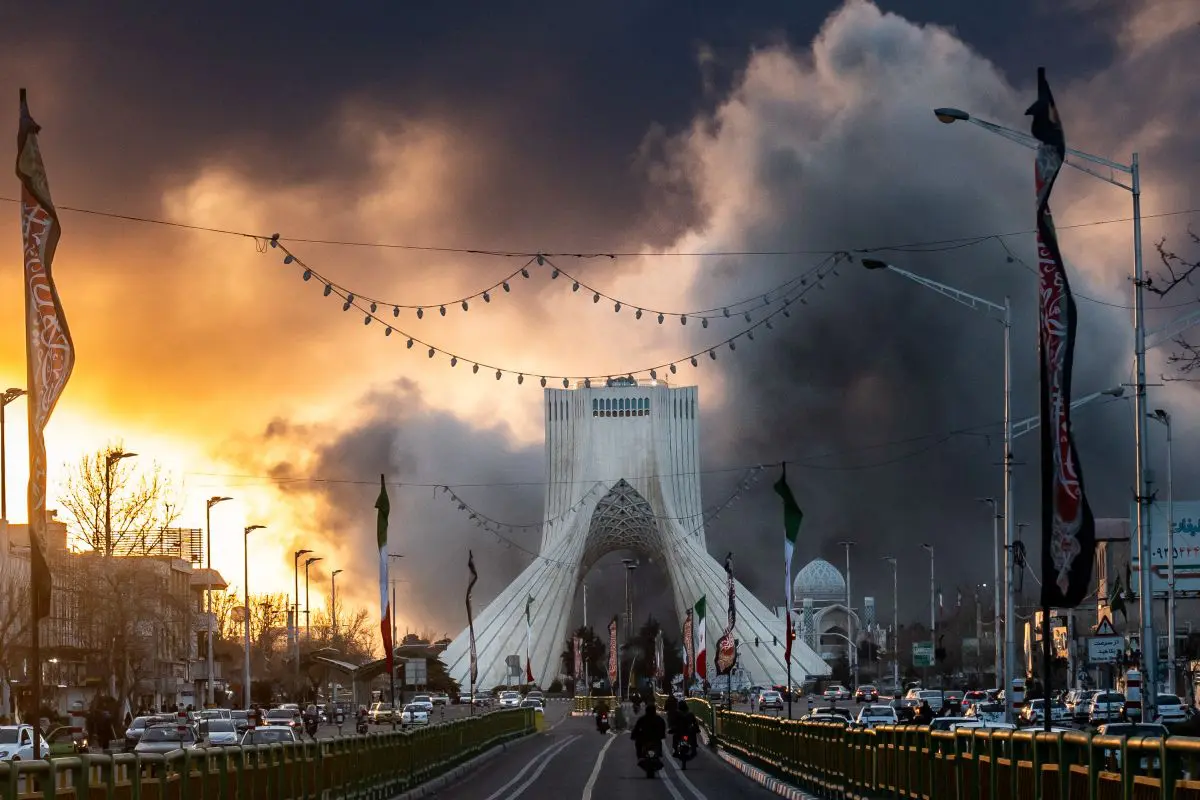
TEHERAN (IRAN) (ITALPRESS) – The scenario in the next few hours remains “very dynamic” and “depends both on how the military operation of the United States and Israel continues, and on their real ability to degrade the Iranian missile capacity and securitarian apparatus, exercised by the Guardians of the Islamic revolution and Basij. He stated this in an interview with the agency Italpress Nicola Pedde, director of the Institute for Global Studies (Igs) and expert of Iran. “To strike planes of the 70s on the slopes, obsolete ships at sea or in the ports, is not at this time the kind of advantage that allows the Americans and the Israelis to win this military challenge. The real force of Iran is the missile component and drone launch and the ability to exercise territorial control within the country, i.e. the internal securitary capacity,” said the expert.
For Pedde, “without the removal of these two elements the internal front remains open, and therefore the ability to control, both external and therefore the ability to raise the political and economic cost of the conflict.” Moreover, in order to reach the regime change hoped by Tel Aviv and Washington “the ability of the pasdarans and the basij to be able to exercise a new repressive phase, because if this does not happen it is difficult for the population to go down the street to provoke a rebellion, because in January it has hit them hard and made a massacre, and this time would do much more”. As for the Kurds, even in case of external support, it appears “excessive” think they can destabilize the entire country. More plausible an attempt to feed ethnic fractures, in line with an Israeli vision that considers “acceptable” also the collapse of the system, unlike the United States that see it as “a bad scenario”, explained the analyst.
Tehran considers the attack launched Saturday by Israel and the United States an “existential threat” and aims to “reach as much as possible, absorbing any damage”, with the aim of “ raising the political and economic cost” to force Washington to negotiate “on other assumptions”, Pedde explained, admitting that it is not certain that Tehran succeeds in this goal. To avoid collapse, Iran “is ready to overcome any red line, including allies, because in fact alternatives have few”, he added.
At this time, he continued Pedde, “the surrender then means being annihilated by a popular protest or an uprising”, and “the conflict is what, as it is residual, opens a sporadic margin of chance of survival”. Tehran’s strategy is not the total escalation, but a calibrated pressure: “do not empty the arsenals”, but maintain a “pression of constant fire and centellinata”. The temporal goal is “to resist between two and three weeks”, hoping for a strong rise in oil and gas and an increase in internal criticism in the United States. There is also to be taken into account how long Israel and the United States can support the conflict both in terms of ammunition and logistics, he said.
As for regional actors, Iran has put into practice what has been announced for years: “If there will be a conflict the price will pay the whole region”, explained the director of Igs. “The majority of these countries are wondering whether this conflict has hopes to end tomorrow or after tomorrow or if it lasts three weeks and Iran increases infrastructure attacks. When the conflict lasts a few days or more, and Iran should increase the attacks on energy infrastructure, I believe most of these countries would add to the coalition between the United States and Israel by attacking Iran,” he said.
The “advertents” of Tehran do not only concern the Gulf actors. In recent days, a missile was shot down in Turkey and a drone, perhaps launched by Lebanon by Hezbollah or a cell in Cyprus against the British base of Akrotiri. Pedde excluded that these are errors, but in the case of the drone that hit the British base in Cyprus represents “the will to send messages especially to Britain at this time, in the same logic as those that are sent to the Gulf actors”. “Your intervention also in support of only marginal, logistic, of this operation is considered a declaration of war and then prepare you eventually to suffer the blow,” according to the expert.
On the economic level, finally, “the energy crisis affects all and China significantly”, said Pedde. Beijing “will definitely start a very rapid diversification and replant policy that will take weeks, but I don’t think it poses the problem of an existential threat to the Chinese economic system”, explained the expert on the impacts of the closure of the Strait of Hormuz and the possible stop of Iranian oil exports to China and the Gulf countries. The conflict then offers “the possibility to increase the relationship with the Russians, who are the great beneficiaries of this phase, where they can finally repaint a little cash with crude supplies at prices no longer from balance, but market”, concluded Pedde, while Beijing announced that the envoy for the Middle East will go in the region in an attempt to find a way out to the conflict.
– Photo IPA Agency –
(ITALPRESS).
