
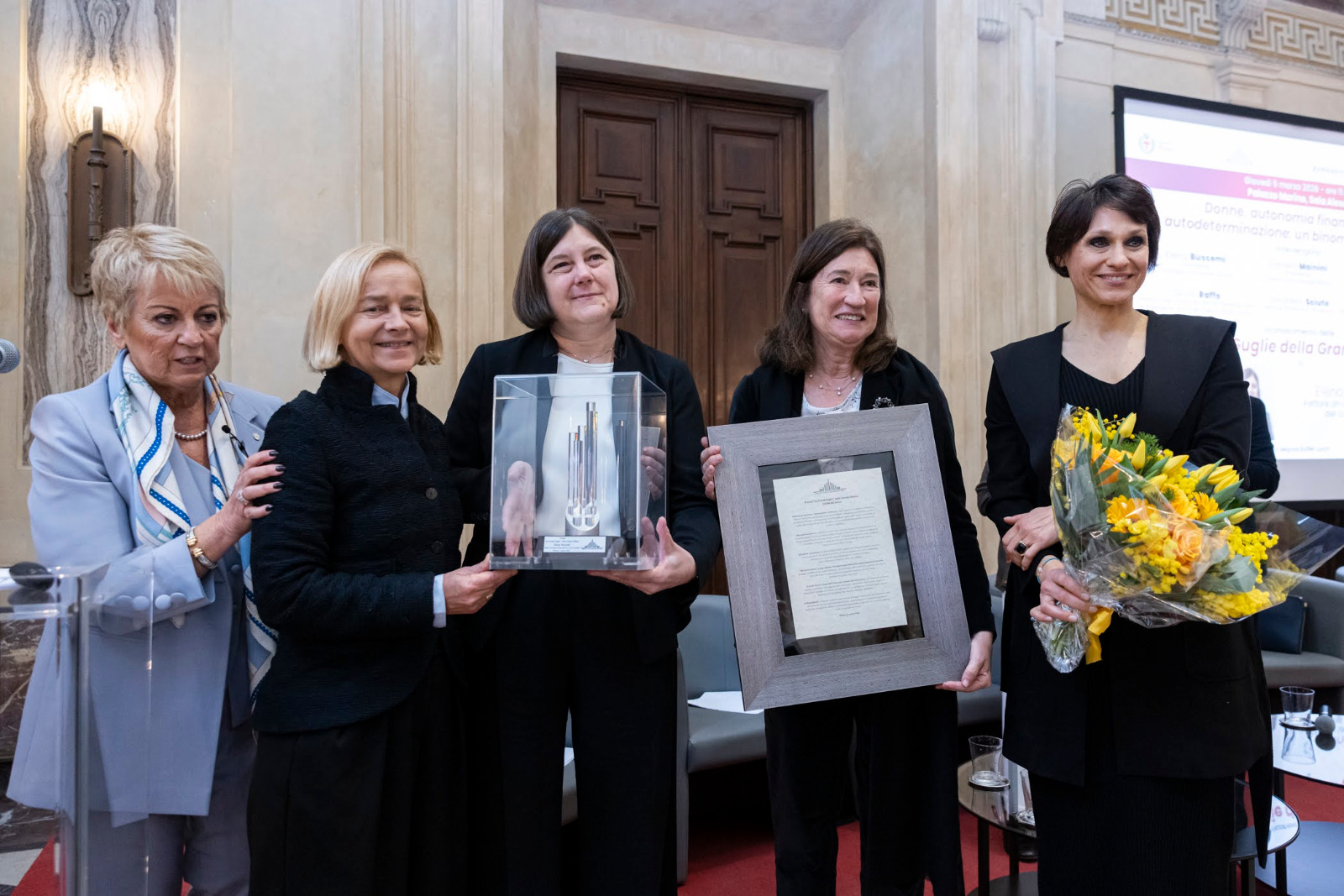
MILAN (ITALPRESS) – “Economist of great experience, first woman leading the Fuce and vice president of Fiuc, is also the first female director of the Catholic University of the Sacred Heart. His figure is an example of female leadership and a model for young generations.” It is one of the most significant steps of the motivations that led to the award of the “Grand Guglie della Grande Milano” Award to Elena Beccalli, director of the Catholic University of the Sacred Heart.
“I am grateful to receive a recognition that goes beyond the personal goal,” said Rector Beccalli, receiving the Award on Thursday 5 March in a Greek Hall Alessi of Palazzo Marino, also in the presence of some students from the Catholic University of the Sacred Heart. In fact, it is a “appreciation for our educational mission and our commitment to the new generations. This is why I would dedicate it to the entire university family: to teachers, staff and especially to students and students. Every day, together we work to activate that process of change that we need so much,” said Beccalli. “There is another reason that makes me particularly proud to receive the prize: I am a Milanese adoption and Milan is the city that welcomed me, a generous and inclusive city. This spirit of welcome should not be lost, indeed we must continue to cultivate it carefully”, said the director of the Catholic.
The Prize – whose aim is to enhance personality that with vision and commitment contribute to the cultural, economic and social development of the city – was delivered by Elena Buscemi, president of the City Council of Milan, Daniela Mainini, president of the Centro Studi Grande Milano and promoter of the initiative, and Manuela Soffientini, president Grandi Guglie della Grande Milano. The event also represented an important moment to reflect on a crucial theme: “Women, financial autonomy and self-determination: a necessary combination.”.
“This is one of the central challenges for the future of the country, making it necessary to invest in training, financial culture and equal opportunities,” said Daniela Mainini, who, moderated the debate greeted the artist Caterina Caselli, present in the hall and symbol of female emancipation already in the sixties thanks to his songs. On the same line also Elena Buscemi, who has remembered how much women, although extraordinary and with behind brilliant training paths, we still have a lighter wallet. “We talk a lot about violence, but without capital autonomy it is not possible to get away from risk situations. Economic independence is the first condition of freedom,” he added.
The meeting was enriched with the contributions of Barbara Alemanni, professor of Banking and Insurance at SDA Bocconi School of Management, Giulia Raffo, Country Chief Financial Officer of Generali Italia and president of Alfuturo Servizi Assicuravi, and Donatella Sciuto, director of Politecnico di Milano. The rapporteurs have addressed the theme from different perspectives – academic, economic and managerial – highlighting how financial education, access to credit and the female presence in decision-making roles are strategic levers to foster financial autonomy and self-determination of women.
Rector Beccalli also outlined some stereotypes that accentuate the gender gap. A phenomenon of social and cultural nature, as well as economic. According to estimates of Banca d’Italia, gender equality in employment would determine for our country a GDP increase of 7 percent. However, the data are not encouraging: a woman out of five has no current account, and among those who have it, often the account is shared. “The current account is an active citizenship tool. For this reason we must work with financial operators and accompany concrete actions that reduce distances,” said the director of the Catholic University of the Sacred Heart. In this direction, the “Women in Finance” program, conceived by banking, financial and insurance sciences over the years of Professor Beccalli was head of the Faculty.
A set of activities including scholarships, mentoring programmes, networks and alliances to overcome that shyness that often distinguishes young women in approaching economic and financial disciplines. “The initiative, which has been continuing for several years, is giving its fruits,” because, he said, “the first change to be pursued is primarily cultural”. Scientific literature confirms that. A study conducted by Rector Beccalli, with colleagues Francesca Arnaboldi and Francesca Gioia, shows how the composition of the portfolio changes at the birth of a child. The analysis of the financial portfolios of Italian families on data of the Bank of Italy has returned an amazing photograph: the only factor to affect the relocation of resources is the genus of the newborn. 2
At the birth of a child, families tend to move towards more risky tools; at the birth of a child, instead, they prefer safer tools, especially of a bond nature. “This is a very strong cultural signal. It means that, unconsciously, a child is attributed to a more solid and certain future, while for a child one imagines a more uncertain path, which would require more risky tools to generate performance.” In short, “a rooted stereotype that emerges independently from the level of education, wealth or household income,” concluded Rector Beccalli, recalling the role of universities in removing the structural barriers that still persist, ensuring “parity in opportunities to all, regardless of gender”.
– Catholic University photos –
(ITALPRESS).
