
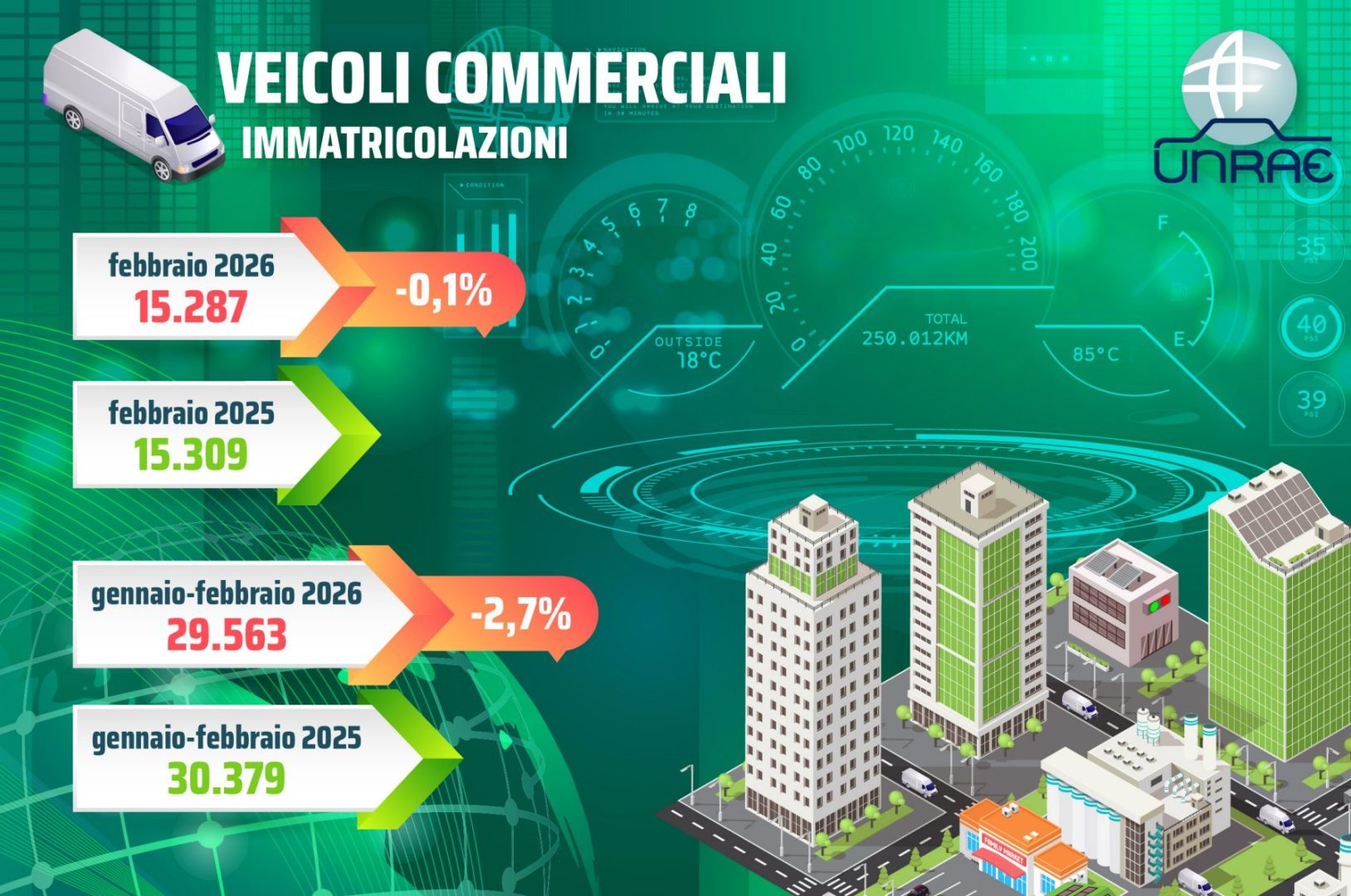
ROMA (ITALPRESS) – After three consecutive months of decline, in February 2026 the market of light commercial vehicles returns to a substantial stability, marking a -0.1% with 15.287 registrations in front of the 15.309 units of the same month of 2025, but in turn had a bending of 15.3%. Also in this sector, as in that car, a positive contribution of short-term rental emerges in the month under review: in its absence, the market would have evidenced a contraction of 3.5%. In the first two months of the year the decrease is reduced to 2.7%, with 29.563 units compared to 30.379 of January-February 2025.
In an economic scenario characterized by a persistent uncertainty, the commercial vehicle market in 2026 will be able to count on the incentives announced by MIMIT, of which however the scheme has not yet been officialized. Considering the technical times necessary to make the measure operational, the actual use of resources will not be immediate and it is estimated that the impact on registrations will be manifested from the last quadrimestre of the year. Therefore, the forecast for a moderate decline of the registrations is confirmed, expected to 187,000 units, with a decrease of 1.1% compared to 189,000 units in the entire 2025. In February the pure electric vehicles recorded a bending at 2.7% of the market, in slight recovery compared to 2.4% detected in January, but in decrease regarding 3.1% of February 2025. The application component supported by the incentives provided with the resources of the MASE is confirmed.
“As UNRAE has emphasized on several occasions – says Roberto Pietrantonio, President of UNRAE – there are other inseparable enabling factors for the development of the transition in the light commercial vehicle sector. Among these, the strengthening of charging infrastructures suitable for this type of vehicle, similar to what is already foreseen for heavy vehicles, the introduction of a 50% tax credit on private investments in fast columns (over 70 kW) for the three-year period 2026-2028, and above all a corrective intervention on the high costs of energy for charging, today under pressure more than ever for the geopolitical notes”.
On the European front, with reference to the revision of the CO2 emissions regulations, UNRAE considers that light commercial vehicles need ad hoc provisions, with specific objectives – in terms of targets and deadlines – differentiated compared to those provided for cars. On 4 March the European Commission presented the “Industrial Accelerator Act”, which – for light electric vehicles, plug-in hybrids and hydrogen – introduces a minimum share of European origin content as a requirement for access to public incentives and contracts in the field of electric vehicles. In detail, vehicles that benefit from state subsidies must be assembled within the European Union and incorporate – batteries excluded – at least 70% of continental components (including countries with which the EU has entered into partnership agreements), calculated on the value.
“On the theme of ‘Made in Europe’ – says Pietrantonio – the Association reiterates its concerns regarding the proposal, highlighting the concrete risk of customer penalties for both business and consumers. The competitiveness of the sector is built through targeted investments and innovation capacity, not through protectionist measures.”.
– photo office press Unrae –
(ITALPRESS).
