
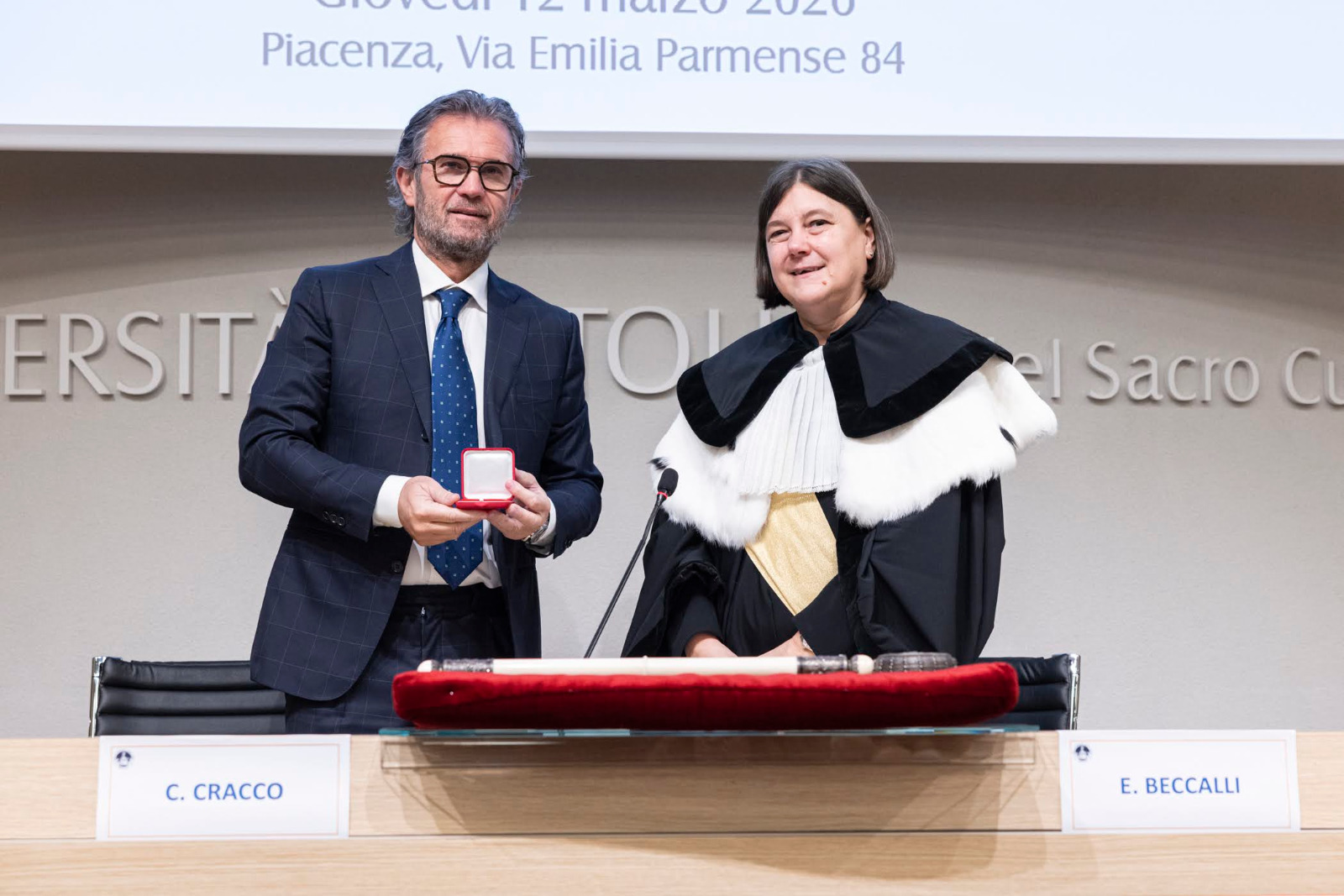
PIACENZA (ITALPRESS) – A dies academicus, that of the headquarters of Piacenza-Cremona, in the name of nutrition, sealed by the invitation to hold the prolusion to Carlo Cracco, who, said the rector of the Catholic University of the Sacred Heart Elena Beccalli, “with the creativity of his dishes has contributed to make Italian cuisine a global symbol”.
The opening speech of the rector started from two assumptions related to the alliance between generations: “In an era marked by an unprecedented demographic transition, the combination of nutrition and longevity represents a new frontier of human rights. Moreover, aging should not be understood as a process of subtraction, but an extension of human dignity also guaranteed by food choices. In these two assumptions is contemplated the interdisciplinary universe at the center of the activities of the campuses of Piacenza and Cremona”. On the first slope, “longevity means not only adding years to life, but life to years. This shows the link between nutrition, longevity and human rights.” But the problem of correct nutrition also concerns young generations. “In 2026, the global scenario describes a paradoxical reality: for the first time in history, the number of obese children and adolescents exceeded that of the underweight.” This is “a broad political theme, a social issue of the first level”.
Professor Beccalli called for action on a shared commitment between institutions, communities and the world of research. “To institutions, to fully recognize clinical nutrition as a primary component of essential levels of assistance. To communities, because they rediscover the value of the shared meal, powerful antidote to solitude, which in turn represents one of the most insidious causes of malnutrition. To science, finally, why continue to innovate in the field of food technologies without ever losing sight of the centrality of pleasure of taste and quality of food experience”. A concrete answer is the creation of a new research center of excellence on longevity on the Cremona campus, initiated with the Bocconi University, through the support of the Invernizzi Foundation. The rector also recalled that “if man is what he eats and if our humanity depends on responsibility towards others, then ensuring nutritional safety is an act of universal and intergenerational justice”. This is why “fighting food poverty and clinical malnutrition is not just a health goal, it is the only way to live in a society that can still be civilized.” It is necessary to assign relevance to social and environmental sustainability, as well as economic, implying a development in the present not achieved at the expense of the future. “This refers to an intergenerational justice profile, based on an alliance between generations.”.
Chef Carlo Cracco also spoke about this in his prolusion, where he expressed the very meaning of the kitchen, which “is not only a set of techniques or the expression of an individual creativity: it is above all a cultural heritage that develops and enriches itself thanks to the transmission of knowledge, experiences and values between teachers and students”. As a more significant figure for the alliance of generations, the chef recalled that of Gualtiero Marchesi, who “represents not only a great cook, but also a master capable of forming and inspiring entire generations of professionals”. In the evolutions that has suffered over time the kitchen Carlo Cracco has assigned great value “to the idea of a brigade that you operate as a team. Each person contributes with his own talent, sensitivity and energy. My task, as a chef, is to create the conditions for these qualities to express themselves in the best way.” According to the chef, the history of cooking is the result of an alliance between generations, based on a very clear principle: “Innovation never arises in isolation, but from the encounter between experience and the future. Each generation builds its own path from the bases left by those who preceded it. It is precisely in this continuous dialogue between teachers and students, between organization and creativity, between memory and change, that I recognize the true strength of gastronomic culture: an authentic alliance between generations”.
Rector Beccalli did not fail, in his intervention, to recall the news of the headquarters of Piacenza-Cremona. In Piacenza, “the innovations will affect the three-year term in “Economy and management for sustainability”, the three-year profile in “International business management” and the master’s profile in “Management”. In Cremona, instead, he will change his master’s degree in “Management and Digital Innovation”. Also in Cremona he started “the master in “Artificial Intelligence and data science for enterprises”, born from the collaboration with the Politecnico di Milano, according to an authentic logic of co-opetition”.
And in the city of Lombardy from next academic year thanks to the support of the Arvedi Bruschini Foundation will enter into operation a new residence that will host 70 students and visiting professor. On the research front 2025 represented an exceptional year, “the best ever in terms of ability to attract resources and design. A total of 177 new research projects, worth almost 11 million eur,” said the rector, without forgetting the continuous commitment of the headquarters in the Africa Plan with ten projects. At the dies academicus also attended the mayor of Piacenza Katia Tarasconi, the Unique Administrator of Epis Monica Patelli and the former student and PhD Rebecca Mariani.
The mayor reaffirmed that for a city like Piacenza to be able to count on a dynamic and qualified university reality is therefore a great opportunity. It means attracting young people from many parts of Italy and also from abroad. It means creating cultural exchanges, relationships and new ideas.” The representative of the Epis and president of the Province invited “to work together, putting in common the skills of each one, in particular of our young people who are together, present and future, to offer our communities and citizens who live in a starry menu in which the territory and its people are protagonists”. He closed the ceremony Rebecca Mariani who described the University as “place where generations can dialogue, meet and sometimes collide but always constructively”.
– Photo press office Catholic University –
(ITALPRESS).
