
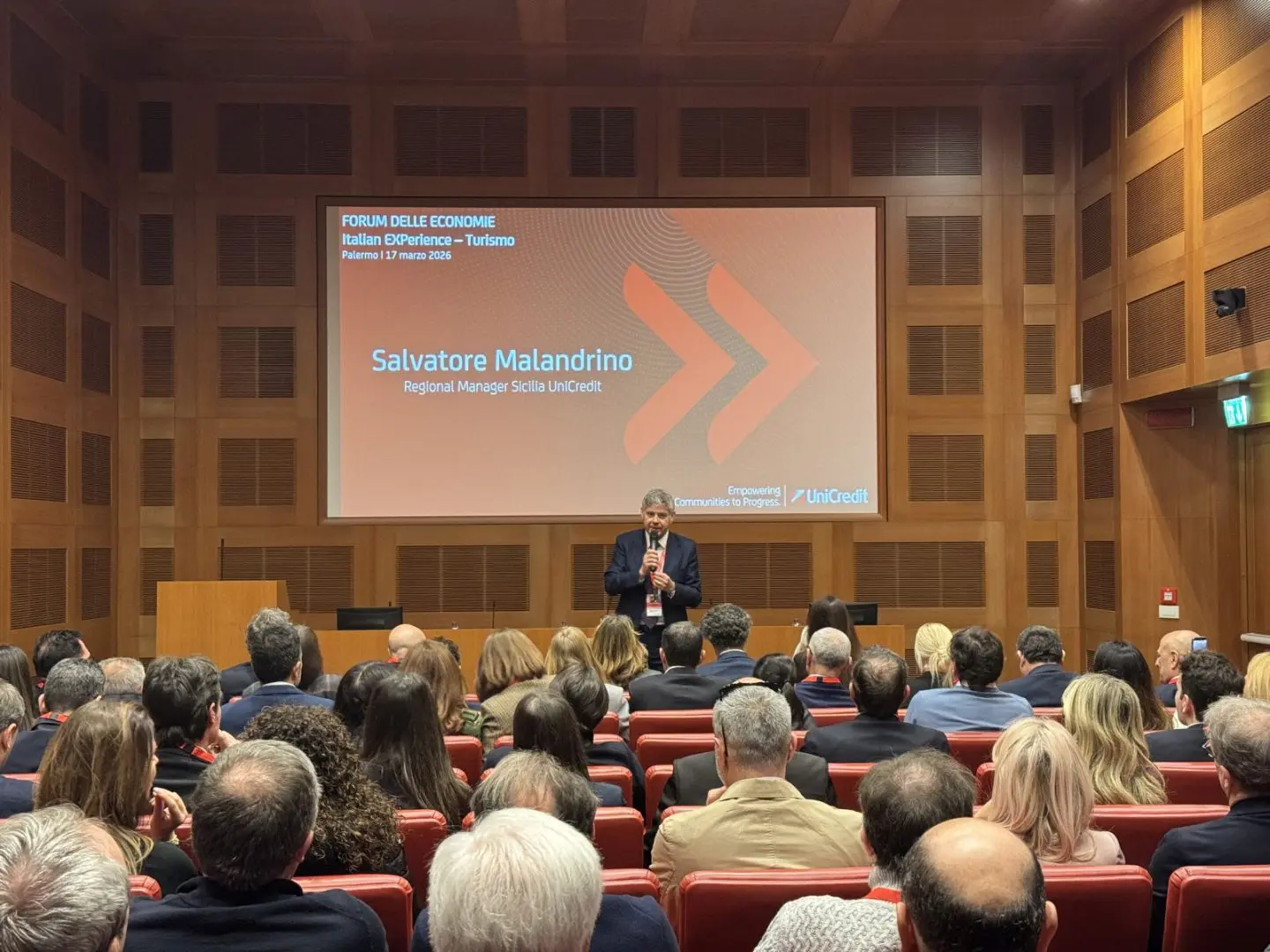
PALERMO (ITALPRESS) – A sector that represents 4.2% of the Sicilian economy and 4.8% of the tourist industry at national level, thanks to the involvement of many sectors: from transport to shopping, to the food industry and to the cultural, natural and recreational offer. These are some of the data contained in the study of Prometeia on tourism in Sicily, presented in Palermo during the Forum delle Economie, organized by UniCredit in collaboration with Federalberghi Sicilia.
The meeting was opened by the interventions of Salvatore Malandrino, Regional Manager Sicily of UniCredit, and Nico Torrisi, President Federalberghi Sicilia and Chairman Advisory Board UniCredit Sicilia. After the presentation of the study by Andrea Dossena, Associate Partner of Prometeia, a round table was held on the future of tourism in Sicily, among new trends and synergies with the sectors of excellence in which Rosa Di Stefano, President Federalberghi Palermo, Luciano Pennisi, Vice President La Sicilia di Ulisse, Marcello Mangia, President & Head of Hospitality Mangia’s, Francesca Planeta, President Planeta Estate, Giovanni Ruggieri.
“UniCredit confirms its commitment to support Sicilian tourism, the key sector for the economic development of the island. Through dedicated financial solutions, specialized advice and a capillary network on the territory, we accompany companies in a path of growth, innovation and quality of the offer. With more than 2.9 billion new loans granted in Sicily over the last two years, of which 1.5 to the companies, we continue to invest in order to value the local excellence and increase the attraction of Sicily on national and international markets”, underlined Salvatore Malandrino, Regional Manager Sicily of UniCredit.
Prometheia Studio. Photography (incomplete) on the trend of tourist flows during 2025 confirms the results already emerged in 2024 and reports, after the years of the race (not completed in all compartments) to the pre-pandemic values, important changes in the composition and type of tourists. Important changes to be interpreted in order to guarantee the Sicilian economy an important contribution to development, especially with the approach of the term of financing of the PNRR that have driven economic growth in recent years.
According to the preliminary figures of the Sicilian Region, in 2025 the presences on the island exceeded 22,5 million (established on 2024), but with antithetical trends among tourists: those of the Italians have descended under 10 million (-6.3% compared to the previous year), those of the foreigners have gone up to almost 13 million (+5.5%).
A lower result than the Italian average, where the domestic component confirmed the values of 2024 and the foreign one grew by 4.3%. A difficulty also witnessed by the arrivals at the airports of the island, in only moderate increment in 2025 to 23 million passengers, but with a decrease of 1.7% of the Italians (against a stability at national level and of a growth in Puglia and Sardinia) and an increase of the foreigners (+5.1% to 8.3 million), but lower both to the national figure (+7.6%) and to that of the other two regions (over +13% in both).
Also the variation of the average duration of stays, although with limited variations of year to year, has been slightly negative for Sicily, due to the effect of Italian tourists (below the threshold of 3 nights), and positive for the Italian average (in both components), where also the average duration is higher (3,4 nights against 3,1 of the island).
Results that, however, do not diminish the importance of the sector, which represents 4.2% of the Sicilian economy and 4.8% of the tourist industry at national level, thanks to the involvement of many sectors: from transport to shopping, to the food industry and to the cultural, naturalistic and recreational offer. Sectors that were able to experience a sustained growth of invoiced from 2019 to 2025, higher than the national one, despite the absence of large enterprises and the poor number of those of medium size.
The dimensional limits have however weighed on the profitability of the enterprises, in particular in the last two years and in the key sectors of the sector: welcome and catering. These limits also emerge in the degree of wealth of companies, in Sicily much lower than the national average and that of Puglia and Sardinia.
The fragmentation of the offer is widespread to all compartments, from that of sports and recreation to the management of cultural and naturalistic goods, to the structures for the nautical pleasure: Sicily is the Italian region with the greatest number of landings, but the third place in the number of boat places puts it in the penultimate place in the ranking of the average size of the landings, in particular in the marines.
An increasingly international tourism and, in the Italian component, aimed at a clientele with medium-high spending capacity (unfortunately Italy is, among the countries of the Mediterranean, that with the largest percentage of population that does not participate in the phenomenon of tourism), then requires to revitalize the segment of luxury welcome, whose size has instead decreased in Sicily in the last five years, in counter-tendenza regarding the national average and in Puglia and Sardinia.
Investments and attraction of capital seem obliged paths to resume the thread of the strong growth of the section of the two-year 2022-’23, expanding quality and type of tourist offer (non-hotel structures are often associated with longer stays) and allowing to value the many riches that, even in comparison with the other regions, make Sicily a natural tourist pole, which has not yet been able to fully exploit its wide cultural, artistic, naturalistic and cultural heritage. A heritage that is clear to many foreign tourists, who, thanks to important film productions, demonstrate through their online research a strong interest in the island.
-Photo xd6/Italpress-
(ITALPRESS).
