
ROMA (ITALPRESS) – The fundamental concerns for the ongoing conflict are likely to produce confused analysis. In order to avoid this, the description of the conjunctural framework that emerged at the end of February last is separated from the reflection on the prospects of GDP, from March to December 2026, in the case of short conflict and in the case of prolonged conflict. For the first part, therefore, beyond the many economic indicators in progressive improvement between October 2025 and February 2026, IC estimates explicitly clarify the strengthening of the Italian economy.
Overall, tendential variations range from +0.5% of December 2025 to +1.3% of February 2026. They are not just person care, leisure, tourism and technology to support spending. The supposed improvement of consumer propensity also appears to involve other sectors. Cars grow, clothing falls, consumer electronics are strengthened. This translates, with the support of employment in slowing down but on the maximum and inflation under control, in a tendential variation of the monthly GDP that passes from +0.5% of January to +1.4% of February.
Then, a new war, with immediate impacts also on energy prices that reverberate on consumer prices. In March we estimate inflation at 1.8%, a value still very manageable and within the targets of monetary authorities. The worrying aspect is that it cannot be liquidated as an isolated case, of course. This, however, would have a negative impact on the activity of the month of March that would flet a tenth point from February. The March GDP trend would still be over 1%: what would lead to a first quarter of growth at 1% compared to a year earlier, a value which was not recorded since the last quarter of 2023. The shocks will have, however, impacts in the coming months, of intensity correlated to the duration of the crisis and, passing the shock from the channel alone ‘more prices of raw materials, greater inflation, reduction of real disposable income, reduction of consumption, reduction of GDP’, we made two hypotheses: increase of 40% of the prices of energy (with TTF perfectly related to Brent) for a period of two months after March and return, therefore, to June (that is from.
A temporary shock would have very limited impacts: by recalculating inflation on an annual basis and comparing it with the baseline (without war) the average price growth would be four tenths higher, with a GDP under one tenth compared to the reference. The prolonged conflict scenario, however, would significantly reduce GDP: from the baseline to +1% growth would be limited to 0.5%/0.6%, especially for lower consumption dynamics via lower real income caused by inflation to 2.6% compared to a 1.7% base. In short, the recovery of the Italian economy would disappear. In the worst scenario we also considered a negative impact on the level of economic activity deriving from lower investments and from lower world demand, with negative reflections on exports of goods and services (tourism). Finally, always in the worst scenario in December 2026 inflation would rise around 4% tendential: there could be no exclusion of significant prejudices even on the performance of the Italian economy in 2027.
In February 2026 the Confcommercian Consumption Indicator (ICC) is estimated to grow 1.3% compared to the same month of 2025. The figure is a synthesis of an increase in both expenditure for goods (1.4%) and for services. The dynamics of the last month represent a consolidation of the recovery signals that emerged in the previous bimester. To confirm a more favorable evolution of demand, it is found that the trend is spreading to the different segments of consumption. Compared to the recent past, in fact, the number of sectors with negative variations is reduced. In this context of recovery of consumer propensity, fears of a possible return to more restrictive shopping behaviour are inserted. The beginning of the conflict in Iran, with the return of uncertainty and fears of a recrudescence of inflation, could block the possibility of moving from a recovery phase to a real growth.
Analyzing what was found in February 2026 for the different functions of consumption, it is observed that, after a long period in the negative territory, the most dynamic component was that relating to goods and services for mobility (+6,0). The growth for goods and services for communication (+5.8%), a segment for years among the most dynamic, has been slightly lower. In positive territory, even with more modest variations, there are also goods and services for the care of the person (+1.8%), goods and services for the house (0.8%), hotels and meals and consumptions outside the house (+0.4%), food, drinks and tobacco (0.3%) and clothing and footwear (0.1%). Among the macro-functions only the segment of recreational goods and services (- 2.1%) showed a negative trend, synthesis, however, of dynamics articulated within it. At the level of individual consumer voices, in February, as in contrast to the recent past almost all aggregates show, even with different intensity, favourable trends. In particular the recovery of the automotive that, after 13 months of reductions, records an increase of the purchases from the private (+9.5%).
In line with what has been observed for a long time the families continue to pay much attention to those goods and services whose demand is related to leisure as recreational services in the strict sense (+6.9%, thanks to the permanence of positive performances for the cinema shows), household appliances (6.2%), air transport (+3.9%) and fuel (+3.4%). Positive also the trends for electricity spending (1.7%), hotels (+1.5%), pharmaceutical and therapeutic products (+1.1%) and, to a lesser extent, domestic food (+0.3%) and meals and meals outside the house (+0.1%). Also for furniture and furniture the decrease in demand, after a few months of recovery appears quite contained (-0.1%).
The recoveries go, however, carefully evaluated and for many functions of consumption limit only the fall compared to the volumes purchased at the end of last decade. On the basis of the trends recorded by the different variables that contribute to the formation of consumer prices, an increase of 0.6% of the index in terms of economic activity is estimated for March 2026, with an annual change of 1.8%. The expected rise for the current month reflects the first effects on prices resulting from the beginning of the conflict in Iran. At the moment tensions seem to have been discharged on those products, such as fuels, for which the time of transfer from raw materials to the final stage, that is to consumption, is faster.
These impulses would be partially mitigated by recent government measures to reduce excise duties. If, at the moment, the recovery of inflation is within the limits established by the ECB, many unknowns remain on its possible future evolution. As illustrated in Table 1bis with the prolongation of the conflict, tensions, which at the moment are concentrated on a few segments, are likely to move along the different chains, triggering a new inflationary flame that, although of a size less than that of 2022-2023, could compromise the possibility of recovery of consumption and growth.
SANGALLI “SEGNALI INCORAGGIANTI, PETROLIO CHE SALE DIMEZZA CRESCITA”
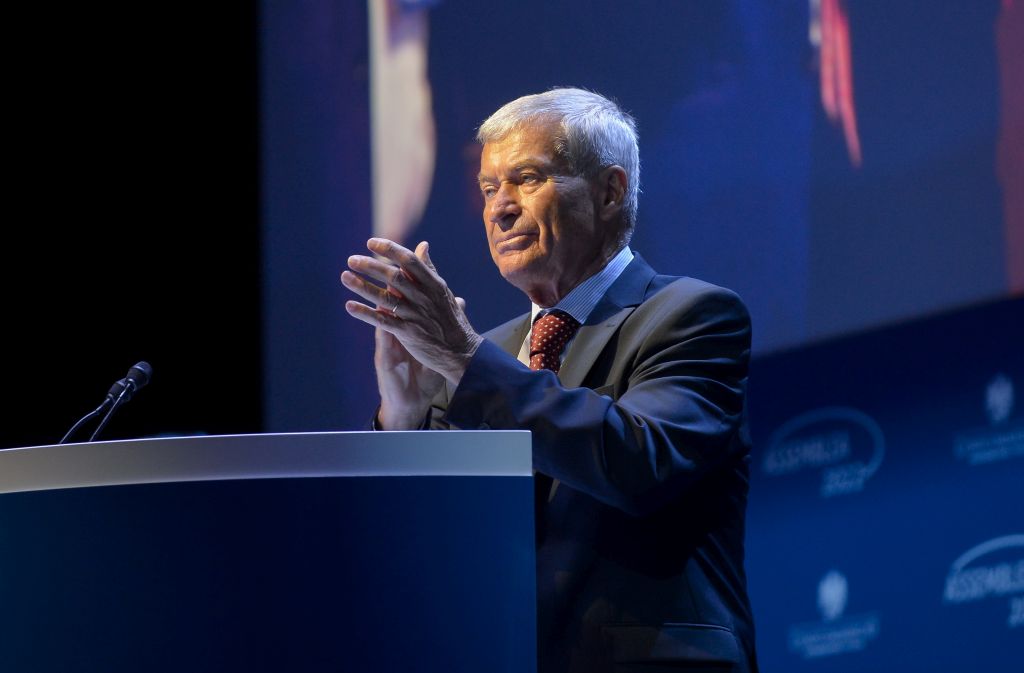
“2026 began with very encouraging signs for the economy: consumption up to 1.3% in February, inflation under control, employment at the highest levels. But the scenario of war is likely to distort the recovery. We hope that the price of oil will return by May around 70 dollars, because this would have an impact on GDP and very modest consumption. Conversely, if quotations remained over $100 until the end of the year, growth would be halved“. Thus the president of Confcommercio, Carlo Sangalli, commented on the conjunction of the Study Office of the Confederation today.
– Photo IPA Agency –
(ITALPRESS).
