
ROMA (ITALPRESS) – Although the Earth has extensive fresh water resources, their distribution is dramatically unequal: about half of the world population lives a condition of severe scarcity for at least one month a year. A phenomenon that, fueled by the climate crisis, is no longer limited to arid areas but is becoming a systemic reality that affects more than 4 billion people, making natural cycles less and less predictable. This is the scenario outlined by the United Nations World Report on the development of water resources 2026 entitled “Water for each person: equal rights and opportunities”.
The document highlights a complex framework in which water management is not only an engineering or environmental challenge, but a profound question of social justice and gender equality. In rural areas and developing countries, the burden of supply falls almost entirely on women’s shoulders. This daily commitment, estimated at 250 million hours globally, subtracts valuable time from education, rest and income-generating activities, trapping entire generations into a cycle of poverty. The cost is not only temporal, but also physical and psychological, exposing women and girls to health and safety risks during long routes to reach sources. The lack of sanitation and clean water for menstrual hygiene leads to shame and absenteism: it is estimated that 10 million teenage girls (between 15 and 19 years), in 41 countries of the world, have lost school, work or social activities between 2016 and 2022.
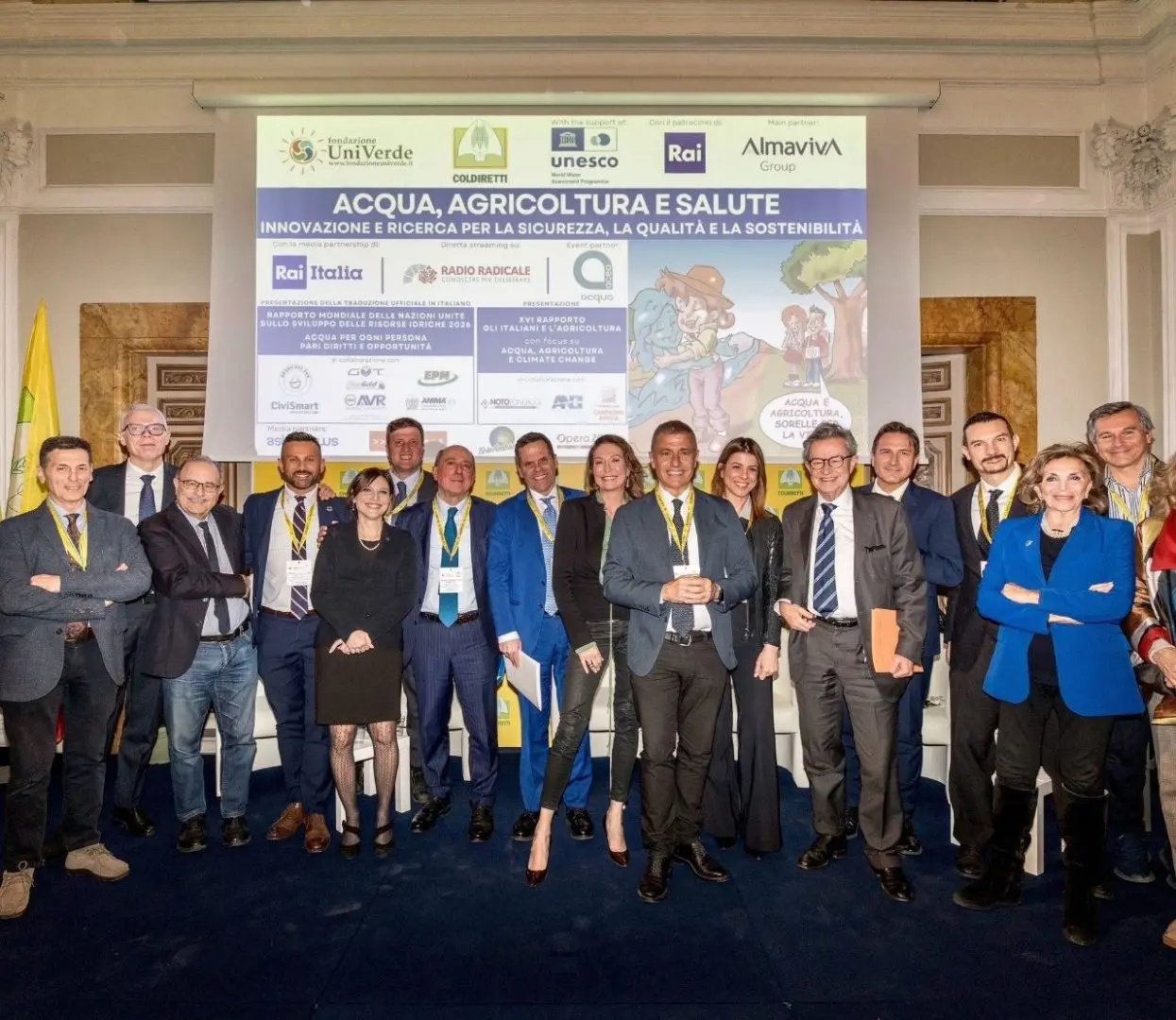
The official Italian translation of the United Nations World Report on the Development of Water Resources (UN-WDR 2026) curated by the UniVerde Foundation with the supervision of the UNESCO World Water Assessment Programme (UNESCO WWAP) was presented yesterday afternoon at Palazzo Rospigliosi at the conference “Water, Agriculture and Health: innovation and research for safety, quality and sustainability”, sponsored by the UniVerde and Coldiretti Foundation, with the support The editorial project that has translated into Italian and presented the UN-WDR 2026 simultaneously with the UN in New York and UNESCO in Paris – where the English and French versions were presented respectively – was made possible thanks to the support of Acque del Sud, G.M.T., CiviSmart, E.P.M. and the support of AVR Italian Association producers Valvole e Rubinetti federata ANIMA Confindustria.
The Report identifies the agricultural sector as the main custodian of global water resources, reflecting the vital role of agriculture in food safety and maintenance of the territories. In this perspective, agricultural activity is recognized as an engine of innovation and resilience: the strengthening of enterprises in the first sector, with a focus on enhancing the female role, is indicated as the key to efficient water management. A message that acquires an even stronger value in 2026, proclaimed by the UN “International Year of Agricultural Women”. As is now tradition, the data of the “Italians and Agriculture” Report was illustrated at the 16th edition, focusing on Water, Agriculture and Climate Change, realized by the UniVerde Foundation and Noto Sondaggi with the supervision of Coldiretti and in collaboration with ANBI and Fondazione Campagna Amica.
From the analysis it emerges that the Italians now live with a “new normality”, in which the climate today represents an unpredictable and dangerous element but recognize (58%) the important work of maintenance of the territory by farmers. The most acute concern is for the risk of flooding, with 58% expressing a maximum alert level (vote 8-10); followed shortly by the risk of drought, with 54%. If you look at averages, the level of apprehension remains crystallized at a very high value: 7,4 out of 10 for both disasters. In order to protect food security and land, 83% of respondents consider it urgent to address climate change by supporting farmers. To protect the Italian agricultural and agri-food heritage from extreme phenomena remain priority, for 71% of respondents, interventions against drought as water saving and efficiency. The perception of the need to develop specific adaptation plans for the agricultural sector (54%, well +8% compared to the previous report).
The conference was opened by the greeting addresses of Vincenzo Gesmundo (General Secretary of Coldiretti): “The availability of water is central to the lives of people and for our agri-food excellence and cannot continue to be handled in an emergency manner: we cannot imagine that Italian citizens should go up on a truck to go get water with tanks or that farmers see their crops deleted or their animals die of thirst because of drought. Providing the country with an infrastructure that guarantees the availability of water resources has become a strategic factor that cannot be further postponed. This is why we return to re-launch our proposal for an invasive plan with pumping systems to produce electricity and collect rainwater, so as to make it available when needed.”.
They brought institutional greetings: Francesco Lollobrigida (Minister of Agriculture, Food and Forest Sovereignty): “Italian agriculture is now one of the most resilient in Europe, placing Italy as the first value-added agricultural economy in front of countries like Spain, France and Germany. This primacy is supported by the extraordinary numbers of agri-food exports that, in 2025, reached 72,4 billion euros, guaranteeing the country a very rich agricultural economy. To defend this heritage, we fought in Europe to ensure the right remuneration to those who guard and protect the territory; a result obtained through the recovery of all the funds of the Common Agricultural Policy and the addition of new resources. In the field of clean energy production, we have already funded 24 thousand companies, to which will be added another 6 thousand through a new call for solar that respects the agricultural vocation of the territories, with the aim to guarantee to the agricultural realities 30% of its electricity needs from renewable sources. We are then investing on research in Assisted Evolution Technologies, focusing on hybridization systems capable of generating plants resistant to phytopathies, less hydro-eigenti and with a reduced need for agropharmaceuticals. A way that excludes every openness to GMOs. Finally, we have established a directing cabin dedicated to water resources to return to having a national water strategy.”.
Gilberto Pichetto Fratin (Ministro dell’Ambiente e della sicurezza Energetica): “Water means future: for the environment, energy, community development. It serves a global and national approach, with a strong focus on current climate change and international scenarios, with conflicts across the Mediterranean. We must explore every technology, focusing on best practices such as waste reuse, invaders, desalination, efficient and circular water management that avoids intolerable waste. There are strong investments in the PNRR, including the new MASE Integrated Monitoring System (SIM) with innovative technologies to detect and prevent hydraulic risks, but also for precision agriculture and the fight against marine pollution. Decisive is the effective governance of the sector, with strong managers able to make investments. 2026 is full of international commitments, Italy can be the focus of water negotiation. At the UN Conference of 2023 the country took 18 voluntary commitments, of which half directly attributable to the MASE. We are very active, with the Mattei Plan and with the many actions of international cooperation, for access to water and resilience of water systems, especially in Africa. Italy is aware of an ethical responsibility that must unite us all in safeguarding our most precious source of life”.
Introductory interventions were curated by: Alfonso Pecoraro Scanio (President of the UniVerde Foundation): “Preventing the criticalities that lead to an emergency management is not only a duty, but a possible goal: the answer lies in an eco-digital revolution that focuses on the resilience of the territories and co-ordinates the ecological and digital transitions between them. As UN-WWDR 2026 points out, the challenge is to support safety and production quality, ensuring sustainability and competitiveness both in the agricultural and water sectors. In this scenario, technological innovation, infrastructure digitization and artificial intelligence are not simple technical tools, but strategic allies to enhance the efficiency and circularity of our subsidiaries. The awareness of citizens towards this path of growth is clear, as confirmed by the Report ‘Italians and agriculture’: 72% strongly supports the introduction of blue certificates. This tool, in the example of the white certificates for energy saving, intends to enhance and reward those enterprises that, with far-sightedness, invest in water saving technologies, in the wake of the path already undertaken by the agricultural sector, as a model of modernization and good practices. The strong consensus recorded, with peaks of 78% in the South and significant growth in the Islands (+11%, at 72%), shows that Italy is ready to support advanced solutions, including the structural integration of safe and certified waste water for irrigation purposes. The conference, bringing together institutions, stakeholders and research institutes of excellence, marks a decisive step: transforming water resource management into a great sustainable development opportunity for the entire country system”.
Ettore Prandini (President of Coldiretti): “The guarantee of water is central to the Italian agri-food sector with about 41% of the added value produced by the sector that derives precisely from irrigation productions. Faced with the challenge of climate change, it is therefore necessary to rationalize the use of an increasingly valuable resource and Italian agriculture is now in the forefront of the implementation of solutions for Agriculture 4.0 and 5.0 for water saving. According to the Census on the digital maturity of farms carried out by the Polo Innovation Digital Agriculture of Coldiretti Next, a ten-year farm has invested in the digitization of irrigation systems, with the aim of combining sustainability, cost reduction and increased productivity of crops.”.
Fulvio Conti (Head of Water, Agriculture, Environment and Space Business Unit, Almaviva Group): “The water is the invisible thread that links three fundamental elements to our future: agriculture, health and sustainability. Managing it well means ensuring food security, climate resilience and quality of the life of the territories. Yet, today we underestimate this potential: in Italy we only use 3% of waste water. Integrating environmental data, digital agriculture and water monitoring allows not only to improve the use of water resource, but also to strengthen health prevention tools. It is on this integration between water, food, health and technology that Almaviva is building digital solutions to accompany territories and institutions towards a truly sustainable development model.”.
The panel “Towards the United Nations World Water Conference”, announced the ministerial-level side-event that should be maintained, the conditional is obligatory in view of the tensions in the Middle East, in the United Arab Emirates in December of this year.
Miguel De França Doria (Director of UNESCO WWAP – World Water Assessment Programme) presented in video message the synthesis of the United Nations World Report on the Development of Water Resources 2026 ‘Water for each person: equal rights and opportunities’ and said: “We are very grateful to the Univerde Foundation for the continuous collaboration, since 2018, for the Italian version of the report and for the support of its dissemination and visibility. I take the opportunity to announce also our intention to co-organise, at the next United Nations Water Conference, which will be held by the end of the year, a ministerial event with the Univerde Foundation and the Mame Mor Anta Saly for Development Foundation. This event is an opportunity to discuss with ministers and policy makers on how to accelerate progress towards the Sustainable Development Goal n. 6 on clean water and sanitation services, just as the world enters the last five years of Agenda 2030. It will also be an excellent opportunity to deepen the data of the UN-WWDR which, this year, focuses on an urgent reality: gender equality in the water sector, the removal of social, legal and financial barriers that limit the right of women to water and, at the same time, investments in funding that take into account gender issues and that are sensitive to gender issues.”.
Approximately 2.1 billion people do not yet have access to safe drinking water, 3.4 billion people do not have access to safely managed sanitation and 1.7 billion people still live without basic toilets in their homes. For Fodé Seck (Ambassador to the Ministry of Foreign Affairs of Senegal and General Manager of the Mame Mor Anta Saly pour le développement Foundation): “Today’s meeting at Coldiretti headquarters offers the ideal platform to announce to the international community the side event at ministerial level that the two foundations, UniVerde and Mame Mor Anta Saly, have decided to organize together and under the supervision of UNESCO WWAP, within the UN Water Conference next December. Water resources are seriously threatened by both anthropic and natural factors: overfishing, production models and unsustainable consumption, pollution from liquid and solid waste, including plastic, worsening the adverse effects of climate change and much more.”.
At the panel “Water as a strategic infrastructure for the future. The key role of enterprises”, with the moderation of Tessa Gelisio (Giornalista and television host), were illustrated best practices of virtuous Italian realities that can accelerate the ecological and digital transition, in the direction outlined by the United Nations with the Agenda 2030 and reach the Sustainable Development Goals.
Enrico Pezzoli (Delegant of Acea Acqua): “In the face of climate change, the water transition has become a priority, now inseparable from the energy one, to guarantee security and growth in the country. In Italy, the modernization of the networks is urgent, especially for the agricultural sector, where water availability is the basis of food safety. Operators like Acea play a central role in transforming sustainability into operational capacity, optimizing transportation and enhancing plants. Technological innovation and digitalisation are essential tools, but require a solid governance capable of attracting investments. Finally, it is necessary to promote a new culture of water, passing from the perception of good granted to that of precious resource for national well-being”.
Luigi Giuseppe Decollanz (President of the South Water Board): “The water development engine not only economic but above all cultural and democratic. There is no civilization that has not been founded on water and there is no democracy that has not benefited from it. Ensuring good water is the primary goal of the South Water project whose motto, not by chance, is “More Water, more Development, more Democracy”. Annamaria Barrile (General Manager of Utilitalia): “The water resilience has become a central theme in the operational strategies of utilities: it goes from maintenance and realization of new invaders to interconnections between the aqueduct patterns, to complementary water resources such as desalation, reuse and recharge of the bonfires. At the national level the value of the investments incurred by the tariff has increased up to about 4 billion a year, but the sector demand is estimated by Utilitalia at least 6 billion a year. The PNRR has certainly given a significant boost, with more than 5 billion allocated in 5 years up to 2026, but in the near future we will have to cover the delta between the 4 billion deriving from the tariff and the 6 billion requirements”.
Andrea Villa (Vice President of AVR – ANIMA Confindustria): “Sustainable water resource management is a concrete challenge and a systemic priority that concerns industry, agriculture and public health. The participation of Avr, association of valve builders and faucets federated Anima Confindustria, at this moment of comparison promoted by Univerde Foundation, is the occasion to bring a responsible and collaborative contribution on a topic that requires shared solutions and long-term vision. We believe that only through a real partnership between institutions, managers and industry it is possible to make infrastructure more efficient; in this context, the Italian valve and tap sector sector is ready to contribute.”.
Emanuele Giglio (Responsible R&D by G.M.T.): “Water is no longer just a natural resource, but a real strategic infrastructure — for agriculture, industry and cities — which requires a systemic and not only environmental approach. The real challenge is not only about availability, but performance: efficiency means getting the same results with less resources, reducing waste, losses and energy used in management. To transform water into a smart infrastructure, sustainable data, technologies and economic models are needed, with tools such as blue certificates that act as investment accelerators. GMT, as ESCO, has developed strategies to apply to the water sector the same approach already consolidated in the energy sector, focusing on the integration between water and energy efficiency and the intelligent use of data. Treating water as a strategic infrastructure is the necessary condition for ensuring safety, sustainability and competitiveness over the long term.”.
Riccardo Amoroso (Delegant of CiviSmart): “CiviSmart promotes projects, even in public-private partnerships, to develop innovative solutions in smart metering, communication networks and remote control, integrating photovoltaic systems to reduce water consumption. Through data-driven models, it helps reduce losses, optimize resource management and develop waste water recovery solutions. In this context, it supports local public administration in the energy transition, from public lighting to the adoption of sustainable technologies in the adjacent sectors, positioning itself as a strategic partner for intelligent water systems.”.
Carmine Esposito (Council of E.P.M. and President of FNIP-Confcommercio): ‘As EPM we have chosen to support the translation of the UN Report 2026, because we believe that water efficiency is the pillar of the eco-digital transition and that therefore it is essential to disclose its content. The strong consensus of citizens towards blue certificates and waste water reuse confirms that the country system is ready for integrated and circular management models. Technological innovation and advanced services are strategic tools to ensure sustainability and quality, transforming resource management into a real development opportunity for businesses and territories.”.
To follow, Antonio Noto (Director of Noto Sondaggi) presented the data of the XVI Report “Italians and Agriculture”, according to which the path of modernization of Italian agriculture finds one of its most vivid and loved expressions in the concept of multifunctionality, which has transformed the farms – already appreciated by 72% of the respondents in how they keep the agricultural traditions alive – in real hub of diversified entrepreneurship that enjoy a very wide appreciation. The direct sale of products is the emblem, with 90%, followed by the farm, appreciated by 82% of the Italians ( aggregated). They follow agro-asili and pet therapy (74%), educational farms (71%) and agro-sporting activities (69%, +3%).
On the front of innovations, the report signals a strong push towards the use of clean waste water for irrigation purposes, with 77% (aggregated data). Priority is confirmed (61%) irrigation monitoring and management systems but 54% of the sample (+8% compared to the previous two surveys) focuses on low consumption irrigation equipment. In order to facilitate this transition, citizens ask the central and local administrations, as well as equip themselves with enabling technology infrastructure (40%), to provide incentives based on rewarding factors (28%) and to simplify access to aid (21%, +3% on 2025).
At the panel “Innovation and research for safety, quality and sustainability” apical figures from the main National Research Institutes dealing with water, agriculture and health in a “One Health” approach:
Andrea Lenzi (CNR President): “Today it becomes essential to develop integrated strategies that combine environmental sustainability, productive efficiency and climate resilience. Research and innovation, technological transfer, state-of-the-art infrastructure are the key words that guide the action of the National Research Council in the agricultural sector, where we also experience innovative solutions directly in the field with industry operators. Relevant PNRR projects such as Agritech or the National Biodiversity Centre and projects born within the Mattei Plan are concrete answers to the complex challenge of water resource management. The Cnr will intensify its commitment, also participating in the Euro-Mediterranean Water Forum in Rome in autumn, in the awareness that the protection of this resource is crucial to human health, animal and the environment.”.
Maria Alessandra Gallone (President ISPRA and SNPA): “Water, Agriculture and Health, three central themes for the future of our country. Sustainable management of water resources, food safety and health protection are closely interconnected challenges that require an integrated approach based on knowledge, innovation and collaboration and in line with the One Health principle, which recognizes the indissoluble link between human health, animal and ecosystems. It is precisely through this systemic vision that we can deal more effectively with environmental and health issues, promoting solutions capable of generating widespread and lasting benefits. ISPRA, through the BIGBANG model, provides estimates of the national hydrological budget; the last findings tell us that in 2025, total rainfall in Italy is down by about 9% compared to 2024, therefore also the renewable water resource is down compared to historical averages. The Institute renews its commitment to promoting advanced tools for monitoring and environmental evaluation, because investing in innovation means strengthening the ability to prevent risks, improving the quality of agricultural production and ensuring the protection of ecosystems and health of citizens.”.
Maria Chiara Zaganelli (Director General CREA): “Water is a strategic resource for agriculture and CREA is committed to making its use increasingly efficient in all crop systems. Through advanced research, genetic improvement and technological innovations we develop solutions that allow sustainable management of water resources, supporting businesses and territories in transferring effective practices. We also provide analysis and studies in support of public policies, contributing to the transition to increasingly resilient agricultural systems, capable of continuing to guarantee quality and food safety.”.
Fabio Vitale (Director AGEA): “Agea governs the technical and technological balance of land management through innovation. The goal is to protect the environment, economy and collective health together. Through advanced satellite technologies studied in the Agency it is possible to observe in real time the entire Italian territory and, on a high definition map base in addition to the multilevel classification of land use, it is possible to read integrated crops, ecological elements, non-productive areas and water infrastructure. From this comes a more effective planning of the use of the water resource, also in terms of water reuse and, consequently, improvement of the infrastructure. We talk about Water Credit, strategic leverage to generate virtuous economic flows without creating new debt. This is how a public administration capable of using data, advanced technologies and predictive tools can already be implemented today.”.
Claudia Brunori (Director of the Department of Sustainability, Circularity and Adaptation to Climate Change of Production and Territorial Systems, ENEA), intervened in connection, said: “ENEA proposes a systemic and integrated approach to the efficient management of the water resource in order to ensure the competitiveness and resilience of the productive systems but also health and well-being of the population. The water stress caused by climate change makes the link between water, agriculture and health increasingly tight. This requires a paradigm shift: wastewater treatment plants must become high-performance bioreactors that are able to eliminate pollutants and recover water, nutrients and other resources, such as phosphorus, non-renewable critical raw material that is imported 100% from outside Europe. This requires significant investments, but with poor benefits in the medium-long term.”.
Luca Lucentini (Director of the National Water Safety Centre): “The UN‐WDR 2026 report sets us face to a complex challenge, which Europe has approached through the new water resilience strategy, passing from a retrospective approach to compliance with points of use to preventive and integrated risk management – from the natural course of water to the entire integrated water cycle – for the safety and sustainability of use and reuse of the resource. The convergence of institutional strategies and competences of excellence in the management towards the paradigm “One Water, One Health”, with the commitment of the National Centre for Water Safety (CeNSiA) of the Higher Institute of Health, today Italy is an advanced laboratory of water culture and governance as a human right, a strategic productive factor and a presidium of public health for agricultural sectors and communities”.
Massimo Gargano (General Manager of ANBI): “Innovation and research are one of the assets of the adaptation strategy, supported by ANBI; others are maintenance of the territory, realization and efficiency of hydraulic infrastructure, promotion of water culture. The reclamation and irrigation consortia are open-air laboratories and have in the experimental area Acqua Campus, in Budrio in Bolognese, a reference centre for irrigation efficiency, internationally recognized. An important game is linked to the agricultural use of waste water: a resource as useful in times of climate uncertainty, but for whose use we have asked for the prior certification of health, issued by a third body; in play there are public health and credibility of agribusiness made in Italy. In this context, a decisive role is played by the Multifunctional Invasive Plan, proposed by ANBI with Coldiretti: not only would water reserves be created, useful for agriculture and for the production of renewable energy photovoltaic and hydroelectric, but these tanks would contribute to repainting the falde, whose suffering has significant consequences not only on quantity, but also on the quality of water resources”.
Integrated management models and multisectoral and multifunctional synergies can respond to the need for coordinated action on the UN Sustainable Development Goals (SDGs), in particular the objectives n. 2 “Ear end to hunger, achieve food security, improve nutrition and promote sustainable agriculture” and n. 6 “Enhancing to all sustainable water and sanitation initiatives”.
The link between water, land and health is indissoluble: supporting agricultural and industrial sectors in the path of adaptation and mitigation of climate effects, facilitating them with regulatory tools, incentives and innovative technologies, is the only guarantee for safety and food quality in a changing world.
Citizens, according to the data of the Report “Italians and agriculture”, are increasingly aware consumers (77%) that climate change is also fought through the food choices of individuals and if, in the intentions detected by the demographic survey, they are available to adapt to the principles of the Mediterranean diet (74%) and to prefer foods Km0 (78%), they are partly doing it if you look at the data, +26% compared to 2023, relating to fruit and vegetable consumption.
Solid remains the contradiction to the consumption of synthetic products (63%) and to the consumption of foods containing insects (63%), preferring Italian agricultural products considered more genuine (70%), tasty (68%) and controlled (66%).
– Univerde press office photos –
(ITALPRESS).
