
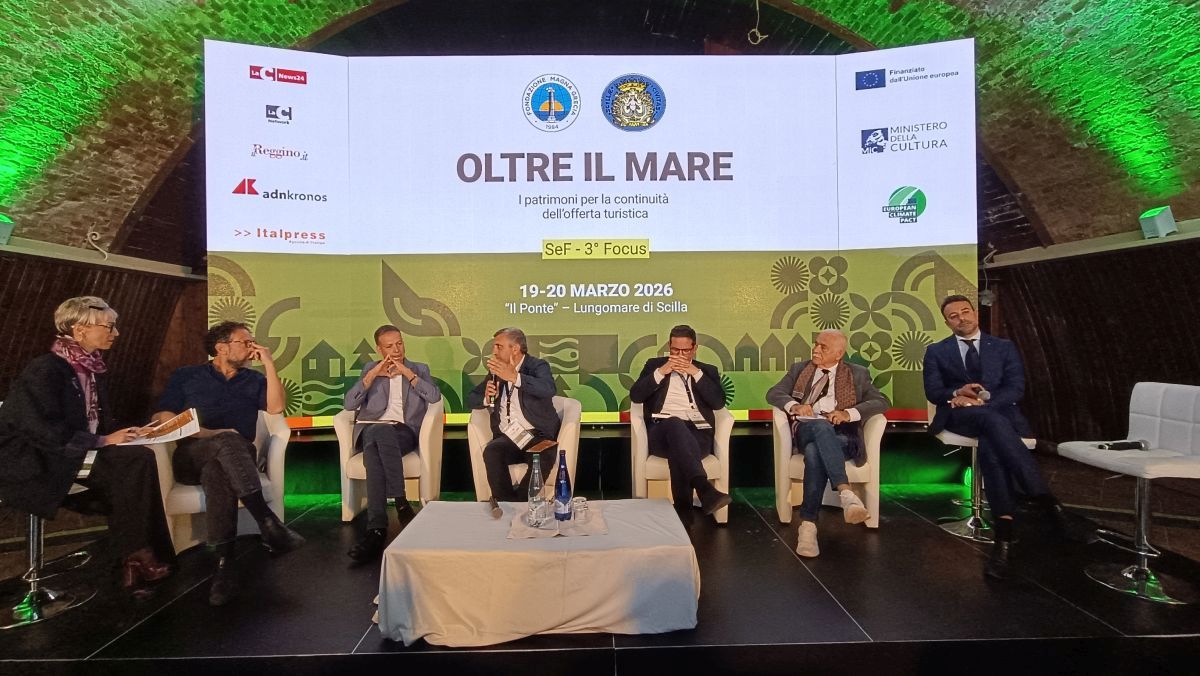
SCILLA (ITALPRESS) – “To stimulate a debate on sustainable tourism that attracts visitors twelve months a year and to open strategic scenarios on the future of the territory”. This is the goal of the third “Focus Sud e Futuri – Beyond the sea: the patricians for the continuity of the tourist offer”, promoted by the Magna Grecia Foundation, chaired by Nino Foti, who brought together institutional representatives, academics, economic operators and representatives of the world of culture and information.
The initiative has concluded a three-year cycle of meetings related to the PNRR projects dedicated to historical villages, outlining a broad and articulated vision of the prospects for development of the Mezzogiorno. At the heart of the first day, the question of the seasonalization of the tourist offer, considered as an indispensable condition to ensure economic continuity and systemic valorization of cultural and environmental heritage. The debate was enriched by the interventions of Regional Councillor Eulalia Micheli, actor Alessandro Preziosi and director Mimmo Calopresti. The second day, moderated by journalist Federico Quaranta, has deepened the link between cultural roots and valorization of the internal areas. To open the framework of the interventions was the same president of the Foundation, Nino Foti, who offered a wide-ranging reflection on the meaning and perspectives of the path undertaken: “Today we come to the completion of a three-year journey that, far from exhausting, finds its authentic starting point right now. From an original intuition, from a project conceived with farsightedness in 2023, an initiative has been developed that has gradually been structured as a permanent laboratory of ideas, visions and operational practices. What we celebrate today is not a conclusion, but the inauguration of a trajectory destined to affect in depth the economic, social and cultural development of this territory. Our ambition is to valorise in a systemic and concrete way everything that positively continues from this land: from the extraordinary landscape beauty, which has consecrated Scilla among the most fascinating villages of Italy, to the cultural heritage layered in its roots, in archaeology, history and myth that for millennia nourish its identity”.
However, Foti continues, “the enhancement cannot stop to an evocative or contemplative dimension; it must be translated into action, in tangible design, capable of making citizens active and aware. Only through widespread participation will it be possible to strengthen the reactive capacity of the territory and build a truly inclusive and lasting development model.”
In this perspective, “the theme of seasonalization of the tourist offer imposes itself as a crucial hub.
The goal of making the territory attractive throughout the year is persecutable, but it requires a strategic vision articulated and, above all, structural interventions no longer procrastinable.” Foti focused on the importance of mobility and the problems that still exist on the infrastructure system. For this reason, he adds, “I felt it necessary to urge a concrete synergy between productive categories, institutions and representative bodies, so that a shared vision and coordinated action may be perceived. Only through a choral commitment will it be possible to fill the gaps existing and return to this territory the infrastructure conditions adapted to its ambitions. Ultimately, the path undertaken by the Magna Graecia Foundation is an invitation to collective responsibility: transforming Calabria’s extraordinary potential into real opportunities, making its heritage not only an object of admiration, but a live engine of development and future”.
At the event the publisher Florindo Rubettino presented the project Sud Heritage proposing an innovative reading of industrial tourism as an identity development lever.
Rubbettino highlighted how “the places of production can turn into narrative spaces, able to tell the Italian knowledge and to combine tradition and innovation.
Businesses, in this vision, are configured as authentic cultural practices, custodians of memory and, at the same time, laboratories of the future.” Federico Quaranta’s reflection on this project was echoed by Federico Quaranta, who recalled his speech on the narrative level, stressing the need to return authenticity and depth to the story of Calabria, a land of extraordinary symbolic and cultural density. From the convergence between the strategic vision of Rubettino and the narrative approach of Forranta emerges a unitary perspective, in which economic development and construction of the imagination proceed in hand. Culture, tourism and sustainability are configured as well as interdependent elements of a strategy capable of generating lasting and conscious growth.
– photo xs9/Italpress –
(ITALPRESS).
