
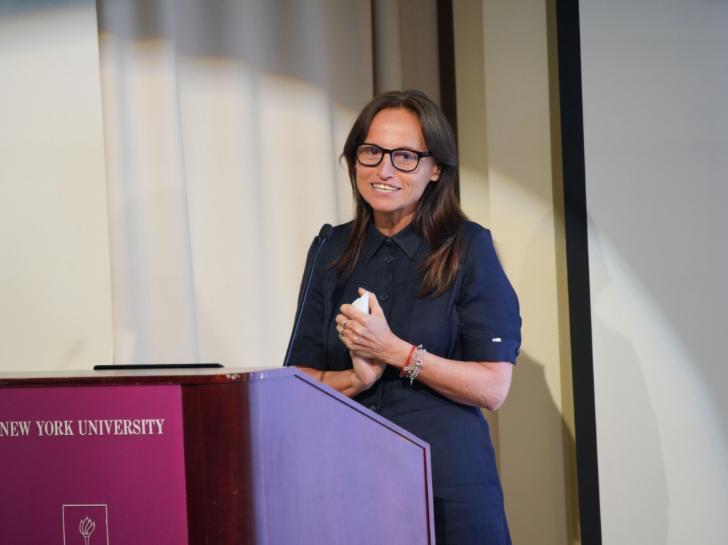
Barbara Pelachin Marciandi is the new Comites guide in New York. It was unanimously elected during the 29th assembly, which also participated in the Consul General of Italy in New York, Giuseppe Pastorelli. When I call her, her emotion is still very strong and she transmits all the energy with which, together with her team, she has already worked.
From the vision to the priorities of his mandate, in this interview the new president of the Comites in New York tells, also through his own personal story, the centrality of networking, the importance of dialogue with the new generations and with the different waves of migration, up to the actions to enhance the Italian identity in a global context.
The goal, as Marciandi says, “is to strengthen, with a pragmatic and inclusive approach, a broad and articulated community, transforming personal experiences into useful tools for those who today build their future in the United States”.
Let’s start from the beginning: what emotion was the election and to whom was the first thought?
It was a great satisfaction, that I do not live only as a personal result: it is a team goal. I didn’t start this path alone, but along with Ornella Fado and Leide Porcu, with which we built the list “Italy in the Heart”, led by the Cavaliera Giuliana Ridolfi Cardillo. We started together, and together we got here. The first thought, then, went to my family: to my husband and to my four children. They are my strength. Without their support it would not be possible to face such a commitment, which is not only work but also responsibility for a broad and complex community.
So the teamwork seems central: is it a prerogative of the Comites?
Absolutely. I do not look at political colors: Comites is not and must not be a political arena. It must be a group of people who work together for the community. You’re not going anywhere on your own. In these early hours we have already begun to structure internal working groups, but with a clear opening: each member will have to collaborate with external people. The Italian community is made of different skills, characters and backgrounds, and this is our strength.
What will be the first concrete actions of your mandate?
We already have a very dense calendar. We will continue the projects launched in the previous years, such as the Columbus Day parade, the Mentorship program, the project against domestic violence, Pride and the one dedicated to comics. The Comites meetings will be hilarious: after that at the Consulate, the next will be in New Jersey, then in Queens and Brooklyn. We want to be present on the territory, in associations, within the community. There will also be new projects, already emerging in the last meetings, but I prefer to talk about it when they are defined. We will then have to get in touch with the honorary consulates and associations that will want to cooperate.
How does Comites look at the new generations?
Young people are fundamental: they are the future. We can’t ignore them. The Mentorship project was born precisely from this need: to create an exchange between generations, from 18 years on. I am a teacher and a mother: I know that the relationship is mutual. They are not only adults to teach young people, but also the opposite. It’s a continuous exchange. This attention is also born of a personal experience. When we arrived in New York, ten and a half years ago, with four little children, we found ourselves completely alone. Understanding how school, health, insurance and rent work was complicated. From there the idea of building something that can help those who arrive today was born.
What role can Comites play with these practical difficulties?
We cannot and must not replace the Consulate, but we can make ourselves available. Our role is different: we can guide, inform, create network. For example, address people to services such as Fast IT or Prenot@Mi and explain how to move. But above all networking: contact people. We are not a job center, but we can facilitate opportunities. And today the network is everything.
And the relationship with associations and other Italian realities in New York?
It is fundamental. We are open to collaborations: anyone with a project can contact us. The idea is to work together, creating mixed working groups. Comites may have a coordinating role, but projects must be shared. That’s how you build something solid.
For the first time the Comites saw two women at the top, with her President and Ornella Fado Vice-President. What value does this leadership have?
I don’t see it as such a matter. I am not a feminist in that sense: for me they count skills, seriousness and loyalty. If today there are two women at the top is because we worked well together. Ornella and I are different, but precisely for this complementary. That’s what made the difference. Sure, it’s a signal of change. And maybe it’s no coincidence that it happened in New York, a city that often anticipates certain dynamics.
What are the main requirements for the Italian community in the United States today?
It depends on generations. For the historical Italian-American community, the central theme is citizenship, in particular repurchase. It’s a very sensitive matter. For newcomers, however, the main problem is to remain: visas, work permits, cost of life and health. We often talk about very well-prepared guys who come to study, master, PhD, medicine, MBA, and want to build their future here. Our task is to help them orient themselves, even through networking.
It can happen, sometimes, that those who built their own path with fatigue are more reluctant to share. It is a resistance that I understand, but I think it is essential to make an extra effort and help us more. The Italian community is strong, prepared, capable. We just have to become more cooperative.
What is the difficulty of sharing for some?
He’s human. Those who have done so much work, those who have arrived without support, sometimes tend to close. I understand. But we can’t stay there. I lived that phase myself. When we got here, we didn’t know anyone. It was difficult. Then, in 2017, I felt the need to put myself into play: I started teaching Italian at Collina Italiana and, thanks to a colleague, I came into contact with a group of Italian women in New York, NYIW. From there I started building a network. Then came the Covid, who interrupted everything. And only in 2021 I was involved in the Comites project by Fucsia Nissoli. At that time I realized that I could turn that personal difficulty into something useful to others.
So the entry into the Comites was born from a direct experience?
Yes, completely. He was born of a concrete need. And in fact, when I was elected the first time, I realized that the community was looking for something new. My message was clear: to be a bridge between Italy and the United States. A bridge, as they say here. And I think this idea is still current.
How does the migration experience change between those who come as an expat and who come alone?
It changes so much. Those arriving as expat already have a structure: home, school, insurance, all organized by the company or university. Whoever comes alone, students and young professionals, has to build everything. And that’s where the community becomes fundamental. Having someone to ask saves time and energy and helps avoid mistakes.
At the same time, is the community also a way to maintain its roots?
Yes, absolutely. Having to share traditions and continue to speak your language is very important. It is the first thing to preserve, because it is the bridge with the family and with the origins. This is how one can fully experience the opportunity of biculturalism: being Italian and American together, which not only means speaking two languages, but living two cultures. This gives you a huge mental elasticity.
New York is probably the symbol of this plurality. How does Italian identity fit in such a complex context?
New York is all multi-cultural, multi-ethnic, multi-religious. That’s exactly what enriches you.
The point is to value the Italian heritage without turning it into something nostalgic or, worse, artificial. Traditions must remain authentic, but adapt to times. You can modernize the form, communication, languages, but you cannot change the substance. If you twist, lose authenticity and become something fake.
So innovation yes, but without losing identity?
That’s right. It’s a balance. The great Italian organizations are also doing this: they open up to young people, they update, but they keep their identity. The substance does not change. Change the way you tell her.
How much does your profession as a teacher of Italian and history affect your institutional approach?
So much. From history you learn that you have to know the past to understand the present and build the future. From Italian and literature you learn the depth. I love Dante: it’s incredibly current. It tells experiences that we all go through, even today. These two dimensions, memory and awareness, drive a lot of my way of working.
Volunteering is another central element of its path. What role does it play today, especially for young people?
It is fundamental. Volunteering forms you as a person. He teaches you to put yourself in the shoes of others. I’ve always done it, as a girl, and my children do it. It must not be something done to appear: it must be authentic. Volunteering learns a lot more than it gives. It is an experience that changes you.
Is there room for volunteering within the Comites?
Actually, the Comites is already volunteering. We are at the service of the community. Projects such as Mentorship or people support projects are voluntary forms. And many members of the Comites are already engaged in various associations.
Looking at the future, what is the concrete sign you would like to leave with your mandate?
I would like to complete all the projects effectively and leave a good memory. Not me, but Comites. In recent months there have been divisions and abandonment. Our goal is to close this path with a job that is really teamwork. Because, as I said from the beginning, you don’t go anywhere alone.
L’articolo Barbara Pelachin Marciandi: “Comites is a live bridge between Italy and the Italian and Italian community of New York” comes from IlNewyorkese.
