
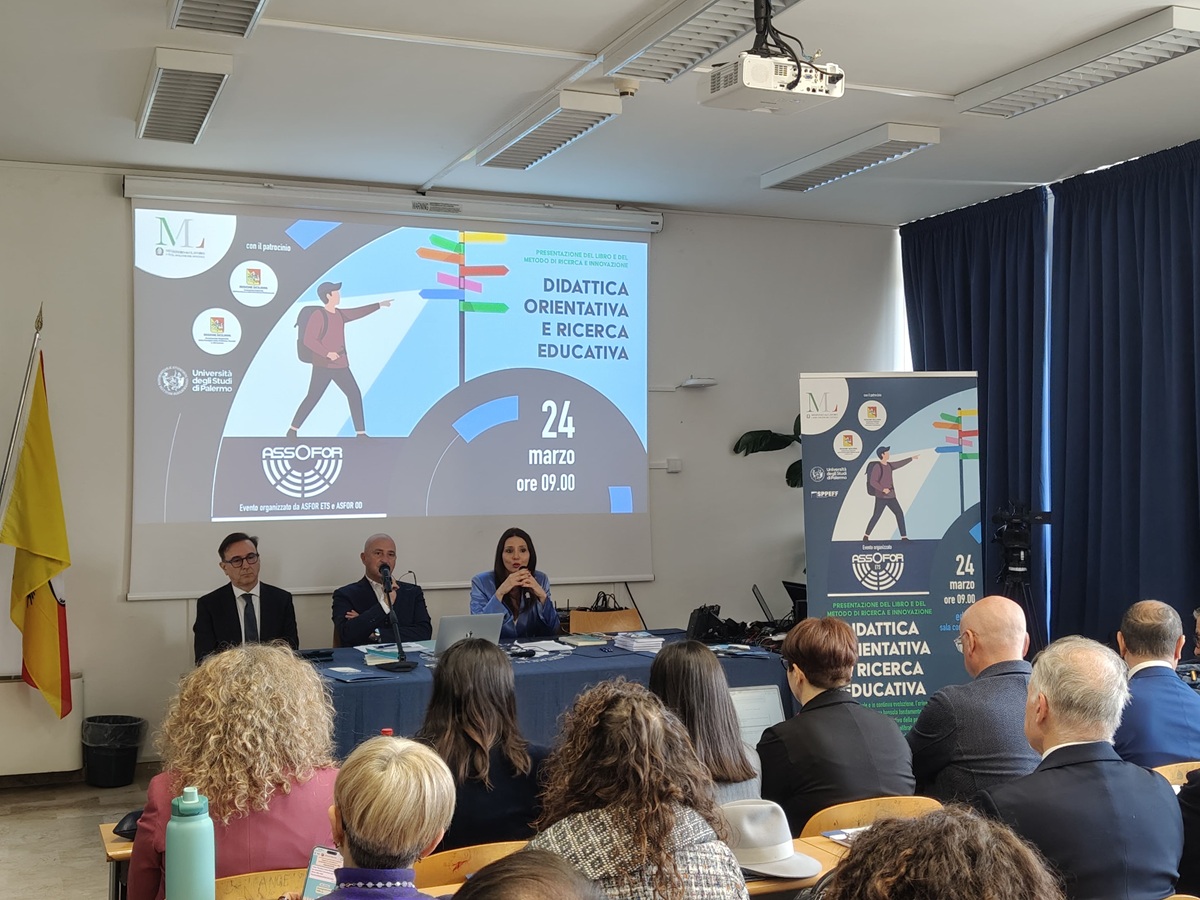
PALERMO (ITALPRESS) – To strengthen the connections between the world of education and the world of work and to insist on the contrast to school dispersion: these are the central themes of the conference Education and Educational Research, organized by Assofor in the Department of Educational and Psychological Sciences of the University of Palermo (building 15) and sponsored by three regional councillors (Education, Labour and Social Policies).
The event was an opportunity to trace on the one hand the perspectives of vocational training in Sicily, on the other a clear picture on the aspects to be solved in the school and on the possible tools to put in place. Among others, the Vice-President of the Luca Sammartino Region, the Regional Councillor for Education Mimmo Turano and the President of Assofor Antonio Oliveri.
According to the data, Sicily finds itself dealing with an important imbalance between demand and supply of skills: in the face of approximately 79 thousand young people formed each year the potential demand exceeds 117 thousand units, with a cover of 67.6%. This misalignment results in overbooking phenomena in some low-demand sectors (personal services, hairstyle and aesthetics, administration and secretariat, generic catering) and in significant deficiencies in technical-industrial and productive sectors (mechanical, electrical, industrial), where enterprises struggle to find qualified profiles.
As regards school dispersion, Sicily is confirmed among the Italian regions with the highest levels: the early abandonment rate reaches 19.4%, the highest national value, compared to 11% in the north and 16.3% in the other regions of the Mezzogiorno.
Among the strategies adopted by the Region to address the employment problem, explains Sammartino, “the European Social Fund today gives us the great opportunity to bring within the classrooms the evolution of the labour market: vocational training is oriented towards inclusion in this market, especially in the new figures that are now required. We are at the door of artificial intelligence: the labour market changes daily life habits in our production sector and it is important to invest not only in new technologies, but in the recovery of human resources that are indispensable for our societies to grow with the values and perspective of a land that continues to produce. We have put on a protocol of understanding with the department of prevention of Sicilian juvenile prisons to give a perspective to children, who today see in professional training a factor of insertion in the labor market: the dialogue between institutions wins when from both sides there is a desire to build a different Sicily”.
To dwell on the forms of contrast to school dispersion is Turano, which shows how it “is in continuous decline: the data of the ministry of Education say that Sicily has severely crushed the dispersion index, but the most important aspect is that on 705 schools only in 57 have a higher index than the Sicilian average. With these 57 schools I am making a personal plan: I will hold a provincial meeting, with their respective directors and individual directors, just to fight this phenomenon. The data on the dispersion concern all the children who leave the school, both Sicilian and foreign: the percentage of foreigners is much higher, because they often denounce a different age than the real one so they are forced to go to the schools and after the first day they abandon; it is a complicated phenomenon, but the fact that I call the principal is indicative of how we are also changing the rules”.
Another theme addressed by the Councillor for Education is the reversal of tendency, by the Region, “on the management of vocational training and Iefp (the paths of education and vocational training, ndr), with which we guarantee education to less fortunate children: towards them we must clearly affect. The Sicilian vocational training is used to finance the offer, based on what the agencies proposed without, however, that the Region had been set up rules: from today on the training is used to finance what is needed to the market, that is, demand. In the absence of rules, the authorities proposed what they wanted, defending their interests: I think it differently, then we will see the result. Training is also served as a social shock absorber, because then in the world of work there were no great outlets: today instead we want to bring people to a real occupation. The last call we have made was the signing of a protocol of agreement with Confindustria and Ance, to establish which qualifications are needed in Sicily: from them I demand that they respect the commitments made, or a massive communication campaign to explain to the people that if they sign up for certain courses then they will find employment”.
For Oliveri it is essential to insist on guiding teaching: this, he emphasizes, “regards both the choice of the path of studies and the addresses in the world of work, involving all aspects of the individual’s life. It is a subject of which we must be aware, because often we talk about the distance between demand and job offer and the tools that can help are not realized: orientation is the main tool in terms of correct information and awareness for the individual on what is the useful path and which produces results. Our recipients are not only young people but also institutions, schools and universities.”.
-Photo xd8/Italpress-
(ITALPRESS).
