
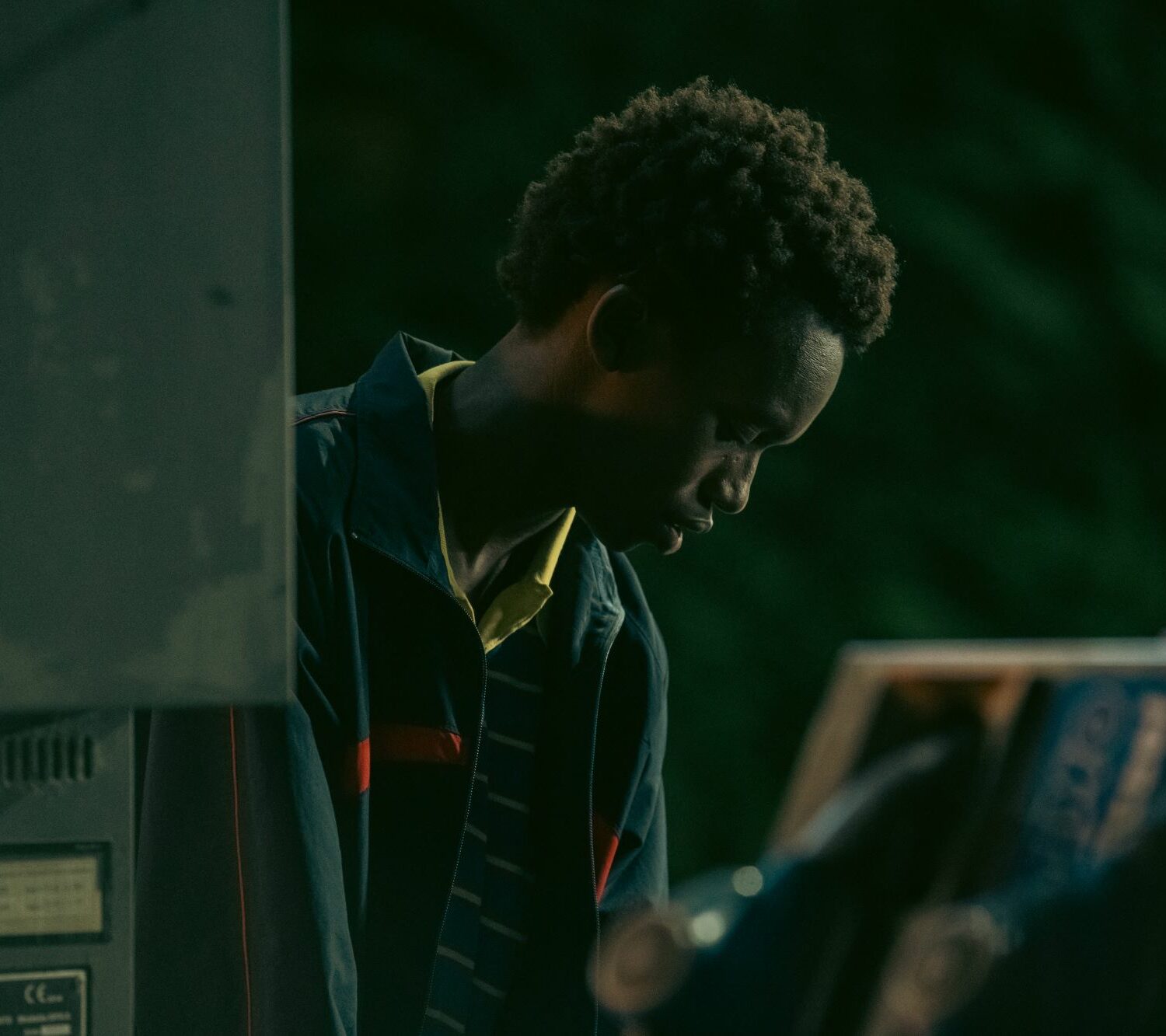
Davide Angiuli does not come to his first film by chance. Born in Bari, raised in the neighborhoods that today tells, he has gone through years of formation between writing and direction, passing through workshops, development of projects and short films. Bad road, presented at the BIF&ST and out in the hall on March 26, is its debut in the feature film. But it already has something very defined: an internal, personal look, which uses the genre without really belonging to it.
The film follows Donato, portrayed by Malich Cissé, a boy who lives on the outskirts of Bari, takes care of Alzheimer’s sick grandmother (played by Lucia Zotti) and struggles to find a direction. The meeting with Agust, Albanian criminal linked to a code of rigid honor, to which Giulio Beranek gives body, drags him into a spiral of turnips and increasingly difficult choices. But told so it is only half of the story.
Because Bad Road is not really a crime movie.
Angiuli, his film fits into a very recognizable thread, the crime of periphery. Was it a conscious starting point?
«I believe that today the cinema of periphery has become almost a genre, with rules, of expectations. When you enter that territory, somehow you have to confront those codes, even to decide how to use them. In my case it was not a choice calculated at the table, but it was a natural consequence of wanting to tell a world I know. I grew up in those environments, between those roads, and when I felt the need to tell a story I realized that the only way to do it in an authentic way was to start there. Of course, once you move into that context, you know there are references, models. Some accept them, others try to bend them, move them. But you cannot ignore them completely.”.
However, the film seems to escape the most spectacular dimension of the crime.
“Because I didn’t care. I didn’t want to make a crime film, I didn’t want to tell a criminal career or ascent. Crime in the film is present, of course, but it is more a tool than a theme. It is something that crosses history, which sets out events, but the center is another. I was interested in telling an emotional condition, that of Donato, his sense of loss, his need to find a place in the world. Crime becomes one of the possible paths, perhaps the most immediate, but it is not the point of speech”.
The relationship between Donato and Agust is the heart of the film, but it is not a “classic” relationship.
“No, in fact I didn’t want it to be a simple, master-student dynamic. It’s a much more ambiguous relationship. They are two deeply lonely characters, in different ways, who meet and recognize themselves in that solitude. This approaches them, but at the same time makes them dangerous to each other. It is a link that may seem like training, but it is also a form of mutual dependence. There is a very strong need to belong, not feel alone anymore, and this need leads them to accept compromises, to push beyond. It’s not a healthy relationship, but it’s real. And somehow, despite everything, it is also a relationship that keeps them alive”.
So it’s a loneliness movie more than crime.
“Yes, I would say yes. For me the film is this: the desperate attempt not to be alone. Donato is a character who does not feel comfortable with himself, who cannot find a place. And then look for something to cling to: a person, a group, a family, even if that family is built on fragile or dangerous bases. I was interested in telling this passage, this moment in which you are willing to everything to feel part of something”.
Even the form of the film seems to go in that direction: much on the characters, little breath.
“It was a precise choice. I wanted the viewer to be inside the movie, not out watching. We worked with a camera very close to the bodies, limiting the wide fields, trying to return an almost physical feeling of pressure. The film runs, never really stops, a bit like the protagonist. It is a kind of continuous race, without pauses, and this contributes to creating that feeling of apnea that accompanies all the history”.
Bari in the film is never a simple setting.
“No, it was essential for me that it was not just a background. Bari is part of the story, it is an active element. The peripheries, the roads, the spaces that cross become part of the experience of the characters. And I think this is also the fact that it is a city I know very well. I didn’t want to tell it in an aesthetic or stereotypical way, but return it for what it is, with its contradictions. It is a harsh place, but also full of energy, of life”.
In the film there is also a tension between staying and going.
“Yes, it is a theme that touches me personally. At some point I went away from Bari, and it was not a simple choice. But it was also a form of salvation, because I felt I was taking roads that would not take me far. When you leave, however, it also changes the way you look at the place you come from. Recognize things you didn’t see before, you’re missing aspects that you might have for granted. In the film this tension is: to remain is to belong, but also to risk being trapped. Going away means losing something, but maybe even saving oneself”.
It is a film of formation, but without a true redemption.
«Yes, I did not care to tell a linear growth, with a clear solution. Life doesn’t work like that. There are times when you understand something about yourself, but it is not said that it is enough to change everything. Donato comes to an awareness, but it is not a liberation in the classical sense. It is more an acceptance, even painful, of what it is. And perhaps this is already a step”.
The article Davide Angiuli: “Cactive road was born from what I lived, I didn’t want to make a crime film” proviene da IlNewyorkese.
