
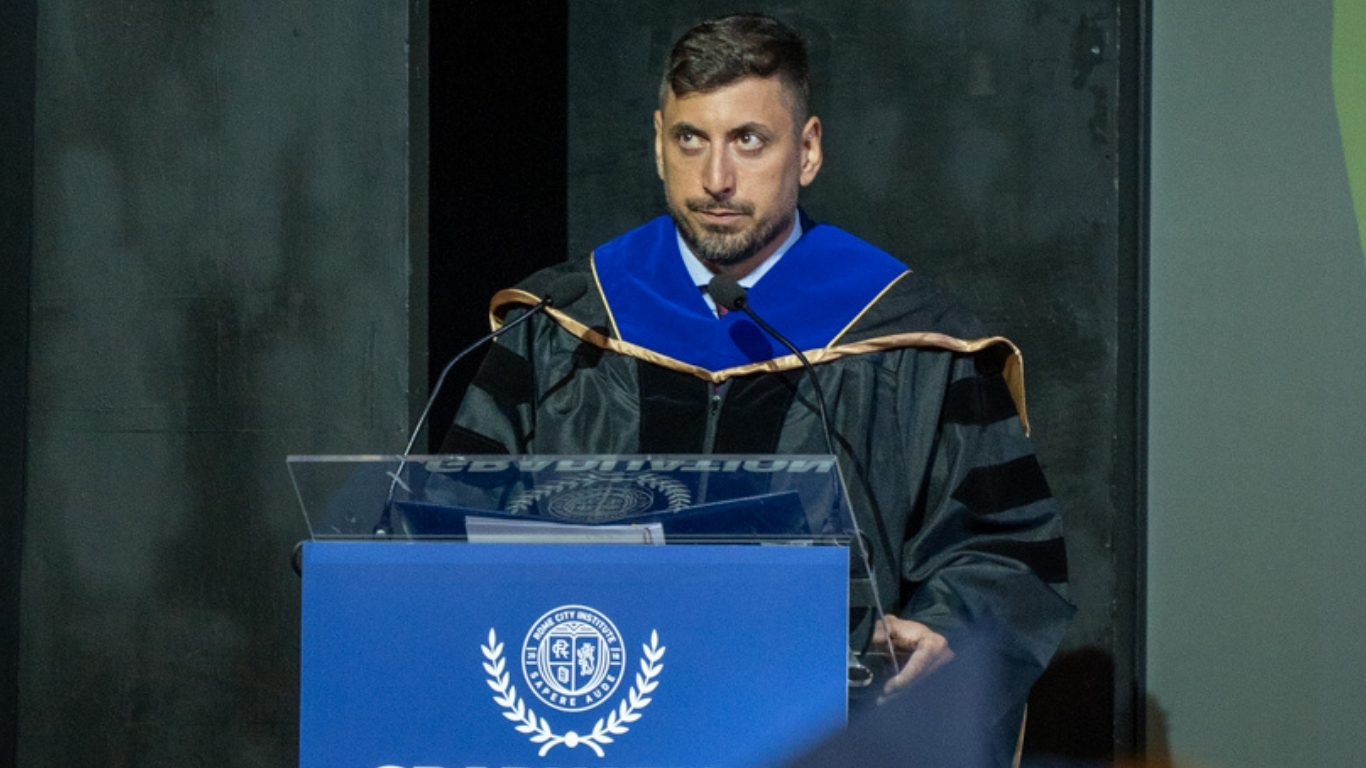
From the Italian Pro League to the American campuses, to the creation of an international university in the heart of Rome. Stefano Elio Radio, president of the Roma City Institute, tells the path that led him to build a concrete bridge between Italy and the United States, combining sports, academic training and global vision. In this interview retraces the origins of the project, the innovative educational model and future challenges, between international growth and the development of new talents.
President, your story shows that you too are a living bridge between Italy and the United States. How was this relationship born? Like all things, it was born by chance. I arrived in the United States in 2013 thanks to Giorgio Antongirolami, one of the people with whom I built everything we created. He was training an American college since 1996, and at some point, he offered me a scholarship to do a Master’s degree in Business thanks to football. At the time I spoke very little English and tried to be a professional footballer in Italy: I had played in the last years in Lega Pro, so I was one of those many good but not enough to play “at the highest level”. I took the opportunity and left.
When I arrived in the United States I realized that the Italians who did sports in universities were very few, while there were boys from all over the world: English, Spanish, Brazilian, German. We wondered why Italians did not exploit this possibility and the answer was simple: a bridge was missing.
From there we created College Life Italy, today one of the largest agencies in the world, with the idea of helping Italian students get scholarships thanks to sports. Since 2013 we have helped about 350 children a year, with the aim of giving an alternative to those who are good but not enough to become professional, because sports can still be a vehicle to become professionals in other sectors.
In 2018 we took a step further: creating the reverse bridge, bringing American students-athletes to Italy. Thus was born the Rome City Institute, starting from a master in sports management. Today we are a university with American accreditation, with 400 students in 11 disciplines, 90% from the United States and Canada, with the aim of reaching 1000 students within two years.
If he were to define the Rome City Institute, how would he describe it? It’s a question we’ve asked for years. Then a Texan entrepreneur gave us a key: he told us that we did what the ancient Romans and Greeks did, that is to put sport in the center of the community.
100% of our students are athletes, but we do not want to be labeled as a sports university, because it would be limiting. It doesn’t mean that sportsmen should only study sports. The most widespread faculty is International Business.
The idea is to work with athletes, because we have also been and believe in the values of sport, and to form leaders of the future: entrepreneurs, economists, politicians. Those who practice sports develop skills that you do not learn about books and will always have an extra march than those who have never done it.
So you bet on a new athlete, capable of becoming a businessman? Sure. In Europe the problem is that many professional athletes do not have academic training and stop at 35-37 years finding themselves in difficulty. In the United States, on the other hand, 99% of athletes graduated because between 18 and 22 years they compete on a collegial level.
This changes everything: even those who become professional are already prepared for the after. And most will not become, so having a parallel academic career gives you an extra march in the world of work.
What is the target of the Rome City Institute? The typical student is an American boy who graduates in a high school and practice good sports. You can choose the traditional path in the United States or come to Rome and experience similarly, obtaining an accredited American degree.
Rome is fundamental for two reasons: it is one of the most beautiful cities in the world and offers a unique international experience. Living abroad even for a year gives an extra march than those who follow a traditional path.
What are the most practiced sports from your students? Football, basketball, volleyball, American football – where we also became owner of 15% of the new league – tennis, swimming, golf, lacrosse, rowing, hockey on the lawn.
An interesting fact is that 40% of our students are female, a very high and quite rare percentage for a university of athletes.
The USA will host the 2026 World Cup this summer. Has football in the United States changed in recent years? With the arrival of Messi something has changed. Football has always been very practiced, especially at a female level, but less followed than American football, baseball and basketball.
Today, however, is the most practiced sport among the under 14. The movement grows, although the economic gap with other sports remains. There are football schools with thousands of boys and the system is developing.
With Serie A we work to increase visibility in the United States through the program “Serie A Elite”, bringing the brand even in reality local and selecting young talents that can make experiences in Italy.
What about the American national level? There are players like McKennie and Pulisic and there will be more. The United States has 300 million inhabitants: it is natural that they become competitive also in football. It will be interesting to see the results in the coming years.
What is the perception of Serie A in the United States today? The Premier League dominates the market: most Americans follow British teams. Serie A is trying to grow, also thanks to an office in New York, but it is not easy because we compete with both other championships and other sports.
The key is to create fans: a person follows a championship only if he has a team of the heart. If you don’t throw a team, don’t look at Lecce-Verona. But if you’re a fan of Lecce, then yes. It is a complex but important challenge.
Returning to you, why should an American student choose the Rome City Institute? Making an international experience is fundamental to the success of a young man. For those who want to combine sports and study internationally, we are the only reality outside the United States that offers this model.
Here you train every day with national level coaches and you study in an international environment. It is a different path, and those who make unconventional choices are often seen better in the world of work.
An experience from us can open doors that a traditional path does not open.
What is the vision that the guide and what kind of impact you want to leave in the long term? To me creating a university from scratch is something extraordinary, rare today. The goal is to leave a legacy, something that can last even after me, maybe for the next 500 years.
We started with 15 students, then 30, today we are 400. We built a model that works, with satisfied students and a community other than the traditional one.
We are little academic in the formal sense, but very serious in content: we want to demonstrate that you can do universities also in a different way, combining study, sport, fun and community sense.
Your seat is in the heart of Rome, in a very suggestive location. How much does this matter? Very. The campus was Temple University for 50 years. Even this was born almost by chance: when he got rid we didn’t have the numbers yet, but we believed in our vision.
Today many American students come to Italy for short periods, so-called “study abroad”. On the other hand, we focus on students who take the entire bachelor’s course in Rome.
Our 400 students are all degree seeking, i.e. they complete their path here. The goal is to reach 1000 students and become the American university with more students of this type in Italy.
In the future we also want to increase Italian students, from 5% to 20%, because studying in an international environment gives a huge advantage even remaining in Italy.
L’articolo Stefano Elio Radio: “So we built a bridge between Italy and the United States through sports and training” comes from IlNewyorkese.
