
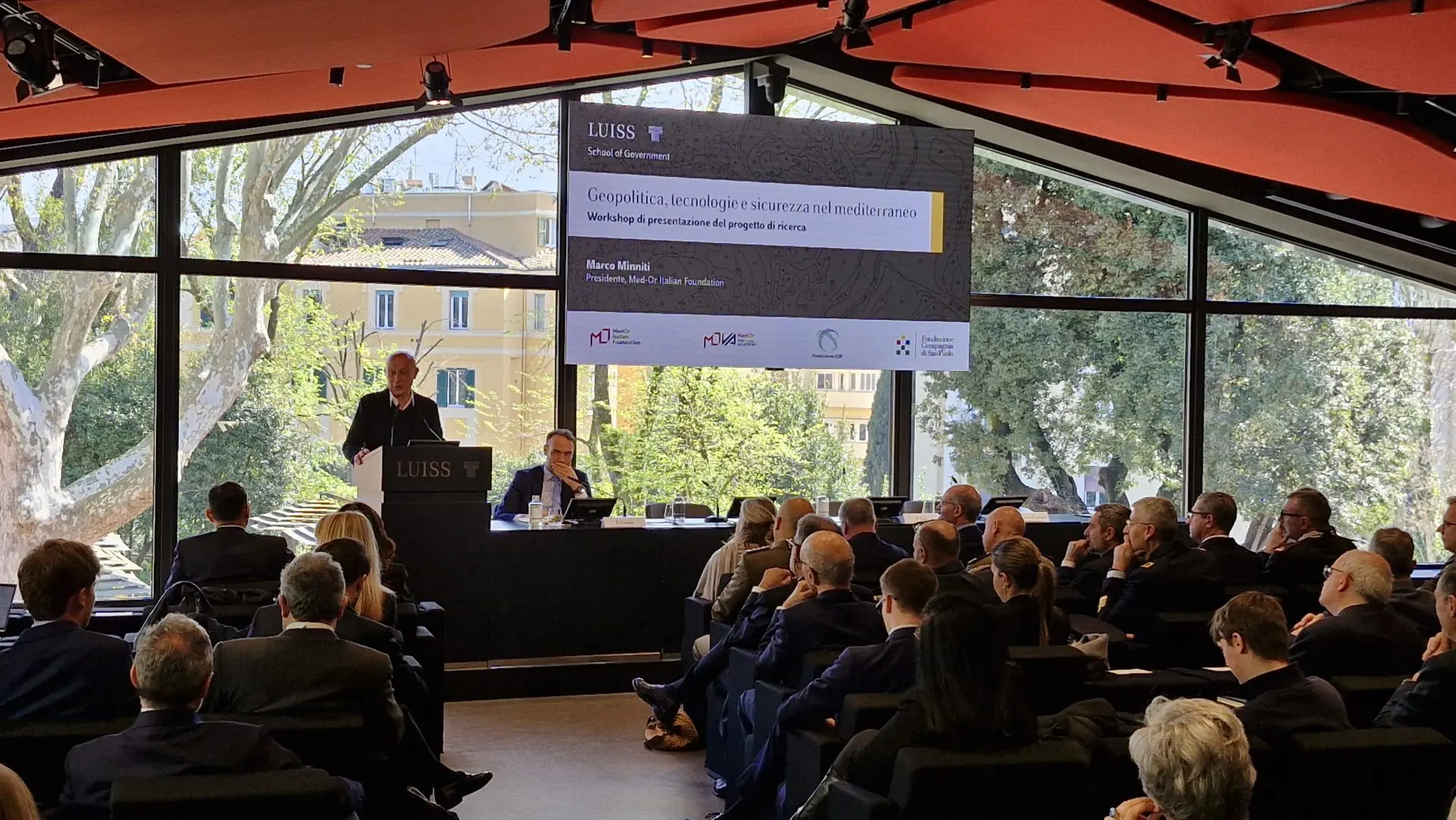
ROMA (ITALPRESS) – ‘In the long term, we must aim to build a new world order, because there is no doubt that a stable and lasting peace in Ukraine, in the Middle East and in the enlarged Mediterranean, can be strengthened only if a new world order is built.’ Thus Marco Minniti, president of Med-Or Italian Foundation, opening the workshop for the presentation of the research project ‘Geopolitica, Technologies and Security in the Mediterranean’, developed by Med-Or in collaboration with Luiss School of Government in the “Geopolitics and Technology”, promoted by the Compagnia di San Paolo Foundation and the CSF Foundation.
‘To do this, there is a need for a role in Europe, which must feel called directly into question, never like now. It is an existential challenge, without precedent, because Europe can be torn apart, and at the same time it is an extraordinary opportunity to be protagonist in the world, because it appears as a democratic point of reference and capable of building strong paths even from the diplomatic point of view,” he points out. ‘Europe today must have its own strategic autonomy: it is not a matter of separating itself from the United States, but of understanding, indeed, that a strategic autonomy of Europe makes even more peaceful and stronger the United States, because they need another protagonist in the government of the world. You cannot leave all this game to Russia and China’, remember Minniti. ‘This role of Europe is fundamental because a new world order cannot be achieved without the south of the world. Europe and the south of the world are closely connected, because the south of the world, to believe in a new world order that can represent it, needs someone to do it by Virgil in this new world order,’ he concludes.
For Gaetano Quagliariello, Dean of the Luiss School of Government, ‘many of the categories with which we have interpreted the international context today do not seem more adequate. We have long been witnessing processes of deglobalization, marked by the emergence of states and nations, by the recomposition of zones of influence and competitions that go beyond traditional military ones. The problem of analysts is to trace from time to time the fall point and to be able to highlight what is the point of intersection between the new things that the international scenario proposes us and those that are the underlying dynamics – emphasizes Quagliariello -. In this context, energy, digital and logistic networks are not only connecting tools, but real power infrastructure and at the same time potential vulnerabilities, precisely because of their increasing technological integration. Standards, rules, forms of governance and conditioning are established through them. And to this is added a further level, what in the common language now we call ‘hybrid war’, a dimension that invests, beyond the military sphere also that of information, perception and mechanisms of formation of consent. If we look at current events, especially at the Strait of Hormuz, we see that energy, commercial routes, maritime safety return to show itself as aspects of the same question, a complex and difficult knot to dissolve: it is also in the light of these tensions that the Mediterranean retains, even strengthens its centrality as a strategic space for the security of the south side of NATO in which economic interests and critical infrastructure are concentrated.’.
For the director of the CSF Foundation, Nicolò Russo Perez, ‘there is an increasingly close relationship between digital transformation and geopolitical security dynamics, with particular attention to the size of the Mediterranean. We live in a period of course characterized by a global interconnection, a strategic competition and a technological acceleration. In this scenario, digital is no longer just an instrument of economic and social innovation, but it is a real space for political confrontation and power projection. Digital technologies, from network infrastructure to artificial intelligence systems to data management and digital platforms, now directly affect international balances, helping to redefine traditional concepts such as sovereignty, security and influence. The crises of recent years have made this transformation even more evident and have shown how much energy, economic and technological dimensions are now absolutely interconnected and how events that occur in areas also relatively remote or far can actually have decisive impacts on our local realities. In this context, associating geopolitical and digital is not only a theoretical exercise, but it becomes an an analytical need to address the complexity we have ahead of us,” he emphasises.
The first session was dedicated to ‘Trans-Mediterranean connectivity: strategic and geopolitical infrastructures, between digital networks, logistics and security’: according to Ambassador Francesco Talò, Italy’s special envoy for the IMEC Corridor, ‘in this context, the Mediterranean can and must have a global vision. In the acronym IMAC there is the word ‘corridor’, but perhaps it is more right to talk about a network: if we had more energy connections between the Gulf and the eastern Mediterranean, we would be much better. They don’t exist, they can do. If there were greater development of green hydrogen being transported, things would be much better. Moreover we must take care of the security of these infrastructures that we go to build and, in this, Italy is put well: our entrepreneurial system – with the two ‘campions’, Leonardo and Fincantieri – can work well, creating for example of the security bubbles to 360 degrees around infrastructures like the harbour ones or those underwater ones’.
Fabio Panunzi Capuano, Vice President Business Development & Corporate Diplomacy of Sparkle, recalled the importance of ‘digital corridors as an integral part of an economic strategy: they are elements to close partnerships and strengthen collaborations. It is evident that, for the geographical areas and the seas crossed by these infrastructures, a punctual analysis of what is the geopolitical ecosystem in which these infrastructures live and above all will live,’ he explains. ‘On existing infrastructures the look is on service continuity, on future infrastructure the look is on how to actually achieve them. The European Commission, a few weeks ago, published its strategy on submarine cables, identifying the corridors on which there is a greater European interest in the construction of new infrastructures. Among the many projects, the most important that is exactly the trans-Mediterranean corridor of the Red Sea and the Indian Ocean: This leads us to identify the Mediterranean, with Italy, at the center of the gateway of data traffic for this network of corridors that, from Europe, goes towards the Middle East and India. What we have to value is diversification, we must ensure that the network is as safe as possible.’.
In the second session dedicated to ‘The hybrid conflicts between cyberspace, disinformation and maritime security’, Alessandra Ruggeri, Head of U.O. Geopolitical Analysis by Leonardo International, has highlighted that ‘the operational continuity of our society is increasingly linked, in an indissoluble manner, to the cyber aspect’ that has become ‘a structural element of strategic competition’ in recent years. The industrial response to cyber threats cannot be to build an impenetrable and infallible system: it would be a chimeric ambition that is denied empirically daily, we have seen how there are no impenetrable missile shields, nor even less computer systems. The approach must be to build those abilities that allow you to anticipate the threat, identify it and possibly neutralize it before it actually arrives at the target, whether in the digital or physical domain. It is in this framework that the project of Michelangelo Dome was born, which aims to translate Leonardo’s multi-domain vision into concrete: it is a system of systems, i.e. a security architecture for informational and decision-making superiority that integrates naval, terrestrial, air, space, command and control platforms, artificial intelligence, forward-looking algorithms, in an perspective of interoperability and international cooperation.
To underline the importance of a multi-domain approach is also Andrea Savino, Vice President Unconventional Underwater Solutions Development of Fincantieri, which recalls the centrality of the underwater, ‘a primary component that today needs a strong technological development investment, was nothing other than the fact that many of the technologies we now widely have in the underwater part do not find an application, simply because the marine medium has a completely different physical classification and provides for a rewrite of technology. This approach should be seen in a multi-domain concept, which is being established both nationally and internationally, because the only way to be able to have this situational awareness is to be able to correlate information elements deriving from multiple sources, to have evidence that there is anomaly and to be able to intervene in the most appropriate manner.
– Photo xi2/Italpress –
(ITALPRESS).
