
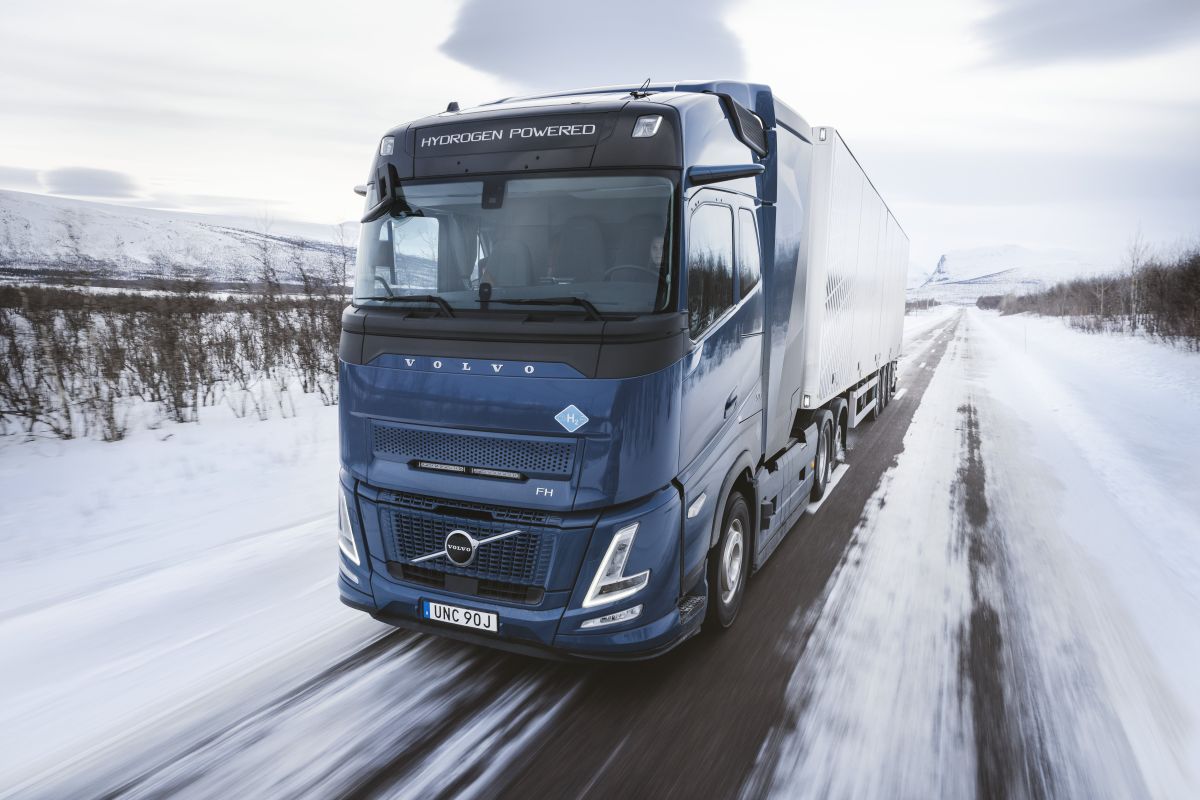
MILAN (ITALPRESS) – Volvo has started road testing of trucks powered by hydrogen combustion engines. Volvo’s hydrogen solution is state-of-the-art in the industry and the commercial launch is expected before 2030. Volvo takes a further step towards zero-emission transport of CO2 by starting road tests with heavy trucks equipped with hydrogen-powered combustion engines.
Volvo’s hydrogen vehicles will offer industry-leading performance, with greater energy efficiency, lower fuel consumption and higher engine power than conventional hydrogen combustion engines technologies. This is possible thanks to HPDI (High Pressure Direct Injection) technology, in which a small amount of ignition oil is injected with high pressure to allow the ignition by compression before the introduction of hydrogen. Volvo already uses this technology in its gas trucks, with over 10,000 units sold globally.
“The road tests are an important stage for our hydrogen combustion engine trucks. I am confident that they will be the best in the industry in terms of efficiency in consumption, power, torque and driveability. Customers can use them just like diesel trucks. Our experience with HPDI technology in over 10,000 gas trucks is a concrete proof of its performance,” says Jan Hjelmgren, Head of Product Management of Volvo Trucks.
Hydrogen combustion engine trucks will be particularly suitable for long distances and regions where the charging infrastructure is limited or where the charging times of battery electric trucks are insufficient.
Volvo trucks with combustion engines powered by green hydrogen have the potential to achieve zero net CO2 emissions “well-to-wheel” using HVO renewable as ignition fuel. They are classified as “zero emissions vehicles” (ZEV) according to EU standards on CO2 emissions. Volvo’s advanced hydrogen engine technology comes from its diesel transmission, offering similar diesel performance and significantly reducing CO2 emissions.
Hydrogen-powered combustion trucks will complete the company’s offer along with other solutions, such as battery-powered electric trucks, fuel cell electric trucks and trucks powered by renewable fuels such as biogas and HVO (hydrated vegetable oil).
“We see a great potential in hydrogen combustion trucks and will have a role in transforming to zero-emission transport. Different decarbonization technologies will be needed. As a global truck manufacturer, we offer a variety of solutions and help our customers choose the best alternative according to the transport mission, available infrastructure and green energy prices,” says Jan Hjelmgren.
Volvo’s hydrogen trucks will use Cespira’s high-efficiency HPDI technology (High Pressure Direct Injection); they will have an operational autonomy greater than the daily driving distance of many customers. Thanks to low CO2 emissions, these trucks are classified as “zero emissions vehicles” according to EU standards.
Hydrogen can also be used in fuel cell electric trucks, where electricity is produced on board: these do not emit exhaust gas, but only water vapour. Volvo plans to introduce these vehicles in small volumes before 2030. The Volvo strategy to achieve zero net emissions is based on three technologies: battery electric, fuel cell electric and combustion engines powered by renewable fuels.
photos: Volvo Trucks printing office Italy
(ITALPRESS).
