
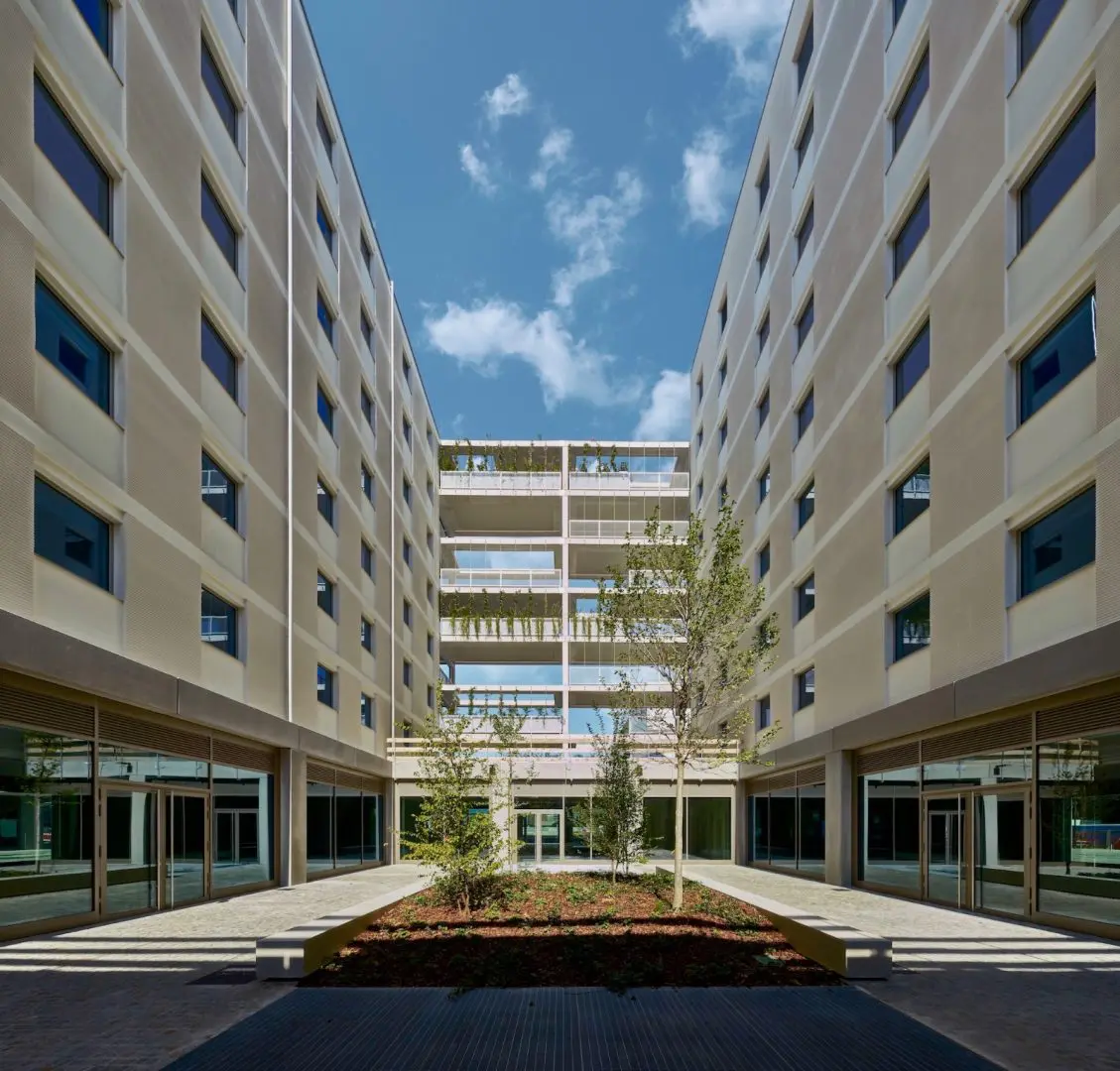
MILANO (ITALPRESS) – The Olympic Village of Milan developed by Coima and designed to become the largest partner student in Italy with over 1,700 beds, on the occasion of the return by Fondazione Milano Cortina 2026 of the rooms used during the Games, after the Olympic success starts the process of re-functioning in the student.
In just six months after booking, 65% of the accommodation’s beds have already been allocated through agreements reached with universities and direct requests via the website. Moreover, thanks to the contributions of CDP Real Asset SGR and MUR (Ministry of the University and Research), which confirmed the suitability of the Village regarding the requirements of the Ministerial Decree no. 481 of 26 February 2024 for the realization of new beds in university residences, 450 beds have reduced rates and for 30% of these (135 beds) a tariff of 250 euros per month is introduced. During the Olympic weeks, the spaces of the Village were configured as a multicultural meeting point, welcoming more than 1,000 Olympic and Paralympic athletes from over 40 international delegations and winners of numerous medals. Through social media, many shared positive feedback on the quality of stay: from the comfort of the rooms and beds to the functionality of the services, from the organization of the common spaces dedicated to sociality and rest, to the care of furnishings and design details.
The harmony of these elements, which has contributed to creating a functional environment for high-level sports preparation, has consolidated the image of a modern, efficient and able to offer standards in line with the expectations of the international Olympic community. Today, after the return of the rooms by the Fondazione Milano Cortina, the conversion of the Village into a student, the fastest in the history of temporary events in Italy and one of the fastest in the world (4 months from April to July).
The aim is to open the future residence in August, in time for the start of the academic year 2026/27, and reach the full employment of the structure already in September 2026. On the outside, the re-functionalization measures provide for vehicular and pedestrian access, the realization of sports fields, the integration of spaces for green and urban furniture. In addition, from the beginning of the design, the ground floors were designed taking into account the post-Olympic configuration to minimize costs and waste. In fact, the approximately 10,000 square meters used as services for athletes, which include spaces dedicated to gym, coworking, catering and medical-sanitary facilities, will be destined for activities and services that can contribute to the activation of the district and the student.
Inside the Village, the furnishings will be completed, in particular the rooms (with the insertion of desks and chairs, not necessary during the Games), and the work of conversion of lobby and common spaces (including kitchens, study rooms or relaxation areas). The future student, with its 1,700 beds, will help to cover 6% of the need for beds for students in the city of Milan, today estimated in 30 thousand units in front of a total population of 200 thousand students. The intervention is in fact one of the investments symbol of the fund Coima ESG City Impact (“Fondo Impact”), among the first in Italy structured according to the principles of impact investing. The Fund therefore aims to simultaneously generate financial, environmental and social returns on the basis of quantitative targets defined above, within a strategy that favours the redevelopment of already urbanized areas and the construction of fossil fuel free, nZEB and Energy Class A buildings. Since 2020, the Fund has mobilized total capitals for around €5 billion through strategic partnerships and partnerships and has been globally established for ESG performance, resulting in Global Sector Leader in the GRESB benchmark with 99/100 and 5 stars.
Started on 30 September 2025 through the website and the interlocutions with the universities of the territory, the allocation of the beds of the Village has already reached 65% of the total, as follows: 135 places DSU (right to the Studio) in agreement with public universities, 730 beds at Bocconi University and 245 beds through recordings received directly through the website www.villaggio.coima.com. Of the 450 seats at reduced rates already provided, 30% (135 units) are offered at a further reduced rate of approximately 250 euros per month (VAT and services included) following the confirmation of the suitability of the Village regarding the requirements of the MUR call (Ministry of the University and Research). The rooms are in agreement with the state universities of Milan. All beds include the services necessary to ensure security, comfort and sociality: surveillance h 24, 670 cameras, concierge 7/7, 425 locker, cleaning, 6 laundry rooms, all utilities included WiFi, 1,000 covered bike seats, 42 kitchens 2 gyms, 42 study rooms and hobby rooms (e.g. auditorium, cinema, music and meditation). The Village is a private student that is part of the share of social housing (ERS) provided in the district of Scalo Romana and, as such, provides a system of calmed rates through a convention with the Municipality of Milan.
In particular, prices have been calculated to cover the cost of realisation of the work by guaranteeing long-term investors who invested in the project (e.g. insurance funds, pension funds, banking foundations) a 5% return, only marginally higher than the yield of ten-year BTPs despite a risk profile of investments substantially greater. The rates of the student, all agreed, are differentiated according to the type of room (single or double) and include VAT and all services related to safety, comfort and sociality. The total average rate of 864 euro per month (VAT and services included) is 25% lower than the Milan market average for rentals including services (1,150 euro per month[2]). Moreover, thanks to the contributions of the National Fund of Social Debt (FNAS) of CDP Real Asset and of the Ministry of the University and Research (MUR), the beds at reduced rates have been tripled regarding the initial quota, reaching 450 units with an average cost in place of bed of 592 euros per month (VAT and services included), of which 30% (equal to 135 beds) destined to the Law to the Studio (DSU), at the cost of approximately 250 euros For access to ordinary low-cost beds, ISEE certification will be required less than 44 thousand euro/year; for DSU beds the criteria specifically set out for this type of beds will be applied by public institutions.
Designed as a campus open and connected to the neighborhood to become an integral part of the city after the Games, the student of Scalo Romana was completed in just 30 months thanks to the close collaboration and integration of supply chain, constituted by Italian suppliers and know-how, selected through a rigorous process of assessment of the performance of sustainability, in order to realize a project in full respect of the requirements nZEB (Nearly Zero Energy Building, high energy efficiency and reduced consumption). The Village resides in the new Scalo Romana district that will cover, between student and housing, the housing requirements in social housing and public housing of more than 2,500 people, contributing concretely to the Piano Casa del Comune di Milano and the sustainable living plan promoted by Confindustria. In addition to the agreed beds of the student, approximately 320 housing units will be realized in social housing or contracted under the framework agreement signed between COIMA and CCL (Cooperative Workers Consortium), of which 220 in ordinary contracted buildings (with allocation costs of less than 4.000 €/mq) that will finance approximately 100 housing in public residential building (ERP, with average rental fee of approximately € 30m/mq).
The partnership between CCL and COIMA aims to contribute to the definition of a new entrepreneurial, urban and financial model in the residential field aimed at the realization of real estate interventions with affordable prices and canons, but at the same time fully integrated in the reality of the district: a goal that will be pursued through the creation of residential contexts where the components of free, conventional and social housing will coexist harmoniously, expressing an aesthetic homogeneous canon at architectural level through the involvement of young people.
– SEC press office photos –
(ITALPRESS).
