
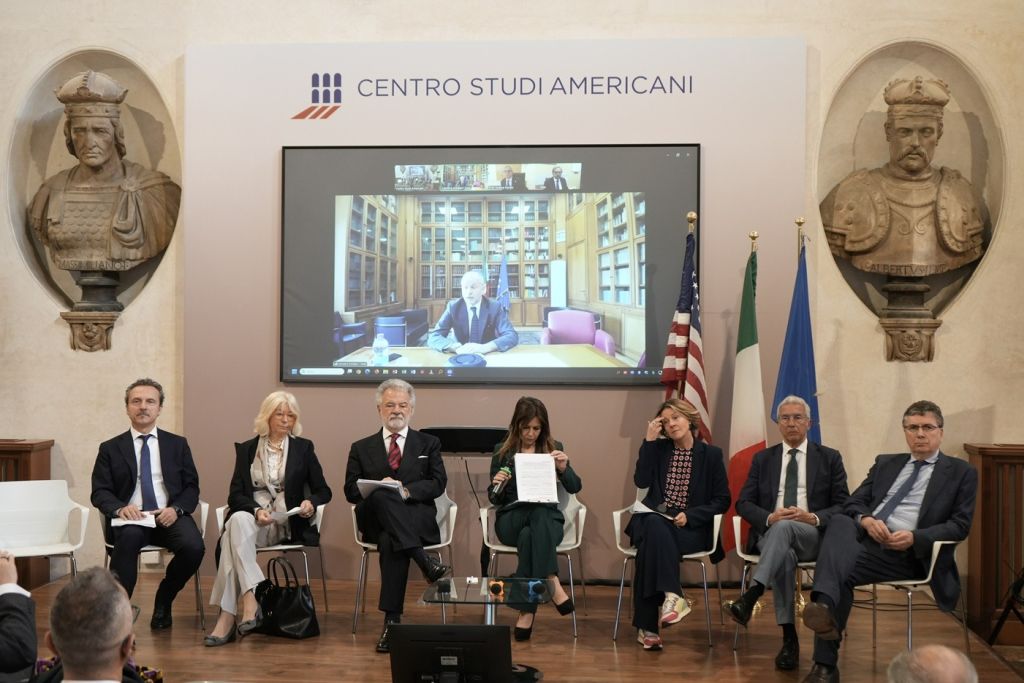
ROMA (ITALPRESS) – Promote a greater awareness of chronic insomnia and the health, social and economic impact it entails for the country system, in order to recognize it by law as pathology and public health priority. This is the objective of the Policy Paper on chronic insomnia, presented during an event at the American Studies Centre in Rome promoted by the Parliamentary Intergroup for Neurosciences and Alzheimer’s with the contribution of Idorsia. The document, which lays down the solid foundations for this priority to be implemented in preventive and effective care measures of patients, was drafted thanks to the contribution of the Scientific Committee of the Working Group on insomnia and other sleeping disorders, recently constituted within the Parliamentary Intergroup for Neurosciences and Alzheimer’s. The Committee is composed of Andrea Fiorillo, President EPA – European Psychiatric Association and Professor of Psychiatry at the University of Campania ‘Luigi Vanvitellì; Gianmarco Marrocco, deputy provincial secretary FIMMG Federazione Italiana Medici di Famiglia Roma; Claudio Mencacci, President SINPF – Italian Society of Neuropsyicopharmaceuticals; Francesca Merzagora, President of Fondazione Onda ETS; Lino Nobili, President AIMS – Italian Academy of Medicine of the Sleep and Professor Ordinary Department of neurosciences, rehabilitation, ophthalmology, genetics and maternal-infantil sciences at the University of Genoa; Giuseppe Plazzi, NAIT President, National Association for Narcolessia; Marco Rolandi, President RLS Italia – Leg syndrome without remarriage – APS; Alessandro Rossi, President of SIMG – Italian Society of General Medicine and Primary Care; Guido Di Sciascio, President SIP – Italian Society of Psychiatry and Director of the Department of Mental Health of the ASL of Bari; Antonio Vita, President SIP – Italian Society of Psychiatry and Professor of Psychiatry at the University of Brescia and Mario Zappia, President SIN – Italian Society of Neurology and Professor of Neurology at the University of Catania. The Policy Paper presents the pathology data and analyzes the health, economic and social impact, treatments, access to care and critical issues that patients encounter in the therapeutic diagnostic path and their everyday life. From the analysis of pathology and its implications for patients, for the community and for the country system, the Scientific Committee has been able to develop a series of recommendations for the management of chronic insomnia. “ Chronic insomnia is a widespread pathology that significantly affects the health of people and the balance of daily life, with repercussions that also extend to the social and economic sphere – said the Minister of Health, Orazio Schillaci -. For too long it has been considered a secondary disorder, while data clearly shows that it is a public health issue that requires greater awareness and a more structured approach. Therefore, the work developed within the Parliamentary Intergroup for Neurosciences and Alzheimer’s and the contribution of the scientific community, which through this Policy Paper, offer useful elements for a more complete reading of the phenomenon and to guide institutional comparison towards increasingly adequate responses to the needs of citizens.” “Cronic insomnia is a health and social emergency that involves millions of citizens and generates an economic impact comparable to that of a Budget Law – said Annarita Patriarch, Secretary Bureau of the Chamber of Deputies –. Continuing to consider it a marginal problem means ignoring enormous costs in terms of health, safety and productivity. I have just filed, as the first signatory, a bill to recognize chronic insomniaas an autonomous and disabling pathology, to be managed in a priority way through a series of actions: its integration in the LEA and the National Plan of Chronicity; the establishment of an Observatory for the study of pathology and, finally, guaranteeing greater working overalls. This political commitment is not only an act of institutional responsibility, but a strategic investment that will, on the other hand, promote a reduction of direct and indirect costs that affect the economy of the country and will put patients back to the centre by providing means of protection for a path of diagnosis and uniform care throughout the national territory”. “This event represents the first appointment of a deepening of sleep diseases that the Working Group interparliamentary on insomnia and other sleeping disorders intends to carry forward – the words of Beatrice Lorenzin, Member V Commission of the Senate -. Starting from the evidence of the Policy Paper, presented today by the Scientific Committee, we can begin a political action that starts from a joint intervention on sleep hygiene, through the training of clinicians and the awareness and information of all citizens. For years I have firmly argued that we need to integrate sleep in prevention policies because it is an area where public responsibility is evident, we think only about road safety and workplaces.” “Unfortunately, chronic insomnia is treated in a very approximate way, with drugs often devoid of scientific evidence and burdened by numerous side effects. Today – said the president of EPA, Andrea Fiorillo – there are extremely effective treatments, which allow not only to improve the amount of sleep, but also quality, going to act on the system of hypervigilance. These modern drugs, which can be defined as real game-changers, should be made available to all people suffering from chronic insomnia disorder, when only a small percentage of patients can use them. Moreover, always referring to the available official guidelines, the treatment of choice in cases of chronic insomnia is represented by cognitive-behavioural therapy, which is only available in very few ultra-specialized centers”. Chronic insomnia is estimated to affect approximately 6% of the Italian adult population; however, for different experts the percentage would be greater, attesting between 10 and 15%. Sleep disorders are widespread in all age groups, with greater incidence in bands between 45 and 54 years and from 65 years on. 70% of patients with chronic insomnia are female. It is also significant the increase in cases between children and adolescents, often linked to the excessive use of social and smartphone, with decreases in school performance and interpersonal relationships. Those suffering from chronic insomnia complain about a poor quality and amount of sleep that affects at least 3 nights a week for a period of three consecutive months: night symptoms, including difficulty sleeping or maintaining prolonged sleep, have repercussions on psycho-physical well-being during the day, because they generate fatigue, poor concentration, irritability. These naturally affect active participation in the world of work, and are a hidden cost for collective welfare. The estimated costs, in fact, are about 14 billion euros a year, equal to 0.74% of GDP, divided between direct costs, concerning hospitalizations, medical visits, drugs and indirect costs, including absenteeism and presentism and road accidents. It is a condition that involves an impact on the mental and physical health of those who suffer from it, which not only affects night and sleep: in fact, more than 60% of Italian patients with sleeping disorders declare to suffer a significant negative impact on psychological well-being and 43% of paunts report a compromise of social life. Sleep deprivation is also associated with a decay of cognitive functions: 62% of patients report concentration deficits and 57% have memory problems. Chronic insomnia also causes important repercussions on working life: in fact, about 82% of people with sleeping disorders complain a decrease in professional performance. Economic projections show that indirect costs caused by pathology reach significant figures: about 5,500 euro per capita is the value lost in terms of productivity, 1.580 euro is the average cost per event in case of accidents and accidents related to sleep. In addition, chronic insomnia is the cause of increased admissions and access to the first aid, especially in moderate and severe forms and of increased road accidents: a study on drivers with insomnia has demonstrated a 1.8-fold risk of being involved in car accidents. Chronic insomnia is not a simple sleep disorder but is an important risk factor: those suffering from depression, anxiety and other psychiatric disorders, often with unsatisfactory treatments, and has a significantly higher risk of developing greater depression, anxiety disorders, alcohol disorders, suicidal and psychosis risk. It is a widely subdiagnostic and sub-treated pathology; in fact, only 40% of patients with chronic insomnia receive a diagnosis and only 21% is treated. It is estimated that 4-5 million people in Italy have not received an adequate diagnosis or treatment for sleep disorders they suffer. In Italy, the traditional approach sometimes leads to continuing over time the use of solutions to promote sleep, a practice rooted in the cultural fabric and which tends to be perceived as normal. However, unfulfilled management of chronic insomnia can affect the vigilance, attention, cognitive functions and productivity, with effects on the quality of life and safety of people. In light of evidence and data, the Scientific Committee considered it necessary to draw attention to the need to recognize chronic insomnia as a disabling disease and therefore public health priority, which needs a well-defined diagnostic and welfare plan, to integrate chronic insomnia into health planning, to strengthen awareness on pathology in the population and to enhance the formation of health professionals, in order to ensure correct international diagnosis and management. “As an industry, together with key partners such as institutions, associations and medical classes, it is our duty to cooperate to begin a path that allows us to recognize chronic insomnia as an autonomous pathology, which has important relapses across the country system. The Policy Paper is an evidence, the first concrete step of this path, which testifies what actions are to be taken to encourage both health workers and citizens towards a cultural change in the approach to the disease”, concluded Giovanni Girgenti, General Manager of Idorsia.
– photos mec/Italpress – (ITALPRESS).
