
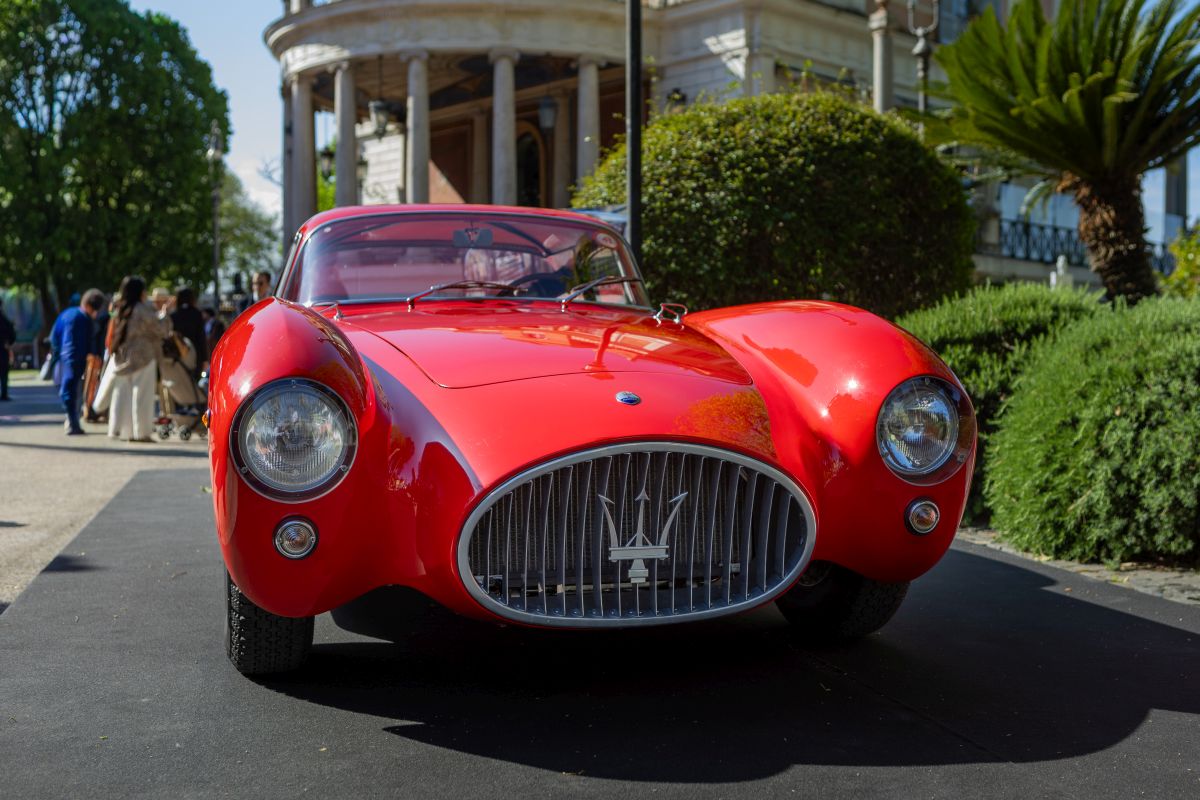
MODENA (ITALPRESS) – Yesterday the first edition of Anantara Concorso Roma, an international event dedicated to Italian excellence, between hospitality and automotive culture, which saw the participation of 70 Italian cars, among the rarest and most prestigious, coming from all over the world and exhibited in the heart of Villa Borghese, at Casina Valadier, from 16 to 19 April. At the event, as an Official Partner, Maserati exhibited some iconic cars: the Type 26B (1927), belonging to the MAUTO (National Museum of Automobile Torino), the A6GCS-53 Berlinetta Pininfarina (1954), belonging to the Maserati Umberto Panini Collection, and the 3500 GT Convertible Vignale prototype (1959) of a private customer, enrolled in the competition and recently certified by the Maserati team. Along with these vintage jewels, the supersportive GT2 Stradale and MCPURA, modern expressions of performance and elegance of the Trident. In addition, other valuable Maserati cars from private collectors included V4 Sport Zagato (1931), a car that won the Best of Show award, the 3500 GT Vignale Spider (1959 – 1963), 3500 GT Vignale Spider ‘prototipò (1959) and Ghibli SS (1970). With the exception of the Type 26B, exhibited in the hall of the Anantara Palace Naiadi Rome Hotel, the other Maserati cars made a beautiful exhibition of themselves at Casina Valadier, the villa in Bucharest square, where a Maserati stand was set up to welcome visitors and fans. “The event has been a unique opportunity for guests and visitors, offering them an immersive journey – we read in a note -: on the one hand, the emotion of admiring some of the most beautiful cars of the Modena brand, on the other the discovery of Maserati Classiche, the team that protects and promotes the preservation and originality of its historical heritage, under the aegis of the project of excellence BOTTEGAFUORISERIE. A suggestive path, therefore, that must be inserted in the wider program dedicated to the centenary of the Trident, the iconic symbol that began on April 25, 1926 on the chest of Type 26 lined with the 17th Targa Florio, giving rise to a legendary history of sports victories, exclusive style and technical primates. To compete, Maserati had the need to place a logo on his car. Originally in black and white, the Trident would have acquired the red-blue colours of Bologna only later, becoming one of the most recognizable symbols of the world automobile. Mario, one of the brothers Maserati, an artist of great experience, took inspiration from the Neptune Fountain, a monumental work placed in the homonymous square of the Emilian city, seat of the “Ditta Alfieri Maserati” founded in 1914 by Alfieri Maserati, together with the brothers Ettore and Ernesto in Bologna. Alfieri, flanked by the faithful mechanic Guerino Bertocchi, brought to the triumph the Type 26 (red, with the nr. 5 of race) in the Sicilian race: first in the class up to 1,500 cc and eighth in the absolute classification. Success was immediate, with orders coming from all over Europe.” Among the absolute protagonists and among the most important specimens, the 3500 Convertible GT Vignale prototype (frame *101*505*), which won in its class, as well as obtaining the award as best interior car. Designed by Giovanni Michelotti and presented at the Turin Motor Show in 1959, it was made of only 6 specimens and represents the first stylistic study of Vignale for Maserati, the origin of the convertible granturismo of the Tridente. “Carrozzeria silver, interior in ivory and red, blue carpets and golden details define a refined and unmistakable aesthetic – continues the note -, while the six cylinders in line from 3.485 cc powered by Weber carburetors delivers 235 CV for a maximum speed of more than 230 Km/h. Based on an accurate restoration between 2023 and 2026, with Maser’s direct supportati Classiche, the car received the Certification of Authenticity number 100 of the Program born in 2021 in the workshops of Modena, which assists customers and collectors in the preservation and restoration of the historical cars of the Tridente. The flagship of Maserati Classiche is the Certification of Authenticity, entrusted to a committee of experts who test each car through a thorough analysis of the technical characteristics and historical documentation kept at the Maserati Archives. Another protagonist of the Anantara Concorso Roma was the Maserati Tipo 26B, the most powerful evolution of Type 26, which was produced in only 8 specimens between 1927 and 1930 for street competitions. Compared to the progenitor, bound to the maximum displacement of one and a half liter of the Grand Prix formula, Type 26B adopted an eight-cylinder in line from 1980 cc capable of delivering 155 hp to 5,300 rpm. The cast iron cylindrical block solved the structural deformations emerged on the previous model, maintaining the solutions already tested: two-seater body shop Sport in aluminum and frame composed of two longherons with beams in steel profiles. The distribution was entrusted to two camshafts in the head controlled by waterfall of gears, with power forced by volumetric compressor type Roots and dry-carter lubrication. One of the most significant innovations, used during the production of the Type 26B, was the adoption of the Elektron – very light magnesium alloy – for base, carter and other components, made in collaboration with the Isotta Fraschini foundries, with a significant reduction in overall weight. The braking system adopted the patented “Perrot system”, which guaranteed a braking independent of steering movements. Since 1929 the frame was shortened with a reduction of the pitch while the maximum speed was between 180 and 210 km/h, with a dry weight between 720 and 780 kg and a capacity of the tank of 80 liters, placed behind the seats. The last engine saw the light in 1930, when the Maserati brothers devoted themselves to other and more challenging designs, leaving Type 26B the ultimate role of a family of racing cars that had written indelible pages. “No less fascinating is the story of the A6GCS-53 Berlinetta Pininfarina (1955), direct evolution of the A6G.CS model (monofaro), of which the Maserati technical staff had already appreciated the excellent agonistic results. The most important qualitative leap was the propulsor – continues the note -: a six-cylinder in line equipped with a new head with double camshaft in the head, which brought the power to 170 CV and the maximum speed to 235 km/h, placing the car between the two most competitive sports liters of the time. It was on this mechanical base that took shape one of the most fascinating coupes of the 1950s. The initiative owes itself to Guglielmo “Mimmo” Dei, Roman representative of Maserati and soul of the Scuderia Centro Sud, who commissioned Pininfarina a sealed berline for some of its customers eager for greater protection from the weather during the competitions. The result was a body shop of extraordinary elegance, presented at the Turin Motor Show in 1954 on the Pininfarina stand, which immediately gained the attention of the public and the specialized press. The smooth and harmonious line of the Berlinetta marked a net boundary between the world of racing cars and that of road granturismo, anticipating with remarkable farsightedness the aesthetic and technical themes that would have inspired the next model A6G-54. In all, only four specimens were made, which today makes one of the rarest and most sought after pieces of the entire Maserati production of the post-war period.” To complete the presence of Maserati at the Anantara Concorso Roma 2026, two supersportives that embodie in the purest form the contemporary vision of the Trident. MCPURA, evolutiondistinguishes for four exclusive content: carbon fiber monocoque, 630 hp Neptune V6 motor with patented precamera technology, Butterfly goalkeeper and, for the Sky version, retractable electrochromatic glass roof. With a weight of less than 1,500 kg and a weight/power ratio of 2,33 kg/CV, it is best in class in its category, combining extraordinary performance and extreme elegance. The specimen exhibited in Rome shone in the launch color AI Aqua Rainbow of the Fuoriserie collection. At its side the GT2 Stradale, born as a homologated version on the road of the Maserati GT2 competition, is instead the most powerful Maserati with driving thermal motor on the road: 640 CV provided by the V6 Neptune, shot from 0 to 100 km/h in 2,7 seconds and maximum speed greater than 320 km/h. “Anantara Concorso Roma is a new world-class automotive event. An exclusive selection of Italian collector’s cars, more rare and prestigious, gathered from all over the world for a three-day event dedicated to the excellence of Roman hospitality, the great Italian culinary tradition and the authentic luxury of Made in Italy – Maserati concludes. A unique context, in which the timeless charm of Dolce Vita has transformed the Eternal City into an exceptional stage, to celebrate elegance, culture and automotive passion.”.
– News in collaboration with Maserati – – press office photos Maserati –
(ITALPRESS).
