
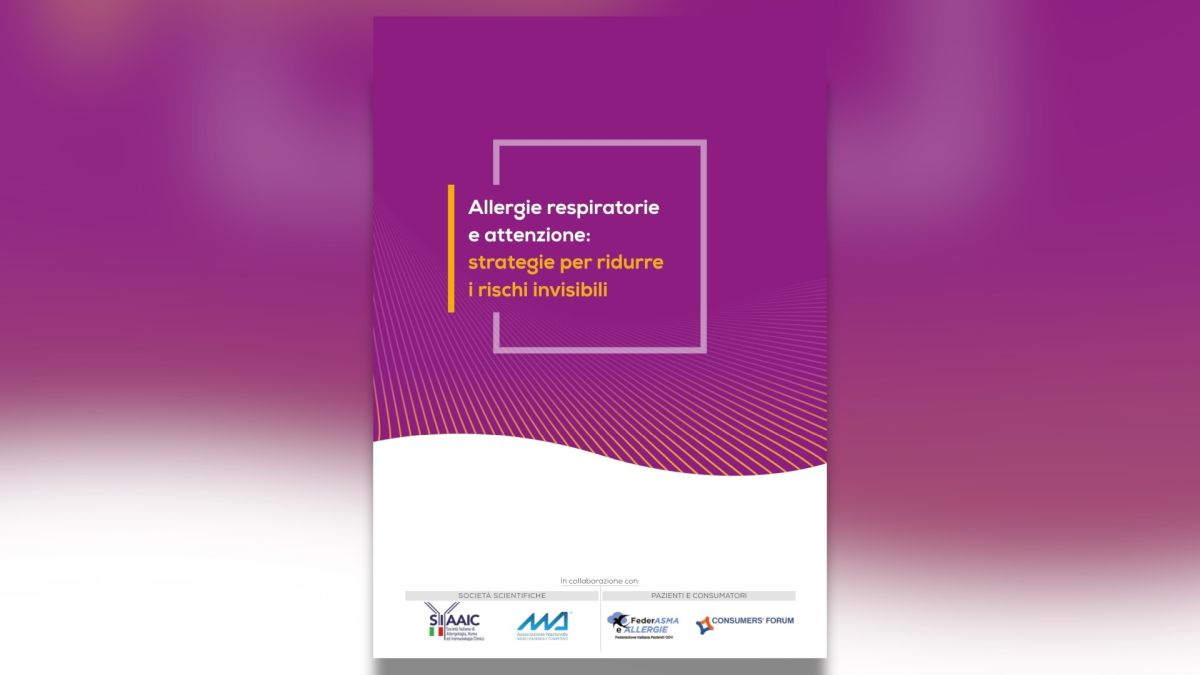
ROMA (ITALPRESS) – On the occasion of World Health and Occupational Safety Day, respiratory allergies emerge as an increasingly important issue not only in clinical terms, but also in relation to safety and performance in professional contexts. Tiredness, difficulty of concentration, sleep disorders are only some of the frequently associated manifestations of this condition, which in Italy affects about 20% of the population – more than 12 million people – and which continues to be underestimated both on the diagnostic and therapeutic level. These are high-prevalence chronic pathologies, progressively increasing, with a documented impact on the quality of life, on daily functionality and cognitive performance, from work to study and all those activities that require attention and clarity. Globally, it is estimated that around 600 million people are involved, while in Europe the total cost, between health and economic impact, reaches 30-50 billion euros per year. On the occasion of the event promoted by Consumers’ Forum, with the patronage of INPS, Italian Association Environment and Security, Federfarma and Fenagifar, the document “Allergie Respiratorie e Attention: strategies to reduce the invisible risks” was presented thanks to the collaboration between Società Italiana di Allergologia, Asma e Immunologia Clinica (SIAAIC), Associazione Nazionale Medici del Lavoro e Competenti (ANMA), FederAsma An awareness-raising initiative born from an idea of Opella Healthcare Italy, in line with the mission of promoting an approach to health increasingly accessible and aware, putting health in the hands of people. “With this project we want to help strengthen awareness on the link between health and safety management in living and working contexts – says Raka Sinha, General Manager Opella Italy – Our ambition is to support people in being increasingly protagonists of their health choices, promoting an informed and responsible approach, in line with our Health mission. In your hands”. Respiratory allergies are still underdiagnostic and frequently handled in an unsuitable way: only a limited proportion of patients access a diagnostic path, while about 50% does not take any therapy or use it in a discontinuous way. “ Respiratory allergies are a high-prevalence clinical condition and still widely underestimated or managed without real awareness, with a significant impact on the quality of life, private and professional – observes Mario Di Gioacchino, Past President SIAAIC – In recent years, however, research has led to the development of the most advanced therapeutic options, such as the latest generation antihistamines, characterized by a sustained pharmacological activity, with reduced This allows you to effectively control symptoms by limiting clinically relevant side effects, such as sedation, and preserving levels of vigilance. In this scenario, it becomes essential to promote an approach based on a correct diagnosis supported by up-to-date methods and a therapeutic choice that combines not only with the symptom but which takes into account the patient in its globality.” The increase in the cases observed in recent years is attributable to environmental determinants such as climate change and air pollution, which affect both the duration and intensity of the pollinic season and the loss of biodiversity that favors the alertnessica.The lengthening of exposure periods – up to more than three additional weeks – and the greater allergenity of pollen contribute to a wider and prolonged symptomatology, with a significant impact on the quality of life. In addition to the clinical dimension, the link between respiratory allergies and cognitive function emerges with increasing evidence. The data indicates that up to 61% of patients have sleep disorders, resulting in an impact on attention, reaction times and performance in everyday activities. “Many patients with respiratory allergies do not follow a proper diagnostic and therapeutic path, with significant relapses on sleep quality and concentration capacity – says Sandra Frateiacci, Vice President FederAsma and Allergie. It is important to consider that the reduction of vigilance can be determined both by pathology and by some treatments with sedative effects of which not everyone is always aware. Strengthening dialogue between patients and health professionals is essential to promote more aware therapeutic choices as well as making information about sedative effects of drugs more accessible. In this sense, we have launched an initiative to collect signatures that calls for the introduction of a pictogram on the packaging to clearly report any effects on the ability of attention and guidance.” A survey carried out by AIAS between March and April 2026 on a sample of 60 Italian companies from different sectors of high operational intensity directly representative of the risk – more than half of which of large dimensions – shows how the relationship between respiratory allergies and working context is still little recognized and rarely translated into structured actions. The results are a paradox: the awareness of risk exists, but has not yet been transformed into concrete measures of prevention. Only 18% of companies included risk assessment (DVR), while 32% provided for systematic health surveillance. Even more limited is the attention to the effects of treatments: hardly 2% has formalised procedures for the management of sedative drugs, and about 80% of companies have not activated any awareness-raising initiative on the subject. “We wanted to light the spotlight on a topic that concerns not only health, but also safety at work – says Furio Truzzi, President Consumers’ Forum – The goal is to strengthen the attention on the correct use of drugs and the impact of respiratory allergies, especially in professional contexts that require high levels of attention such as the guidance of means and the management of particularly risky implants, work at altitude. In this context, the document presented today also proposes concrete tools of information for the citizen, such as the introduction of pictograms on the packaging of drugs that signal any effects on vigilance, to promote more aware choices and contribute to the reduction of risks. We now trust in non-formal memberships of enterprises and institutions to our work and in particular to a renewed attention from Parliament and the Government to an improvement in the legislative and regulatory framework.”.
– Photo Consumers’ Forum –
(ITALPRESS).
