
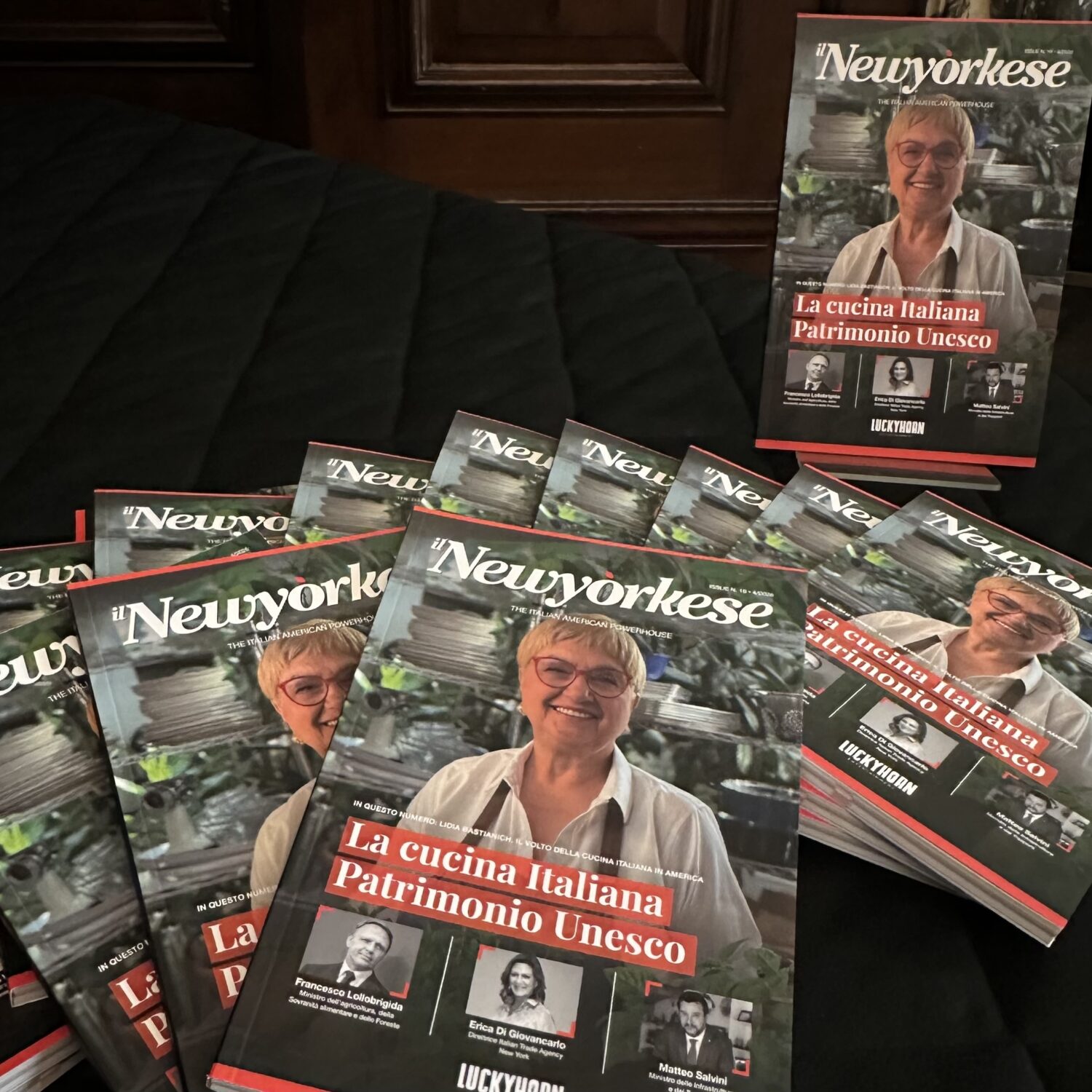
The Italian Institute of Culture of New York held, yesterday, the presentation of the new issue of the New York City dedicated to the Italian cuisine, a recognition that celebrates the gastronomic excellence of the country and its cultural value in the world. To open the event was the reference to the role of Italian institutions in the world. “Our task is to work together with the consulates and communities to suggest to the Italian government what priorities are,” he said, underlining that UNESCO’s recognition represents “the victory of our chefs”, not only in New York but in all the United States. A passage that insisted on the contemporary value of Italian cuisine, described as “a kitchen that continues to reinvent itself every day”, far from the crystallized image of a immobile tradition.
The New York publishing project was presented as an example of this evolution. Born two years ago, it has already reached sixteen numbers and a growing audience. “We are an editorial project that is growing rapidly,” said CEO and Founder Davide Ippolito. Today the network reaches about five million readers a month, with editions expanding in different American cities and also abroad, up to Japan. The launch of the paper version of Good Morning Italy will be presented on 14 May.
Screenshot
The new issue of the New York “La Cucina Italiana Patrimonio Unesco” was born from the joint work of institutions and operators of the sector. Among the contributions mentioned, that of the Minister of Agriculture, Food Sovereignty and Forests Francesco Lollobrigida and the support of the Italian Trade Agency. “We have organized many events to promote Italian cuisine in its authenticity,” said Erica Di Giovancarlo, ICE Director of New York; citing initiatives in New York, Chicago and on the occasion of the Summer Fancy Food Show. “Finally this excellence has been recognized”.
The first intervention was, that of Marta Galfetti, author of the column “The World Tour in New York”, which tells the neighborhoods of the city through the communities that live there. «New York is a city where you can travel without taking a plane», he said. The idea was born during the pandemic, when the movements were limited: «I remember one morning in Chinatown where I thought: I am traveling». From there a project was born that puts people in the center. “The most beautiful stories are those where you meet someone willing to tell you about their world,” he added, recalling the encounter with an old Greek in Astoria who led it in the neighborhood.
The UNESCO award has also been read in economic and logistics. Stefano D’Angelo, managing director of an active group in logistics, has emphasized the criticalities of the supply chain. “The challenge is to maintain authenticity and quality throughout the course,” he explained. In a competitive market like the American one, “they count efficiency and costs, but above all continuity and reliability”. If a product does not arrive in time, “it loses space on the shelves”. For this reason, he added, “Italian companies must be structured in the United States, with a presence on both sides of the ocean”.
A different point of view came from Ernest Lepore, restaurateur and historical figure of Little Italy. His intervention reconstructed the experience of Italian emigration through food. “Little Italy has always been a symbol of Italian identity,” he said. “Through food we have built a community.” Lepore insisted on the cultural value of the kitchen: “It is not only a matter of recipes, but of history and identity”.
Screenshot
Chef Fabrizio Facchini retraced the work behind the UNESCO candidacy. “We organized events, dinners and initiatives with chefs and institutions,” he explained. Among these, a dinner in Paris dedicated to inclusion, with the participation of people with disabilities. “It was an important moment, not only gastronomic”. Facchini then stressed that today it is easier to maintain authenticity thanks to the greater availability of Italian products. “There are two Italian and Italian cuisines. They are different, but both tell an Italian story”.
A more personal story was chef Tony Grande, who arrived in the United States in the 1970s. “When I arrived there were no Italian ingredients,” he recalled. The dishes were adapted with what was found, often distorting the original recipes. “Today is different”, he said, recognizing the progress made thanks to the work of chefs and importers. “There is more awareness”.
The size of emigration has also returned to the intervention of Mario Terrana, an entrepreneur who arrived in the United States as a young man. “At first it was difficult, especially for the language,” he said. «I was afraid to speak». With time he built his career and today he looks at UNESCO recognition as a strengthening of the value of Made in Italy.
To close the meeting was the project Piazza Italia, presented by Marco Giovanelli. Born during the pandemic, it is a space for Italian companies in New York. “The idea was to create a community,” he explained. Not only offices and showrooms, but also events and meeting opportunities. The project is now expanding and will move to Times Square. “We want to be a reference point for those arriving in New York.”.
L’articolo The Italian cuisine World Heritage protagonist of the new issue of New York proviene da IlNewyorkese.
