
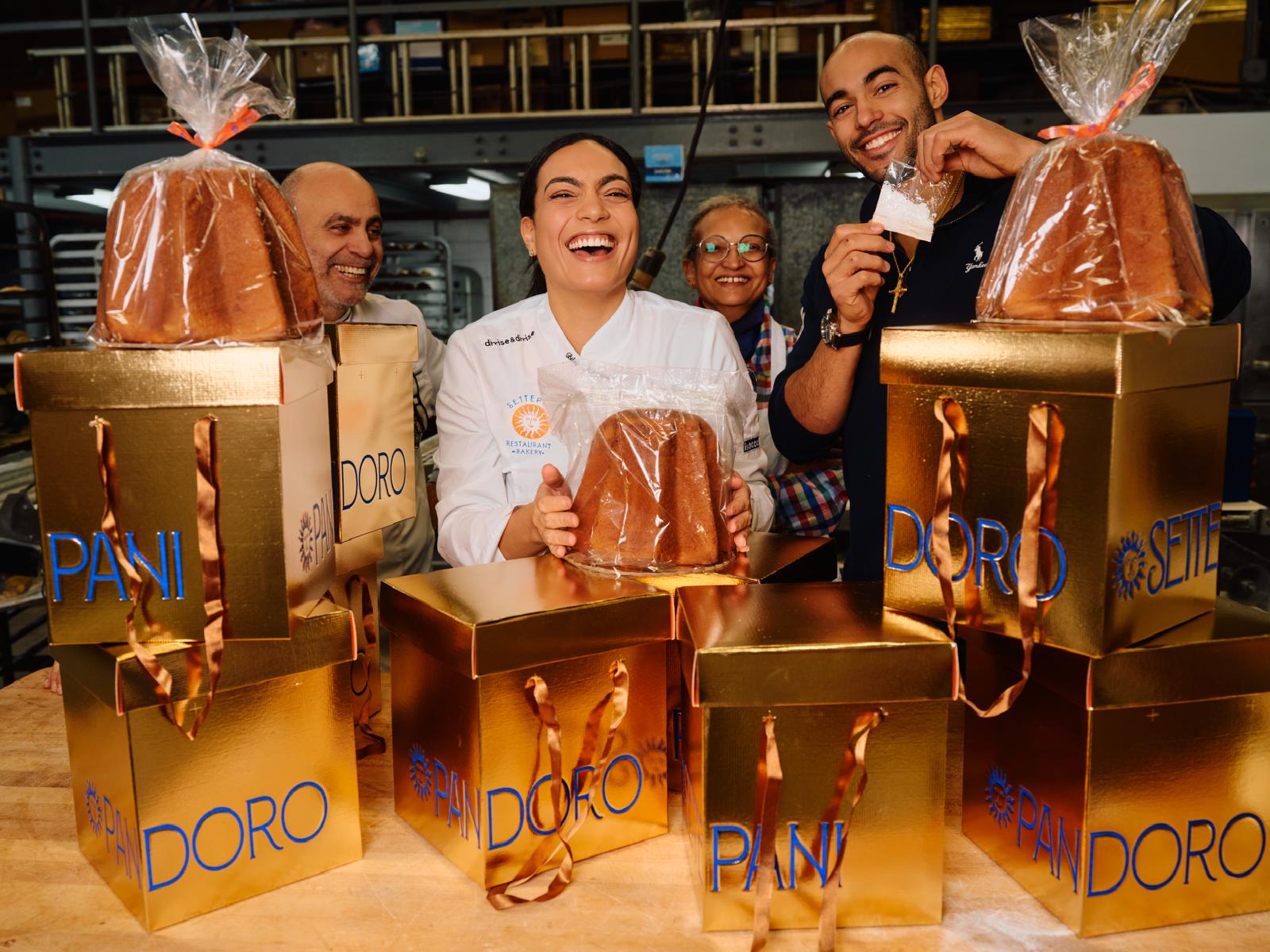
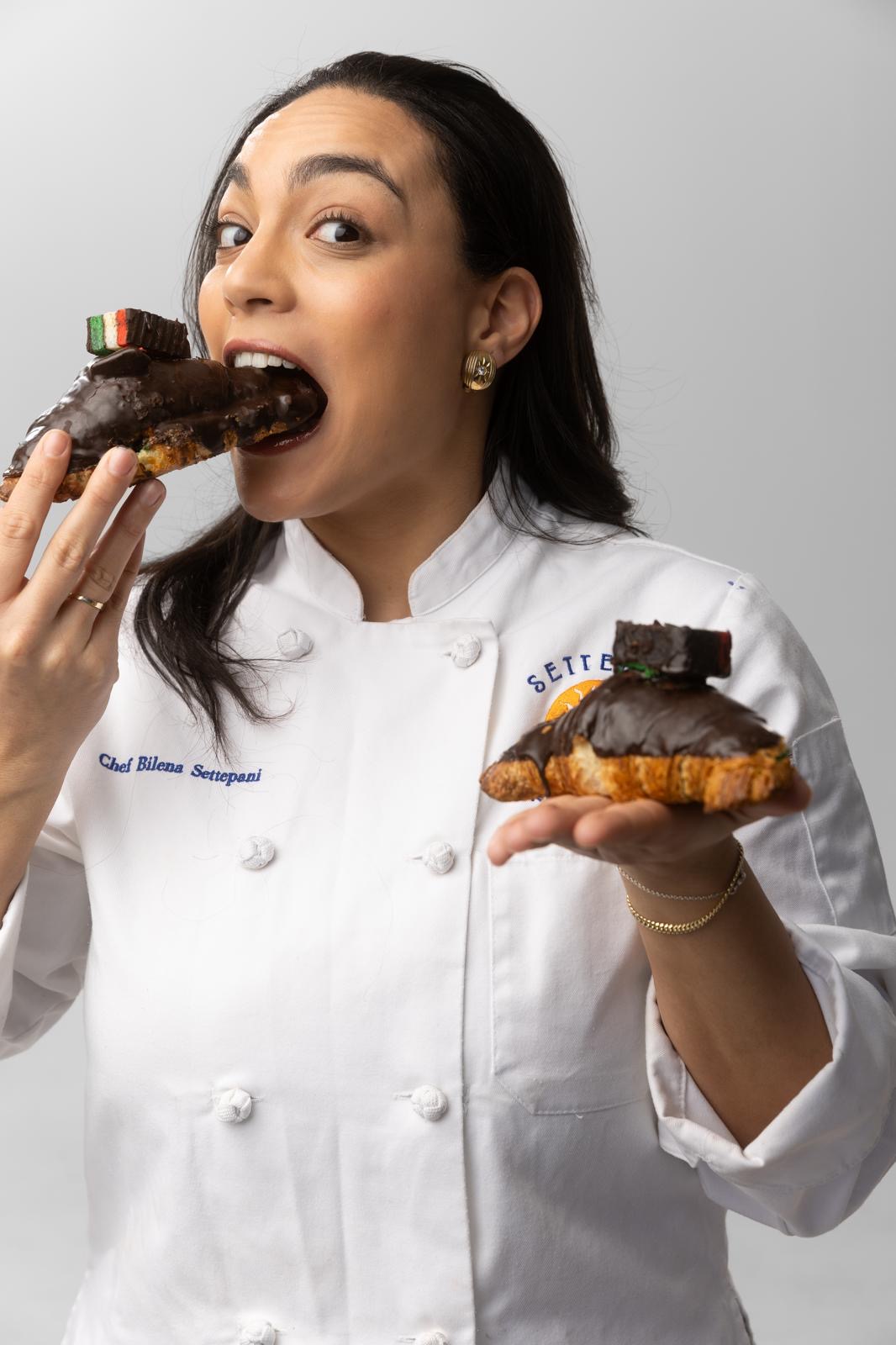
Bilena Settepani is an Italian-American pastry chef, content creator, and entrepreneur. She works in her family business, Settepani, a historic bakery and restaurant rooted between Brooklyn and Harlem, where she grew up. Today she oversees creative dessert development as well as the brand’s marketing and e-commerce. In recent years she has gained visibility on social media for viral creations—like making panettone year-round and the “rainbow cookie croissant”—that blend Italian-American tradition with playful experimentation.
You didn’t originally plan to enter the family business. Looking back, was that shift a conscious decision—or something that became inevitable over time?
As first-generation children of immigrants, my parents always wanted more for us. They know how hard the hospitality industry is and strongly encourage education. While also making so many sacrifices for my brother Seyoum, and I to get a strong education.They didn’t want me to join the business; they wanted us to go to college, explore other paths, maybe become a doctor or a lawyer.
So I tried to make them happy. I graduated in communications and started working in fashion. I enjoyed it, but I always found myself going back to the bakery after work. There was something about working with my family that kept pulling me in. Eventually I went to culinary school, graduated, and started working full time at the family business.
My grandmother used to say, “When are you going to stop what you’re doing and go help your dad? He needs you.” She was very adamant. While my decision isn’t only about honoring her memory, it is about love. I truly love what we do and working with my family.
Food brings people together. It lets us connect with our culture and keep traditions alive, even in a place like New York—which is home, but far from where my family comes from. That connection is incredibly important to me.
My parents immigrated to New York as teenagers and my dad settled in Williamsburg, Brooklyn, while my mom ended up in Queens. My father was a student at NYU when he bought a small bakery in the village on LaGuardia Pl and that was the beginning of the Settepani story – although it was called Bruno Bakery from the original owners, that was the beginning. Over the years the business grew from that original bakery to multiple Settepani locations, including a Sicilian restaurant on 20th Street that was called Bondi, we also had two coffee shops in Westchester in the 90’s early 2000’s. Today we have Settepani a restaurant in Harlem that’s been open more than 26 years, our Bakery in Williamsburg location is celebrating 35 years soon, and we run a few caffe’s one in Dumbo Brooklyn, and this year we opened two new outposts in the Studio Museum and Central Park.
I have been surrounded by food my whole life, my parents, grandparents, and much of my family were and are involved.
You grew up inside Settepani, but today you’re actively reshaping it. How do you balance preserving a legacy with the need to evolve it?
I did grow up inside Settepani. Some of my earliest memories are doing homework at the bakery table or being surrounded by the people who worked with my parents and cared for me. I took my first steps there; my first words were probably food-related.
Your work blends Italian tradition with influences that go far beyond it. Are you trying to expand what “Italian” means—or to challenge it altogether?
I’m not trying to change or challenge what “Italian” means. My goal is to share Italian culture, recipes, and traditions, and to bring people together through them. Recently I started hosting monthly events at our restaurant to build community—bringing together newly arrived Italians, longtime friends, and anyone who loves Italian food. It’s a way to keep traditions alive here in New York without having to travel to Italy. Food is a powerful connector; it brings back memories, emotions, and a sense of home.
Many dishes appear across cultures in various forms—a cotoletta, say, shows up in different cuisines under different names—but they all connect people to memory. For me, things like pastina when you’re sick, caponata after school, or traditional Sicilian cookies like buccellati are deeply tied to childhood and family traditions. Even when we innovate, like making artisanal panettone year-round, a practice my father helped pioneer in the U.S.—we do it to keep the storytelling alive. New flavors and formats aren’t about abandoning tradition; they’re about making it relatable to our community today.
Growing up between different cultures in New York, do you feel more connected to an Italian identity, a New York mindset, or something entirely your own?
I think Italians often grow more prideful of their identity when they’re away from Italy. Growing up in a family nostalgic for home from multiple cultures, I was constantly surrounded by that pride of where we come from. Food is the quickest way to reconnect when you can’t get on a plane, so we keep traditions alive year-round, sometimes with modern twists, but always rooted in authenticity. I’d say I’m a mix: Italian and New Yorker, and also something uniquely my own shaped by both worlds.
Italian food in the U.S. is often tied to nostalgia. Your approach feels more forward-looking, do you think that perception is finally changing?
Yes. Nostalgia will always be central, and beautiful, because it ties food to family and memory. But there’s growing curiosity now: people want to learn, try new interpretations, and understand the stories behind dishes. The future of Italian cuisine here will be that balance, honoring tradition while allowing room for evolution. It’s not replacing the past; it’s building on it for new generations.
You’re not just creating products, but also shaping the brand and its narrative. How intentional are you about building a clear point of view behind everything you do?
I’m increasingly aware that I’m building a brand. At first I focused simply on preserving family traditions; now I see how important it is to have and communicate a clear point of view. For me, preserving traditions and explaining their meaning, why dishes are made, why they belong to certain holidays, how they connect to culture, is essential. In a world full of negativity, bringing people together through food to create joy and connection feels vital, especially in a city like New York.
If you had to define what you represent today—not just as a pastry chef, but as a voice within a new generation—what would you say?
It’s hard to define myself in one box, I see myself first as a baker. Everyone has a voice; mine is one way of keeping traditions and stories alive through something sweet. I hope to represent a generation that values tradition, community, and collaboration, people who believe that we’re stronger together, and support each other instead of competing against each other. I’m grateful for the trust people place in me, when they eat my food, hire us for events, or listen to our story. If anything, I aim to use that trust to build connections and keep our cultural stories alive.