
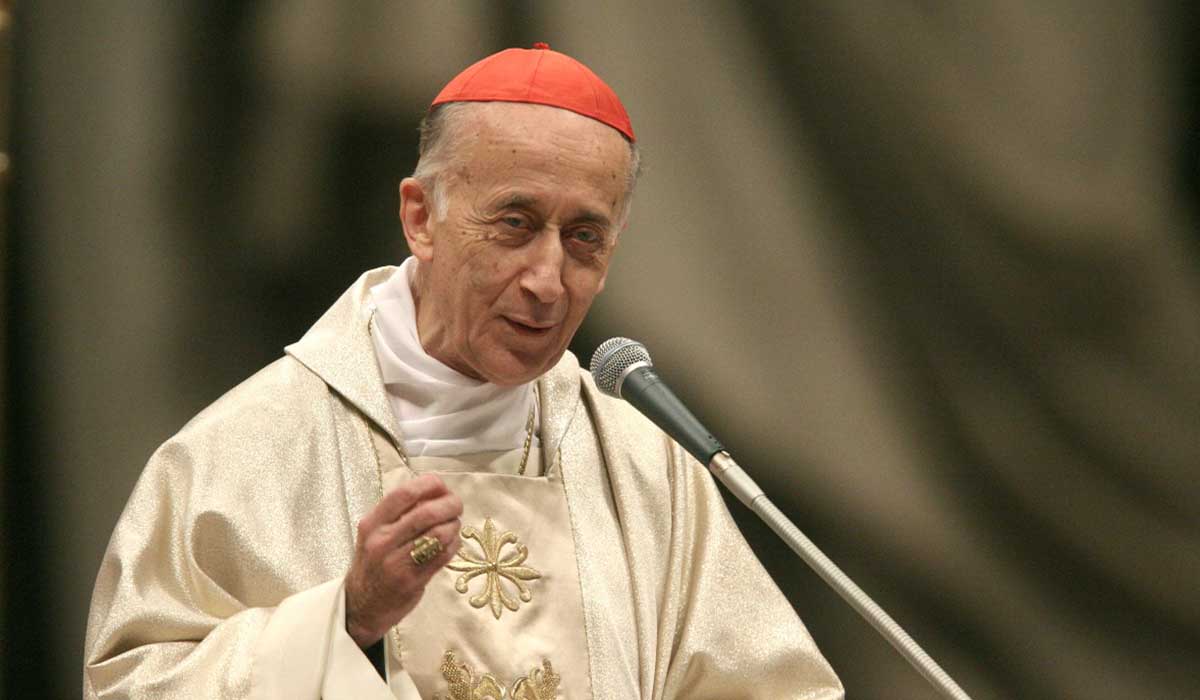
Cardinal Camillo Ruini, one of the most influential figures in modern Italian Catholicism, has died at the age of 95.
He passed away at his Rome residence after a gradual decline in health in recent weeks. The announcement was made by Cardinal Vicar Baldassare Reina and the Diocese of Rome, which expressed deep gratitude for a pastoral leadership that left a lasting mark on both the Church and Italian society.
Throughout his long career, Ruini consistently argued that faith could not be confined to the private sphere. He believed Christianity possessed an essential public role, capable of defending human dignity and shaping cultural and political life.
Born in Sassuolo and formed ecclesiastically in Reggio Emilia, Ruini became one of the most powerful and influential churchmen in Italy during the transition from the twentieth to the twenty-first century. As President of the Italian Bishops’ Conference (CEI) for sixteen years and simultaneously Vicar General of Rome, he guided Italian Catholicism through the political vacuum left by the collapse of the Christian Democratic Party.
Rather than aligning the Church with a single political force, Ruini launched an ambitious intellectual initiative known as the “Cultural Project.” Developed in the mid-1990s, the project sought to counter growing secularization by promoting a dialogue between faith and reason and by reaffirming the centrality of Christian anthropology in public life.
This vision gave rise to what became known as “Ruinism,” a strategy centered on strong public engagement and the defense of what the Church considered non-negotiable values, including the protection of life, the traditional family, and educational freedom. The movement reached its peak during the 2005 referendum on assisted reproduction legislation, when Ruini successfully encouraged abstention, demonstrating the Church’s ability to influence national political outcomes.
His authority was reinforced by exceptionally close relationships with two popes. John Paul II regarded him as a trusted ally capable of implementing the vision of the New Evangelization in Italy and elevated him to the rank of cardinal. Under Benedict XVI, the partnership became even stronger, grounded in a shared concern about moral relativism and a common belief in the cultural mission of Christianity.
His relationship with Pope Francis was more complex. Francis’ pastoral emphasis on social inclusion and the peripheries represented a departure from the culture-war approach associated with Ruini’s era. While remaining publicly loyal to the pontiff, Ruini occasionally acknowledged his difficulties with some aspects of the new direction.
With his death, a defining chapter in the history of Italian Catholicism comes to an end. Few religious leaders have exercised such profound influence over Italy’s cultural and political landscape in recent decades.
News Source: 9Clonne