MILAN (ITALPRESS) – The sector of urban and special waste management in Italy is at a crossroads: on the one hand the performance of the circular economy among the best in Europe, on the other a fragmentation management that brake investments and industrial growth. It has emerged from the conference “Aggregation and circular economy: the new challenges of waste and urban hygiene”, organized in Milan by the Italian Hydrotechnical Association in collaboration with Gruppo CAP and Network Services, and which has brought together institutional representatives, regulators, companies and research centers of the environmental sector.
The data presented confirm the Italian primacy: the circular use rate of materials reached 21.6% in 2024 (from 20.8% in 2023), well above the EU average of 12.2% and before France (17.8%), Germany (14.8%) and Spain (7.4%). Italy also stands out for the productivity of resources – 4.7 euros of GDP per kg of material consumed, against an EU average of 3 – and for a production of waste per capita lower (508 kg/inhabitant) than Germany and France. The national recycling rate stood at 52.3%, higher than the European average (48.1%), while remaining behind Germany (66.9%).
However, the Italian investments in circular economy remain critical: the Italian investments in circular economy remain contained, equal to 10.2 billion euros (0.5% of GDP) in 2023, compared with 39.5 billion in Germany and 22.5 million in France.
On the economic level, the sector generates a turnover of approximately 19 billion euros, equal to 0.9% of GDP, with 122 thousand employees and investments increased to 2 billion in 2024. The picture is however marked by a strong concentration of revenues: the companies “top”, only 5% of the total, realize 48% of the turnover of the sector and tow the large part of the investments.
The horizontal and vertical fragmentation remains the central knot. Territorial governance appears uneven, with the implementation of the Optimal Territorial Ambitis (ATO) still incomplete in several regions: alongside fully operational scope governing bodies, municipal management situations remain in transitional arrangements, which according to analysts represent the main obstacle to industrial scale models.
The data on investments, mergers and acquisitions tell a strong sector. The aggregate investments have gone from 754 million euros in 2017 to more than 1,46 billion in 2024, with an average annual growth (CAGR) of 10%. At the same time there are 270 investment operations in plants and 271 acquisitions, disposals and joint ventures in the last period analysed, with a fifth of the sample companies responsible for 80% of M&A operations.
On the normative level, the interventions have reconstructed the multi-level system that regulates the sector – European Union, State, Regions, local authorities and ARERA – stressing how to keep these levels together is a challenge of governance. It has been recalled the overcoming, since 2020, of the old assimilation of special waste to the urban ones decided by municipal regulations, replaced by a uniform definition by law, and the increasing role of ARERA in tariff regulation, with the new MTR-3 method and the introduction of TICSER from 2028.
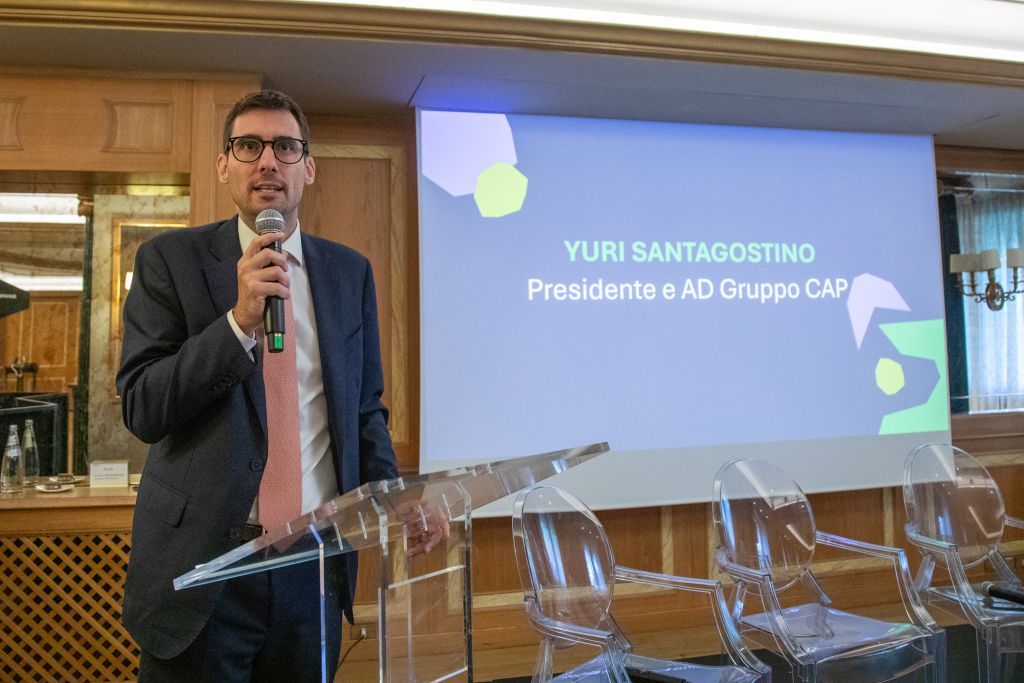
“The urban hygiene services and the world of waste in recent years have experienced great transformations, many of them are still in progress. The two challenges we see as the CAP Group concern the need to aggregate towards managers who are real industrial managers, able to make more investments and create greater efficiency in the service – said Yuri Santagostino, president and CEO of the CAP Group -. A transformation that concerns not only the collection and treatment of waste, but the entire cycle of resources, with the aim of reducing waste and enhancing more and more what we consider today waste”.
“Group CAP has entered the world of waste for years now:first of all, investing on purification plants and in plants where it is possible to dispose of waste and not only our water service products. We decided to intervene also in the collection, there was too much disaggregation in the service. Our company is able to generate value for the territory”, said Michele Falcone, CEO of the CAP Group.
At the centre of the debate also the role of institutions, called to govern this transition through rules, programming and tools capable of accompanying innovation in the environmental sector. “Region Lombardy has made the choice not to define from the top of the territorially defined areas, but is dialoguing with the territories and with all the actors of the supply chain to verify the possibility to allow, incentivize and make normatively adequate any voluntary aggregations that go in this direction”, explained Filippo Dadone, – vicar director of DG Environment and Climate of the Lombardy Region.
– Press Office photos Gruppo CAP –
(ITALPRESS).
