
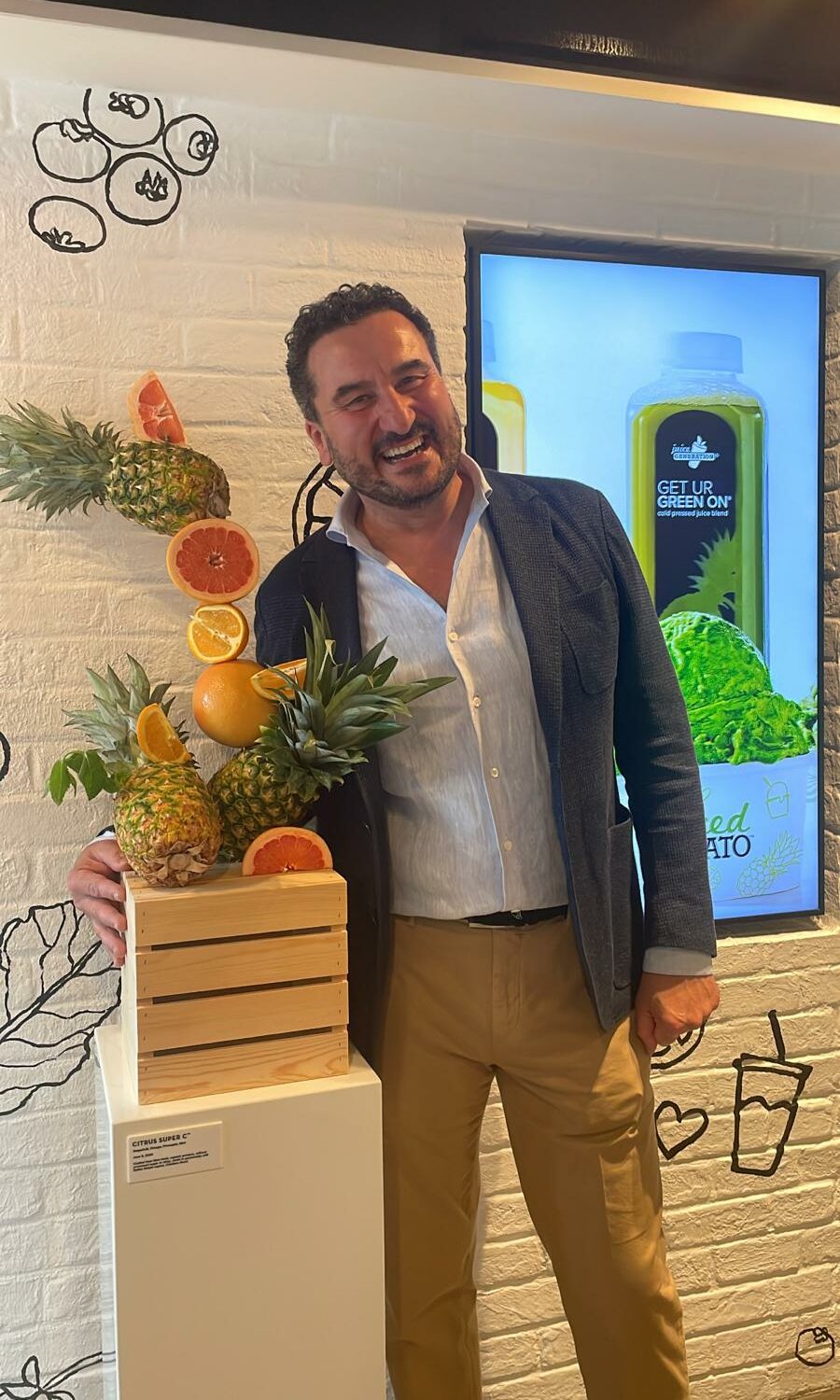
My story is a bit like a movie: a twist that brought me to New York. But in the end, the American dream is more than real. I changed scripts, but the passion for quality and for telling stories-now through food-is the same as it was when I was working in film. I didn’t just want to open a restaurant. I wanted to create a corner of Italy in New York, a place where anyone, Italian or American, could have an authentic experience
Born in Salerno, Cristiano Rossi left a career in film, where he collaborated with internationally acclaimed directors on Hollywood productions such as Gangs of New York and Italian Job, to devote himself to gastronomy after moving to the United States. In New York, he opened Santa Chiara, an ice cream shop that immediately won over the public thanks to the quality of its artisanal ice cream. In 2024, he opened Terrone, a restaurant and pizzeria in the heart of Long Island City, where he offers the “Italian Farm to American Table” philosophy. With his innovative approach, he created a place that offers not just food, but an experience that celebrates Italian culture and tradition.
From the big movie screens to the artisanal ice cream shop in New York. Tell us how this change came about and what was the path that led you here?
I am originally from Salerno, and before all this I worked in film. I was a film operator and I was lucky enough to work with great directors, especially in American productions. In 2007 I was in the United States for a film when I met my wife, who is American. I tried to convince her to move to Italy, and in fact she tried, but between work difficulties and life in Salerno, it was not easy for her. So in the end I moved myself. In 2020 I settled permanently in the United States, but I was faced with a big question: where to start again? Filmmaking, for me, was now a closed chapter. It was with my wife that we realized something surprising: New York lacked real artisanal ice cream. There was no shortage of ice cream shops, of course, but many were using industrial preparations. From there came the idea of bringing authentic ice cream to the Big Apple. I decided to train seriously and went back to Italy to take a course with Giacomo Schiavon, one of the greatest gelato masters. Then I opened my first gelateria, Santa Chiara, and success came immediately. I had the opportunity to collaborate with prestigious realities such as QC Terme, La Maison du Chocolat and Juice Generation-with the latter I created Juice gelato, specially made from their centrifuges and sold directly in their stores. Then I wanted to go further-I started experimenting with alcoholic and gourmet ice creams. That was the turning point. From there, the business exploded, including events, catering and new collaborations all the time.
Then came the idea of opening your restaurant-pizzeria Terrone, whose philosophy is based on the concept of “Italian Farm to American Table.” What does it mean to you?
That’s right. Right in front of the ice cream parlor, a large space had opened up, and the owner asked me if I wanted to do something with it. That area of town lacked a real authentic pizzeria, so I decided to open it myself. I put together an extraordinary team: one of the best pizza makers, a talented chef, all the Italian staff, and of course products imported directly from Italy. Thus, in March 2024, Terrone was born, a pizzeria and restaurant that follows the Italian Farm to American Table philosophy. The concept of Italian Farm to American Table is at the heart of Terrone’s philosophy. It is not just about bringing Italian cuisine to New York, but doing so in the most authentic way possible, starting with the quality and origin of the ingredients. Every product used in the restaurant, from pizza flour to tomatoes, from extra virgin olive oil to cured meats and cheeses, is carefully selected and imported directly from Italy. The idea is to recreate the Italian dining experience without compromise, respecting traditions and raw materials just as a restaurant in Italy would. At the same time, Italian Farm to American Table also means adapting to the territory, enhancing local excellence when possible, but always keeping the soul of Italian cuisine intact. It is a bridge between two worlds, a way to let even those who have never been there taste the most authentic Italy.
How do you think Terrone differs from other Italian restaurants and pizzerias in New York?
I think I was able to convey the authentic atmosphere of Italy, and not just through the dishes. It is the staff, the ingredients, the service, every detail is designed to give an all-around Italian experience. So many reviews say that at Terrone’s it really feels like Italy, and that was exactly my goal. It is not a matter of competing with others, but of offering something unique: I wanted that, for the time of a lunch or dinner, the customer feels like he is in Italy, even if he has never been there. The greatest satisfaction? Having an Italian clientele. In the evening you can hear almost only Italian being spoken, it’s a wonderful feeling. Then, inside Terrone, we created a workshop that has two souls. On the one hand, artisanal production: we do everything ourselves, from bread to croissants, from fresh pasta to sweets. On the other, the sharing of knowledge: given the success of our cooking, we started to organize classes every Tuesday. Pasta, pizza, mozzarella, ice cream-every class sells out. And in September, we want to bring a piece of Italy outside the restaurant as well: we will organize a grape harvest in the piazza, with vats of grapes and people pressing barefoot, just like they used to do in the old days. It will be a unique experience.
You have created not only a place where food is the protagonist, but also an immersive experience that goes beyond Italian cuisine…
That’s right, Terrone and Santa Chiara are not just restaurants, but spaces where Italy is experienced in the round. I wanted it to be a reference point not only for those who love our cuisine, but also for those who want to breathe Italian culture in all its nuances.
Every Wednesday afternoon, for example, we organize classes for children: I teach them the Italian language, between a hot chocolate in winter and an ice cream in summer. It is a way to convey something more, besides taste, a connection with our tradition, with our history. I do it personally, because I have a degree in Literature and I believe very much in the value of teaching.
And then, in New York, all this is possible. I once said in an interview that the American dream really exists. I wrote a simple email to Juice Generation, proposing an idea, and after two days the owner called me directly to meet with me. Here, if you have a good idea and you really believe in it, you find your way. And this city teaches you that there are no dreams too big.
In your journey you have definitely faced challenges, but also great satisfaction. What have been the greatest difficulties and what gives you the most pride today?
There was no shortage of difficulties, and two in particular challenged me. The first was adapting to American tastes. I remember well when I started serving coffee: it was too intense for many customers, who were used to a lighter taste. But I stuck it out, thanks also to the support of the Italian community, and today my coffee is appreciated precisely for its authenticity.
The second big challenge was bureaucracy. It may seem incredible, but New York’s is even more complicated than Italy’s. To open a place you have to go through a maze of agencies, architects, permits and offices, a path that requires patience and determination.
But every effort is rewarded by the satisfaction of seeing my work come to life. It all comes from passion, quality and the desire to share our culture in an authentic way. The great thing is that I never stop: the future is full of ideas. I’m thinking about new expansions, new courses, maybe even another venue. But always staying true to the Italian soul of the project. Because more than a restaurant, Terrone is a piece of Italy in New York.
Your restaurant is not located in Manhattan, but in Long Island City, overlooking the East River. Why this choice?
First of all, because the views are spectacular. Long Island City offers a breathtaking Manhattan skyline, but without the tourist hustle and bustle. It is a more authentic space where you can really stop and enjoy the experience without the hustle and bustle of the city. Many Italians and Italian tourists focus on Manhattan, as if it were the only place to seek authenticity. Instead, I think it is important to rediscover other parts of New York City, those less traveled by the tourist routes. Often, it is in these less taken-for-granted corners that the most authentic realities can be found, restaurants and venues that put quality, research and passion before strategic location or marketing. I speak from my own experience, of course, but I am convinced that true quality is often found in unexpected places. There are realities outside Manhattan that offer more attention to detail than many of the more famous and advertised venues. And then there is an aspect that is particularly close to my heart: many Italian-Americans or people who have been away from Italy for years end up losing touch with real ingredients, with quality and tradition. Going to the same places over and over again, the well-known ones, often means settling for Italian-sounding rather than authentic cuisine. I wanted to create a space where anyone, Italian or American, could have a truly genuine experience, rediscovering the flavors and atmosphere of real Italy, and this, ultimately represents what I expected from my American dream.
The article Cristiano Rossi, from cinema to artisanal ice cream: a journey of passion and innovation comes from TheNewyorkese.
