
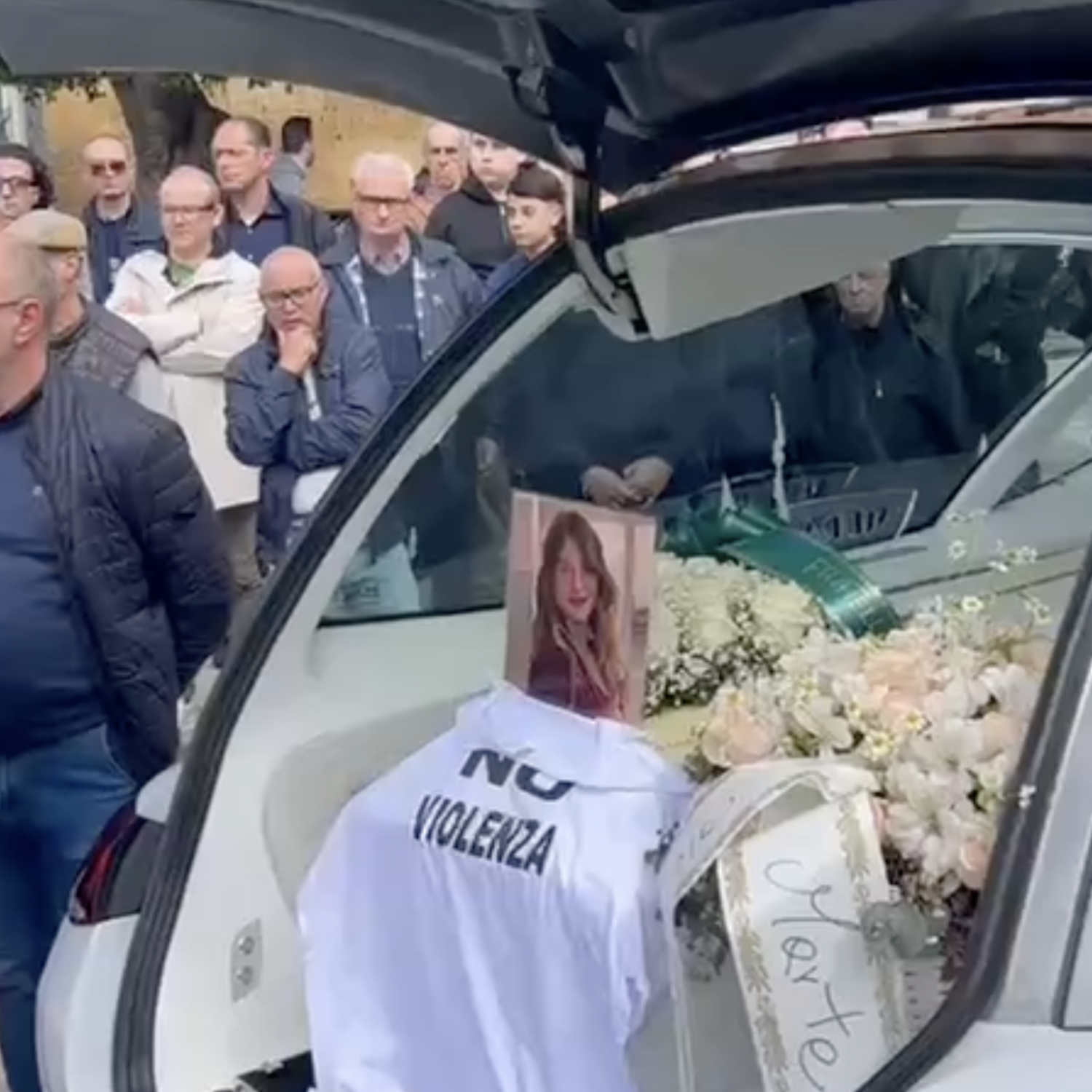
Daughters of all of us. This the cry, this the slogan, this the writing that from the Misilmeri Church ended up in the Palermo stadium, on the pink jerseys of the players.
Sara Campanella was barbarically murdered on the street in Messina with a sequence of stab wounds to her neck that left her with no chance. Stefano Argentino, this was the name of her killer, a 27-year-old university colleague.
He was complaining, so acquaintances say, because Sara lately had not been smiling at him as she used to. An unfortunately exemplary stalker story, where reality (little), sick fantasy (a lot) blur to an unacceptable denouement.
Sara, beautiful, sunny, vital, a future there at hand, returned yesterday to the other side of Sicily, the province of Palermo where she was originally from, but in a white coffin. So much emotion, so much anger, a strong reaction even from the institutions.
Palermo Mayor Lagalla has proclaimed mourning for all municipalities in the city’s metropolitan area. It is a wound of the whole society, not just the victim’s family members. A contentious but thought-provoking voice was raised at the funeral home.
It was said at the microphones of a national news station that today women’s massacres have taken the place of mafia massacres. This is not correct in terms of analysis, but the cry remains. Unfortunately, feminicides in Italy affect all territories. The one that has made even politics discuss, indeed that has broken into all national public discourse, that of Giulia Cecchettin, was committed in middle-class Veneto. In these hours in Rome, investigators are still trying to reconstruct exactly the death of Ilaria Sula. She too young, she too beautiful, she too a university student, she too killed by a man, by a young man, her ex Mark Samson. She too was stabbed.
Since the beginning of the year there are 11 feminicides, by other sources 17, but there is controversy about the data, who collects it, and how, and who disseminates it. And there is controversy over the categories and parameters of so-called gender-based violence.
But going further, without making statistical comparisons that in my opinion are misleading, what was, as mentioned above, called “the massacre of women” at news microphones, is indeed there. And it is increasingly a social and anthropological phenomenon that is difficult to curb.
In spite of media and even political efforts, in spite of harsher punishments and a constant general cultural willingness to discuss the issue, which cannot be denied in spite of sometimes deep ideological divisions. In my opinion the issue is not, or is not only more: the patriarchy that resists.
A few years ago, in 2009, I wrote a story (actually an analysis) of a real event for the collection “I Love You I Kill You” for Cairo publisher. The story was about a young girl killed with a pocket knife by a schoolmate. Killed during class break in a Milanese school. I’ll kill you because the man, in this case a young man (but young are also the murderers of the latest dramatic stories that we have dealt with today and that dominate the Italian media) no longer has a language to respond to the demands for freedom of the new women of the new society.
I love myself too much to be with anyone, Sara said, in a hymn, even an extreme one, to her freedom to self-determine her own destiny. This freedom must be responded to with a new language. Inside a new vision of relationships. And it will have to start with schools, where Italy lags behind the high European democracies.
The article Daughters of us all comes from TheNewyorker.
