
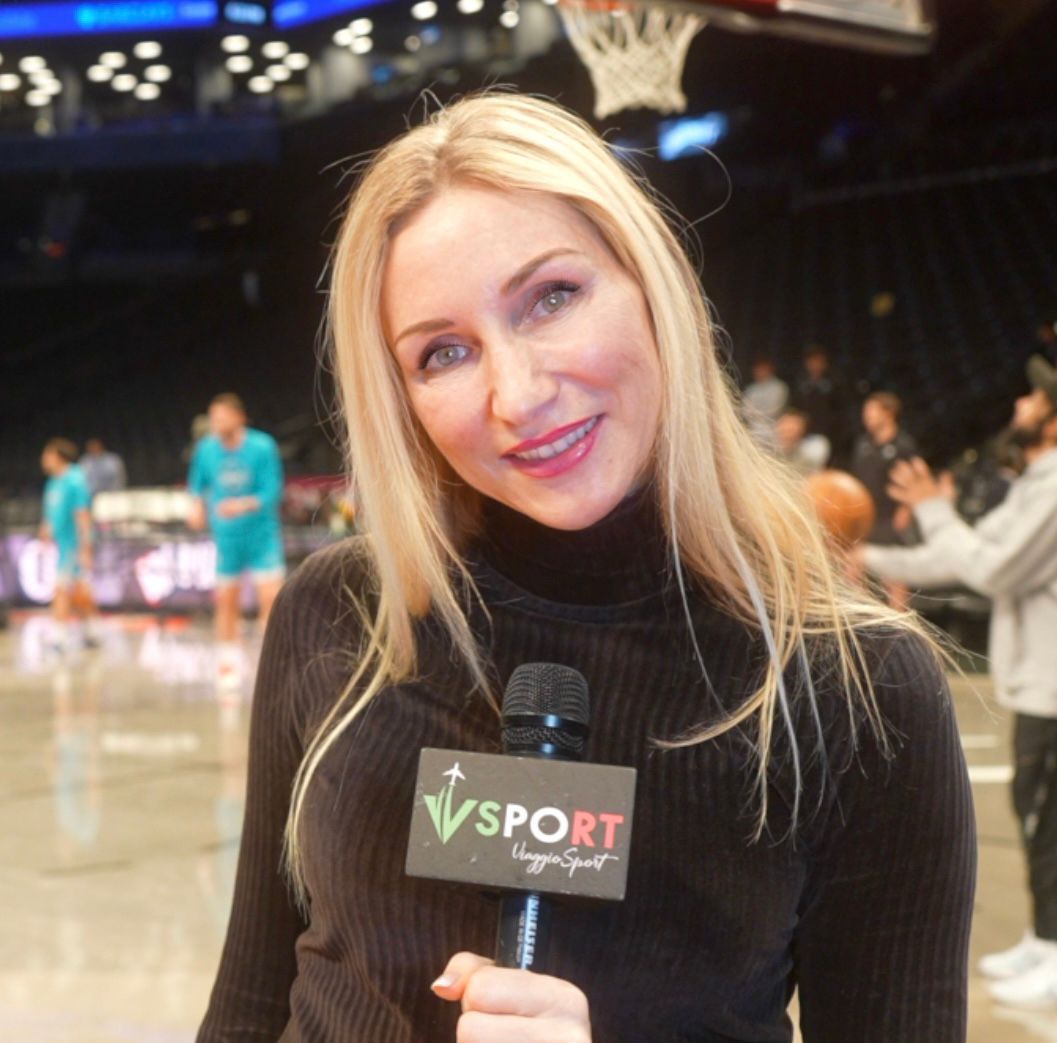
Valeria Rubino’s tone strikes immediately. She has that quick, parenthetical voice, as if every anecdote were a fork in the road, and every fork in the road worthwhile. The narrative of her professional trajectory is not linear, but more resembles a series of roads taken with curiosity, sometimes by chance, sometimes by stubbornness, that led her from Naples to the parquet floors of the NBA, passing through a master’s degree in Miami and an internship at NBC.
“I have always been an athlete,” she begins. “I used to swim with the national cross-country team, 25-kilometer races, 5-7 hours in the sea, lakes, rivers. Once me and the other girls on the national team got too close to some beautiful swans and got swan fleas! And we also competed in rivers, like the Guadalquivir, brown and murky. Crazy stuff.” And he says this with a smile, as if that effort was just another lane to what was to become.
She had also gone to Miami to swim with the university team, but then enrolled in a master’s program in broadcast journalism. Chosen almost by chance: she had also applied to other colleges, she says, after a thesis on the Amazon. But every morning on campus, she felt like she was in an episode of Beverly Hills, and that was enough.
Then he happens to be holding tickets given to him by a family friend, seats very close to the Miami Heat’s parquet. From there he saw Kobe Bryant play for the first time, and something clicked. “I find myself there, with Kobe Bryant in front of me. And from that moment I fell in love with basketball. With that noise there, the ‘crunching’ of shoes. I had seen games in Italy, sure, but it was another world there. Another show.” Interviews with Kobe were always in Italian. “The first time I interviewed him in the hallway – forbidden stuff, but I didn’t know that – as he was about to go home. And since then the tradition of our secret language had been born,” he says fondly.
The turning point comes at a shootaround. Someone from ESPN asks her if she would like to see how production works. “I said sure, and I found myself working for ESPN. No longer paying for tickets, but paid to be there.” Then TNT, Sunsports, and playoffs around the United States. Everything seemed to be going well.
“Then I left everything to come and work in New York, at Rai. As a producer.” He pauses for a moment. “But I don’t like it very much.” Yet, despite the difficulties, he continued. With L’Équipe TV, with LaPresse-where he was a news correspondent, but when he could squeeze in the NBA-then also with BBC, ESPN and Todo Deporte, always with basketball. “I like it because you have to sweat it, success you have to earn it, at least a little bit. It’s a cleaner world than fashion or entertainment, which I followed with Rai.”
To hear her talk about basketball, you understand that it is more than passion. It is a way of being in the world. And when you ask her what the hardest interview she’s had to get, she immediately leaves with a sharp memory. Joakim Noah, just eliminated from the playoffs with the Bulls. “At first he told me no. I had gone on purpose. I told him, ‘I understand the disappointment, but this was an important season for you.’ He put his hood over his head, then said, ‘Okay.’ And he agreed. All the French journalists around me kept quiet. They said, ‘Good, he didn’t want to talk to anyone.'”
The worst one? He smiles. “With Jimmy Butler. He was nervous, complaining about the team. I put the microphone on him, and he was like, ‘This microphone is too close!'” And the most exciting? “Every time I interviewed Kobe. There was a special bond. Italy, his childhood, the fundamentals he had learned from us. He always answered in Italian. He made people smile, every time.”
Valeria now lives in New York City. She has also lived in Miami, twice. “At one point I had decided to quit journalism, I was fed up with the media environment. I wanted to do real estate. I got my license in New York. But then … even there, same problems. Clients who wanted to meet you at midnight in hotel suites. And I thought, ‘No, I’ll go back to New York and start journalism again.'”
Speaking of the comparison between Italy and the United States, she is direct. “Here the players are more human. They go to the streets, stop with children, sign autographs. In Naples I knew soccer players who could only go to dinner on days when restaurants were closed, to avoid problems. Here they don’t. Even the fans are different. Yesterday at the game there were a lot of green Boston Celtics jerseys, and no one was insulting anyone.”
That’s when ViaggioSport, spelled all over – or VSport, to make it better understood by Americans – his most personal project, opens. “To many people it seems strange to combine travel and sports, but they are my two passions. Now I’m trying to make two separate profiles on Instagram, but that’s the way I am: I like travel and I love sports. I don’t live without sports.”
She explains that she does not care so much about the outcome of the games. “Except in the playoffs, sure. But I want to find out the message, the path, the advice for young people. Less numbers, more human side.”
And to young people who want to leave for America, what would you say? “Do a master’s degree here if you can. It is an extraordinary experience. Also, work with Americans: there is more opportunity to grow.” But above all, he adds, “stay true to your values. Don’t make compromises that shame you.”
And then there is Africa. The NBA has invested heavily in Africa in recent years, creating the Basketball Africa League. “I would like to tell five stories of African players who have come to the NBA. To show how they made it, what they are doing for their country, what the NBA is doing. Because giving a message of hope is good. Even if you’re in a village with nothing, you can believe you can make it. Whether it’s in basketball or elsewhere.” Lately he has also been working with Seneweb. “Yesterday I interviewed the only 100 percent Senegalese. It makes me smile too much that I find myself working for Senegal. They don’t expect that from a blonde,” she adds with a laugh.
The article Valeria Rubino, an Italian journalist inside the NBA comes from TheNewyorker.
