
Japan-mania, the result of the viral spread of iconic literature and cultural factors, and the post-pandemic reopening to mass tourism, has infected travelers around the world in recent years. Every day we get pictures of cherry blossom trees, precious kimonos of not-always-enthusiastic geisha, and neon-colored signs of Tokyo’s trendiest neighborhoods that leave not the slightest doubt: Japan is the place to be! I was in Japan in the spring of the now distant 2014 and, besides the less optimistic than hoped-for temperatures, I remember the feeling of a reality so unsettling that it was, absurdly, reassuring and welcoming. Japan likes it because it works. Trains split seconds, services are efficient, cleanliness reigns supreme. We like Japan because it balances exoticism and comfort, adventure and relaxation. We also like Japan because we already know it a little bit even before we actually go there.
But how much Japan is on the streets of New York City? The impact of this culture could be easily calculated by looking at the amount of typical restaurants that continue to open in the city. But to just talk about food would be a mistake. Japanese migration to New York has an interesting, if less impressive, history than that of Los Angeles or San Francisco. The first Japanese immigrants arrived in the United States in the late 1800s, but it was not until the 1920s and 1930s that the first businesses began to develop in New York. World War II and the attack on Pearl Harbor marked an abrupt halt to immigration, with heavy restrictions and surveillance on the Japanese community (for further study I recommend Jamie Ford’s novel “The Forbidden Taste of Ginger”). The upswing then came in the postwar period, when Japanese students, diplomats and businessmen returned to populate the city, driven by the new economic relations between the two countries. Today the Japanese community is well integrated, with some 20,000-30,000 residents concentrated in neighborhoods such as Midtown East, East Village and some areas of Brooklyn. And this is precisely where we must start if we want to explore Japan in New York.
In the heart of Manhattan, just steps away from the United Nations, the Japan Society has been a cultural bridge between Japan and the United States for more than a century. Founded in 1907, this prestigious institution has promoted international exchanges through art, culture, business and education, inspired by the Japanese concept of kizuna, the creation of deep bonds between people. Its headquarters, an architectural masterpiece designed by Junzo Yoshimura and opened in 1971, houses a theater, art gallery, language center and library, all set in an elegant setting of Zen gardens. This institution is an important landmark for the Japanese community in New York, which is strongly connected to its roots, as well as for those who wish to explore the many facets of this culture. The $15 admission fee is well worth the start of this trip to Japan without leaving New York City!
If at this point we begin to sense a certain appetite, symbolic but not even that much, for Japanese culture, it might be a good time to choose one of the many typical restaurants. In Japan, even the restaurant industry reflects a certain rigidity-let me say it-in the structure of thought. It is customary, in fact, for each establishment to specialize in a single dish, albeit declined in different variations. Thus, one finds restaurants devoted exclusively to okonomiyaki, ramen, yakitori and so on, not forgetting, of course, those specializing in sushi. In particular, among the latter, the omakase formula is gaining popularity in New York as well: a dining experience based on total trust in the chef. The term literally translates to “I trust you” and represents a gastronomic ritual in which the chef prepares a sequence of dishes selected based on the seasonality of the ingredients and the creativity of the moment. From the historic Sushi Yasuda to the more affordable Sushi W and Omakase 33, New York offers such experiences for all budgets. On Japanese dining we could talk for hours; an entire area of the East Village around 10th Street between First and Second Avenues has earned the nickname Little Tokyo precisely because of the concentration of authentic experiences! Sake aficionados won’t be able to pass up an after-dinner drink at the exclusive Hard to Explain: it really does feel like Tokyo here!
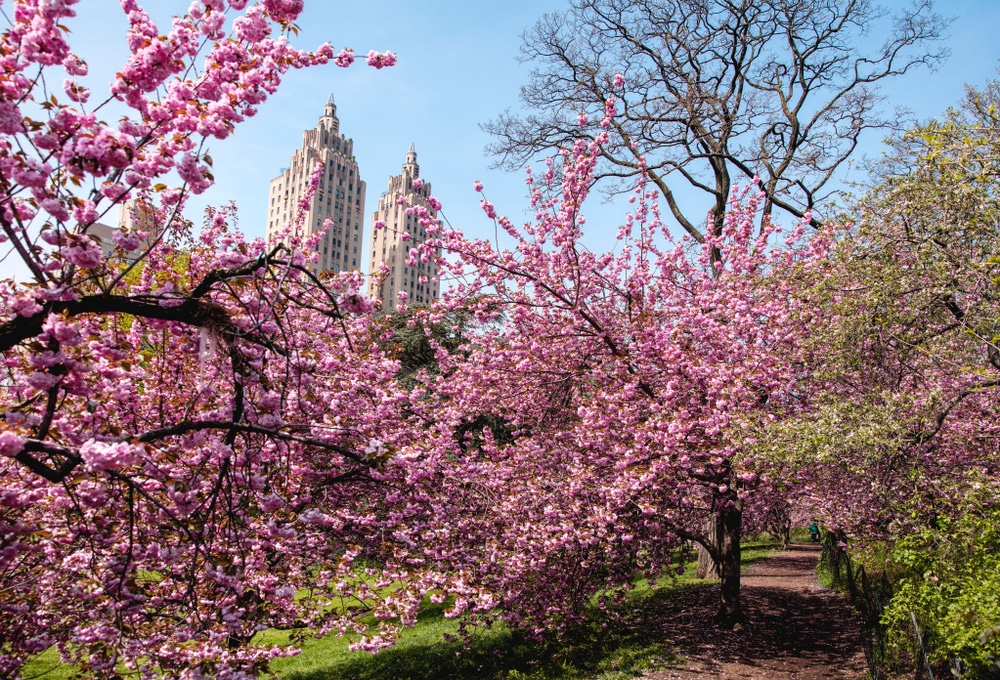
Moving beyond restaurants and in perfect timing with the arrival of spring, when speaking of Japan we cannot fail to mention the art of hanami, which in Japanese literally means “watching the flowers.” This age-old tradition, celebrated in early spring, involves gathering under sakura (cherry) trees to admire their ephemeral beauty and contemplate the passage of time. Hanami is a festive occasion that includes picnics in the open air, flowing sake and convivial moments among friends and family. More than just a custom, it embodies the Japanese philosophy of awareness of the transience of things and the ability to appreciate their fleeting beauty. In New York, there are a variety of maps to track cherry trees and cell phone apps that indicate their bloom status so as not to miss the moment of peak bloom. The fact that this may be totally at odds with the philosophy behind this practice does not seem to bother anyone… So where are New York’s cherry trees? The best places to admire them are Central Park, Roosevelt Island, the Long Island City waterfront, and the Brooklyn Botanical Garden where special events are held each year just for the bloom! Beyond the obvious impoverishment of the practice itself generated by social media, cherry blossom remains an inevitable sign that around April, spring is, indeed and finally, even in New York City, just around the corner!
If contemplating the cherry trees yes, but better to do it without too many people around, then the date is at Rainey Park in Queens. The park is unfortunately closed at the moment for renovations, but on the trail of Japan in New York it is still worth going this far to discover a real gem that from the blossoms catapults us into the world of art: the Noguchi Museum. Located in Long Island City in Queens, the Noguchi Museum is an authentic corner of Japanese culture in the heart of New York City. Founded in 1985 by Japanese-American artist Isamu Noguchi, the museum houses the world’s largest collection of his works, including sculptures, drawings, and design pieces. Noguchi personally designed the space, transforming a former factory into an environment that reflects Japanese aesthetics, with a sculpture garden that incorporates traditional elements such as water, bridges and vegetation, creating an oasis of contemplation and harmony. The museum not only celebrates Noguchi’s artistic legacy, but also serves as a cultural bridge, offering visitors an immersive experience in Japanese philosophy and art.Other Japanese artistic imprints are encountered an New York in the many installations dedicated to Yayoi Kusama: the Davis Zwirner Gallery in Chelsea recently hosted a beautiful exhibition dedicated to this world-famous artist, and the partnership with fashion giant Louis Vuitton has enshrined her in the luxury world as well, transforming her iconic pumpkins and polka dots into pop cult objects and further amplifying the link between Japanese art and global culture. The New York Botanical Garden (NYBG) also hosted an exhibition dedicated to Yayoi Kusama in 2021 entitled “KUSAMA: Cosmic Nature” presenting a wide range of works by the Japanese artist, including monumental sculptures, immersive installations, and a new Infinity Mirrored Room. A new Japanese contribution to the art world is finally expected with the reopening of the New Museum on the Lower East Side, scheduled for next fall (2025). The architectural design of the museum extension has indeed been entrusted OMA architectural firm, under the leadership of architect Shohei Shigematsu who is particularly esteemed in Japan.
Other Japanese places in New York City would not be hard to list, starting with Kinokunyia, the manga bookstore overlooking Bryant Park, but we will have to limit ourselves here to picking a few. One last stop on this trip is unavoidable, however: we are talking about the Japan Village at Industry City in Brooklyn’s Sunset Park neighborhood. Opened in November 2018, this nearly 2,000-square-foot space offers an authentic immersion in Japanese culture through a variety of restaurants, stores, and shared spaces. Not only classic restaurants but also street food, a supermarket, stores selling Japanese crafts, beauty products, and other traditional items, and spaces for cultural and social events. The homepage of the website reads in big letters “Visit Japan without leaving NYC,” and it is here that I would like to leave you to explore the synergy between Japan and New York. Partly because the former industrial warehouses in Industry City are the perfect place to get lost, and partly because here, if you close your eyes, you really feel like you’re in Japan!
What do you think of this first leg of our “World Tour of New York”? Our project is an invitation to look at the city with new eyes, discovering the many cultures that inhabit it and make it unique. This short trip to Japan New York I hope has made you want to explore the city with different eyes. What will be your next destination? Suggestions are welcome!
The article All crazy for Japan comes from TheNewyorker.
