
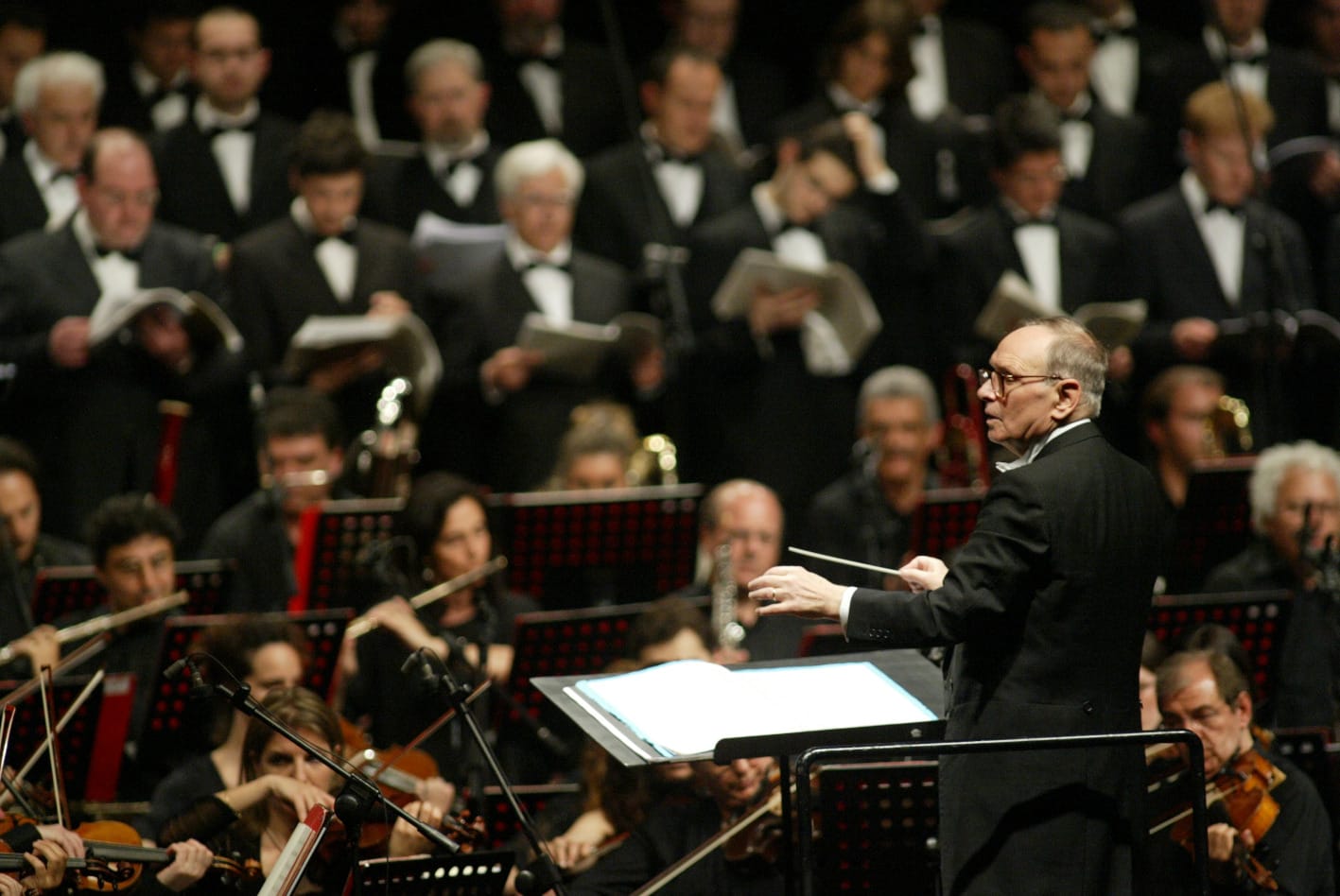
It happens sometimes in life to meet sensitive, capricious, vulnerable, crazy, irascible, but also generous “types.” And again: endowed with great impulses, but at the same time humoral and unapproachable. “Artist stuff.” What people think. That’s right, since artists behave just like that and … when they “turn” it’s good to stay away, since they automatically go from white to black and hardly see the rainbow.
This time we are talking about a book. That book entitled: “Ennio Morricone, the Genius, the Man, the Father,” written by Marco Morricone – son – and Valerio Cappelli, with a preface by Aldo Cazzullo, recently presented in Florence, in the spacious premises of the Zeffirelli Foundation.
Gradually ‘Maestro’ Morricone emerges, an extremely rigorous but also contradictory figure with a pure gaze toward the world. And who loved to play chess. We speak of an atypical Roman, emotional and sensitive, who with his unique and special music pierced the belly. Without stopping yet.
They smile at their two sons, who are present, looking full of tenderness in remembrance of the famous dad who felt anything but a “star,” despite the happy and fruitful business encounters in Italy and America alongside Quentin Tarantino, Clint Eastwood, Joan Baez, dear Tornatore, Sergio Leone-two stubborn, incredible heads! – and other celebrities still.
The memory emerges of a hard worker who felt the same as everyone else, of few dry words, endowed with a childlike spirit, as well as an unabashed Romanist for two hours … who, however, then got over it all and immediately.
In the room packed to capacity, attention is high as he is reminded of his shyness even in the family, despite, “Dad was so creative, but so creative that he unknowingly enriched us family members and all those who stood by his side.”
A force of union dragged along by Maria Travia, Ennio’s wife and his muse. Very sweet and discreet, as indeed she has remained to this day despite her husband’s planetary fame. To her his spouse regularly dedicated every award he received. She. – the first – who judged her husband’s work without granting too many discounts, a true fundamental figure in their union, crowned happily by their four children.
Sunny, endowed with good manners, with a handsome open face and slender physique, son Andrew – a musician himself – performs masterfully on the piano, telling about his profession: “Well, I would observe a leap following what I heard as a child, despite the absolute ban on listening to music within the home so as not to distract dad. Strange-but true. Then again, he was like that, like that thing of locking with the latch – attached then to his neck – his rooms in order not to suffer intrusions and ‘stealing’ of his objects. He was actually more like the mom who was able to donate a few records to the professors, by way of a bamboozlement for us kids!”
A pause, another tune performed, and again the tale about that father who did not eat much, especially before composing, followed, however, by the hasty “little hand” in stretching it toward the plates of others with a mischievous look.
As for sweets: “A real passion for chocolates, albeit hidden by our mother, but found by him more often than not, followed by a sardonic note: ‘Maria, hide better!'”
And again the story of the notebooks: “Little sheets scattered in the various corners of the house, religiously kept by him, to stop ideas on the fly, with endings later toward real masterpieces.”
Masterpieces harking back to Sostiene Pereira, Nuovo Cinema Paradiso, Once Upon a Time in America, The Untouchables, Mission, Sacco and Vanzetti, and many more, well known.
As for envy and malice, those too were inevitable, although they were part of the game, since thoroughbreds arouse tension and admiration.
The conclusion starts with the words of Marco, the other son, explaining that the book in question was not born with the idea of making it a ‘holy card,’ but rather with the desire to convey the deepest essence of that beloved father, giving back the privileges he received. Such as that of donating the proceeds of the volume to charity.
It is worth mentioning that his eldest son Marco, with his wife, founded Armonica Onlus, music workshops for hospitalized patients and their families, considering music itself excellent medicine of the soul, capable of healing human frailties in order to alleviate their suffering.
“Unfortunately, music therapy is scarcely followed in Italy,” he explains, “and that is a pity, as this discipline helps physically and psychologically sick people.
It shines the 5-pointed star on the Walk of Fame, since Maestro Ennio Morricone was the 13th Italian to have his name stamped on the Hollywood Boulevard scene.
Definitely a great accomplishment. As was the Oscar, the first, received for lifetime achievement in 2007, with follow-up to the second in 2016 for the music for director Tarantino’s The Hateful Eight.
In earlier years-in 1986 exactly-hope for the coveted statuette for the film Mission was strong, despite the award going instead to Round Midnight, with justifiable controversy following, motivated by the fact that the music in that film was not entirely original as required by the rules.
Disappointment was not lacking … soon overcome with a shrug observing, “An American award for Americans!”
To Us Opposite, Andrea Morricone, for The Newyorker, then tells of that shy, inflexible and very, very dedicated father.
“But also most generous, of total devotion in his own unceasing profession, with rare exceptions: only when he was resting! A man who loved to reflect a lot, especially when he was not at his desk or at the piano. And it was precisely to the piano that he went when he was in crisis … in quotes … in ‘compositional crisis.'”
Why this? “Because when he didn’t come up with a theme, he would go to the piano, immersing himself completely. As a rule, he never wrote themes on the piano… there he would just look for chords or so, and so definitely a hard worker who also applied himself more than eight hours a day.”
What are the values passed on to you children?The greatest legacy, for me, has been the worship of silence. This is the important message I want to dwell on, and not only musically speaking. The importance of pauses, of absences of sound, of emptiness, of matter being reflected in life. Silence is a highly constructive moment, better an unspoken word than a spoken word.”
Did your father work a lot for America or in America? “A lot for America. It is a fact that his profession unraveled – and not a little – with American filmmakers landing in our country to meet him and work together. With the overseas he had a relationship of great generosity: he made himself loved and knew he was much loved, returning all the love given.”
He supposedly had many friends in the beloved profession. “Yes, numerous, also cultivated toward other areas such as recording studios, various colleagues, cultural institutions and more.”
Still of America speaking, did he travel alone or with all of you? “The two of us would go often and willingly, but it also happened with the whole family.”
That is all I ask of you, for in the course of this evening, thanks to your recollections, “The Morricone Man” has been very much in evidence. If you would like to add anything further, we are at your disposal, despite the closing hour followed by none-too-well looks.
“I would really say to return to silence. The concept of silence by way of spurring everything and everyone, as a most precious value. Sometimes energy must also be contained through not doing or ‘doing little.’ Right intelligent and judicious management of every little detail that belongs to our daily routine.”
So a philosophy of life? “That’s right, a real philosophy of life.”
He stands up smiling and shaking my hand, then heading off in the company of others toward the exit.
“Silence is golden.” A motto we were taught from a very young age. And so inevitable is a moment of personal pause, reflecting, “Mon Dieu, haven’t I talked too much?”
The article The silence of music: simply Ennio Morricone comes from TheNewyorker.
