
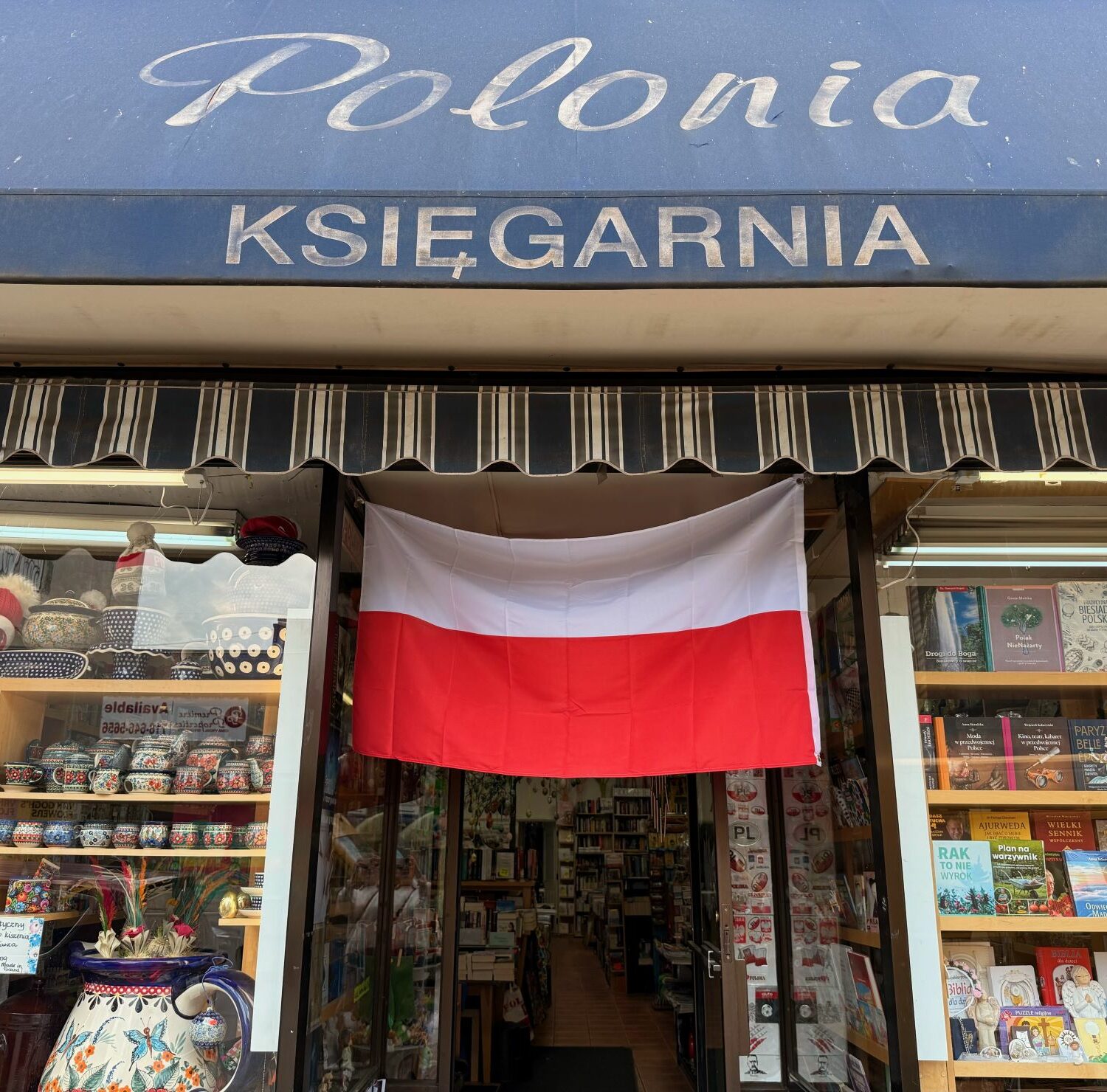
Constantly struggling with the increasingly aggressive processes of gentrification that are affecting many parts of Brooklyn, a proud outpost of New York’s Polish community, settled here since the great European migrations of the early 20th century, survives in Greenpoint. What we are now used to recognizing as an increasingly trendy and desirable part of Brooklyn, overlooking the East River just north of the now-established Williamsburg, looked decidedly different to the early European immigrants: swampy suburbs crisscrossed by shipyards, industrial warehouses, refineries and muddy streets where work was hard and living conditions often precarious.
Strolling through the streets of Greenpoint, one gets a clear sense of the contrasting souls of the neighborhood. If one arrives from the river, as I love to do by taking advantage of the NYC Ferry boat service, the first impact is with the glass windows of brand new skyscrapers that have nothing to envy from those in the Financial District: neither the view of the city skyline nor the prices of rental apartments-a luxury that fewer and fewer people can afford. The other element that immediately jumps out at you is the large mural overlooking WNYC Transmitter Park: it is titled “Love Me, Love Me Not” and depicts a little girl surrounded by floral motifs, in a style somewhere between nostalgic and pop. The work has become one of Greenpoint’s visual symbols, somewhere between memory and transformation, and it represents well the constant dialogue between past and present that runs through the entire neighborhood. As soon as you pass the modern buildings, the houses drop down, revert to brick, and a few red and white flags begin to appear between entrances, a tangible affirmation of Polish pride and territorial claim that is still very much felt here.
But when and how did New York’s Polish community structure itself among these streets?
Polish immigration to Greenpoint did not occur uniformly, but was divided into several migratory flows, each linked to specific historical moments, both locally and internationally. The first substantial wave began in 1903, soon after the opening of the Williamsburg Bridge, which, connecting Brooklyn to Manhattan, facilitated the arrival of workers attracted by the growth of manufacturing and shipping industries on the riverfront. Indeed, many Poles, fleeing poverty and political instability, found here an opportunity for redemption. After World War II, new arrivals responded to the Soviet stranglehold on their homeland, and in the 1980s, Greenpoint welcomed another major wave, this time related to escape from martial law. With the fall of communism and the dissolution of the Warsaw Pact, many Poles emigrated to New York in search of a new life. These newcomers sometimes clashed with Polish-Americans already entrenched in the neighborhood, in a dynamic we find repeated even today in similar situations around the world. Cultural differences and difficult housing conditions generated tensions and stereotypes, but over time the community managed to consolidate, opening stores, restaurants and businesses that transformed Greenpoint into what is still called “Little Poland” today. The Polish community thus developed over time a lifestyle based on the principle of “living and working in the same neighborhood,” offering everything one could need without having to move elsewhere. One of the most significant features was the fact that many Poles could spend their entire lives in Greenpoint without ever learning English, thanks to the widespread presence of the Polish language in store signs and everyday speech.
To find authentic Polish experiences in New York City, one must reach Manhattan Avenue, the neighborhood’s commercial artery. Historically the beating heart of Greenpoint life, this street welcomed the first businesses opened by Polish immigrants during the twentieth century, becoming a landmark for generations. Even today, amid traditional grocery stores, bakeries and familiar restaurants, Manhattan Avenue retains a strong and resilient identity, a symbol of the community that took root here. As is often the case, I like to explore the city’s different neighborhoods starting from a bookstore: I believe it is the serenity I feel in being surrounded by books and the familiarity of the experience that provides me with a secure base from which to start and a method for organizing my work. At Polonia Ksiegarnia – a word that, I now discover, means bookstore – I meet a kind lady who, seeing me enter, addresses me directly in Polish, asking, I imagine, if I needed anything. I explain to her, switching to English, that I am doing research for an article on the Polish heritage of the neighborhood, and although she prefers not to give an interview, she proves helpful in guiding my research. The one with the bookseller is just the first in a series of encounters with people helpful in their confidentiality who tend to approach their neighbors in their first language and, after complaining about the gentrification of the neighborhood, proudly tell the stories of their places. It is in these brief exchanges that I find the attachment to places typical of those who have lived a life, or part of a life, divided between two countries and two cultures that every day, now unconsciously, they find themselves converging.
But let’s return to our bookstore at 882 Manhattan Avenue, where the shelves are filled with books, magazines and typical crafts that cater to every need of adults and children. A small blackboard is loaded with magnets celebrating Polish pride-they would be perfect for my collection! – and the environment is still decorated with Easter trees adorned with decorated eggs in the Central and Northern European tradition. Here I discover the existence of a very active cultural center, based a few blocks away, and a publication, the Kurier Plus, strictly in the native language with no English translations, which weekly updates the community on events and news locally and from overseas. I make the effort to remember that I have never actually left New York when I enter one of the many supermarkets, not far from the bookstore, where the merchandise on display again speaks uniquely Polish: Cracow peppers, flour, herbal teas, stock cubes, sauerkraut, and endless varieties of pickled cucumbers are just a few of the specialties that can be found in here! Even the detergents and medicines are imported products. From the supermarket to the grocery stores is a short step-literally since you can find everything within a very short distance-and so the stops not to be missed are the Nassau Meat Market and Polam Meat Market, butcher shops specializing in kiełbasa, sausages, sausages, fresh and processed meats and pork shanks, and bakeries such as Polka Dot Café (former butcher shop, now restaurant) and Café Riviera, which are packed on holidays and frequented almost exclusively by locals. And it is no coincidence that we are talking about butcher shops and pastry shops: Polish culinary traditions are one of the best preserved cultural aspects, enriched by the abundance and variety of ingredients available in the United States. Polish cuisine is based on meat dishes, soups, potatoes, pasta, dumplings (pierogi), grains, preserves, pickles, and cabbage. Meat occupies a central role, and typical desserts include pączki (fried doughnuts) and chruściki (fried, sugary treats, similar to chiacchiere). Everyone has their own benchmark places, just like at “home,” but if stratta to choose the best Polish restaurant in Greenpoint there is no doubt: it is Pierozec that offers the best Polish pierogi in New York!
Despite the urban transformations and new cultural influences that have hit Greenpoint in recent decades, there is still a strong effort by the Polish community to preserve the authenticity of its roots. One of the elements that continues to serve as the glue of identity is religion, Catholicism, which remains deeply rooted in the daily lives of many residents. The Church of St. Stanislaus Kostka, founded in 1896, is still a landmark not only spiritually, but also socially: masses in the Polish language, traditional celebrations and community activities are held here, keeping the sense of belonging alive. Even in new generations, often born or raised in New York City, participation in religious rituals is a way to stay connected to the culture of origin. It is not uncommon, walking through the neighborhood, to come across images of Pope John Paul II, a beloved symbol of the Polish Catholic faith and a figure still revered with deep affection. And as chance would have it, I was right around here when the white smoke arrived that saw the new Pope Leo XIV elected almost as if to represent a symbolic handover, despite the distance in time.
For those wishing to discover Greenpoint’s Polish heritage, the advice is not to delay: gentrification is advancing rapidly, reshaping the face of the neighborhood and slowly changing its soul. After Poland joined the European Union in 2004, new job opportunities at home curbed emigration to the United States, triggering a significant return even among those who had made Greenpoint their home. Historic stores, traditional bakeries and Polish signs still endure, but the risk that all this will soon be swept away by new construction and out-of-reach rents is real. To visit Greenpoint today is to catch the last authentic fragments of a community that has deeply marked Brooklyn’s history and continues to influence its character.
Thus ends our stage dedicated to Poland in “Around the World in New York.” Thank you for accompanying us on this journey: see you soon with a new story, in a new corner of the world, without ever leaving the city!
The article Under the skies of Greenpoint, the last corner of Poland comes from TheNewyorker.
