
Riso Acquerello is a world-famous Italian excellence. The world’s most Michelin-starred chef, Alain Ducasse, called Acquerello “the Rolls Royce of rice”; renowned Swedish chef Fredy Girardet called it “the soul of Carnaroli,” pointing out that “it is part of the last authentic products,” while renowned Italian chef Gianfranco Vissani said it “touches levels that more a chef could not dream of.”
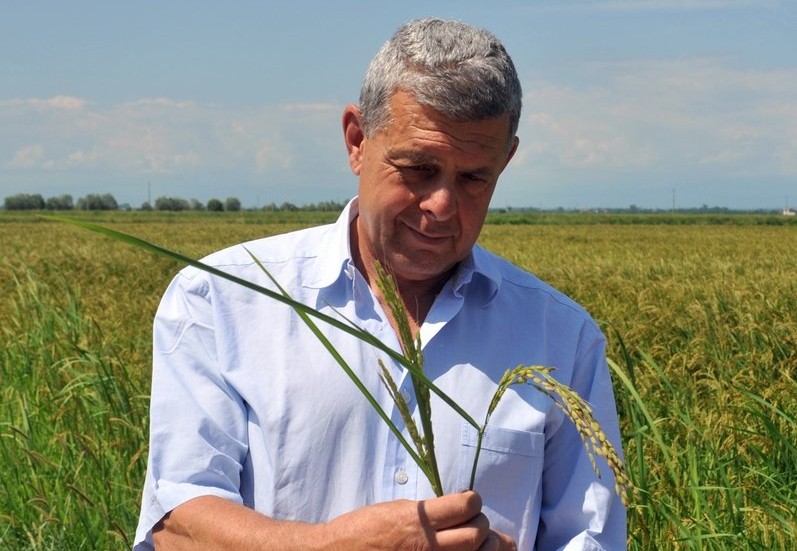
Piero Rondolino, the inventor of Acquerello rice, is the protagonist of the new episode of “Portraits,” the podcast of ilNewyorkese hosted by Claudio Brachino. Rondolino recounts the family history, the importance of the land and the intuitions, which he prefers to call “rational choices,” however, that have made his rice unique and, as such, appreciated all over the world, including in the United States.
The Rondolino family has been involved in rice farming since 1935, when Cesare Rondolino bought the Colombara Estate: “Cesare was my dad, a man who wanted to be a farmer but understood that rice farming would have a more solid future because it depends on water, which is not available everywhere. So he foresaw that rice would remain a solid and profitable product over time.”
Father Cesare’s vision was passed down to his sons Piero and Michele, who chose to continue and innovate the rice farming business together. For Piero, however, it was a choice that was not a foregone conclusion, because in the 1970s his passions and studies could have taken him far from the rice fields: “I wanted to be an architect. I had graduated with Carlo Mollino and wanted to go study in America or Japan, inspired by Frank Lloyd Wright. My father, however, wanted my brother Michele and I to work together, so I started to be a rice farmer.”
The Colombara Estate, a unique place where history, nature and rice culture come together, has immediately represented, from a logistical point of view, the ideal environment for rice cultivation: the Vercelli plain, moreover, is an area historically devoted to rice cultivation. And it is here that Acquerello rice is cultivated with full respect for the environment: during cultivation, the water is kept high at all times, and this makes it possible to maintain, in the 200 cultivated hectares, a delicate ecosystem that is home to the typical fauna of the rice field, from aquatic birds, such as the splendid herons, to swallows, dragonflies and frogs.
“Rice cultivation is special because it is done in submergence, you need clay soils that retain water from the mountains. Here we have a privileged position in this regard: when it rains here in Piedmont, it snows in the Aosta Valley and, after a week, it becomes water, so we have the peace of mind that we have water for the whole rice cultivation.”
Water at the base and center of everything, then: the necessary condition for growing rice, and for 20 years Piero’s job was precisely to control the water level in the family paddy field. That’s why, when he took it to the next level in 1991 and invented his brand, he had no doubts about the name: “The work I did from the 70s until the early 90s was to control the water level in the paddy field, which is fundamental: if there is too much, the rice grows badly, if there is too little, it grows too little. So I was in charge of the most crucial operation in the rice production chain, and when it came to choosing a name I chose one that had the root of water. So it was an ‘instinctive reason,’ let’s call it that.”
Thus in 1991 Acquerello Rice was born, and the choice of Carnaroli monoculture is linked to Italian gastronomic culture: in Italy, especially in the north, the signature dish is risotto.
“We chose to grow a rice that would absorb well all the different flavors that we can put in risotto and therefore a variety, Carnaroli, which we then evolved. We had to evolve it because even though it was not very widespread at the time it was obvious that because it was the best, it was going to become very widespread; so we immediately wanted to add something that would distinguish us in order to be able to make a name for ourselves, and that something was the aging of the paddy rice, when it is still inside the silo (not when it is white) that gives it the tightness in cooking and the ability to absorb flavors, which is a very important thing in risotto. So ours is a Carnaroli, the most suitable variety, improved with aging.”
A rice that is also unique in its packaging: packaged in a can and pressurized with nitrogen, which ensures better preservation than vacuum packing. “A choice that, in my opinion, is more rational than intuitive.”
Its uniqueness and quality have made Riso Acquerello a prestigious brand, an Italian excellence known and distributed all over the world: “America is certainly the country where we sell the most, but only because it is big. In proportion to the population, we sell much more in small countries. There is a substantial difference between distribution in Italy and distribution abroad, especially in the United States: in Italy our distribution goes to stores and restaurants. In the United States distribution is complicated because the Italian system of stores is missing. Probably the future will be the web, but currently the restaurant abroad is much more important than in Italy.”
From father to son, the family nature of the company has never changed-a distinct identity that Piero hopes will remain unchanged in the coming generations. “The key for us is to grow slowly, giving time for values to pass from one generation to the next. We don’t rely on outside managers; we aim to maintain controlled, sustainable growth. I hope that my children and grandchildren will continue in this direction, avoiding compromises.”
Everything in the company’s production and distribution chain is managed by family resources: “Today my wife Maria Nava works with me, who takes care of the commercial side, my eldest son Rinaldo, who follows production, and my other two children, Umberto and Anna, who are engaged in communication, an aspect that is fundamental today.”
Piero’s vision has always been clear and continues to be clear as he looks to the future: “My dream is to train our employees, about two dozen, mostly women, so that they can support my children and grandchildren. We do everything in-house, from production to communication, and we want to maintain this independence. This for me is the future.”
The article Piero Rondolino and Riso Acquerello: history of an Italian excellence comes from TheNewyorkese.
