
Five Italian gardens have made the list of the world’s 25 most beautiful gardens compiled by the New York Times, which asked six international experts to select parks capable of changing “the way we look at plants.” With five appearances each, the United Kingdom and Italy lead the ranking. Of the Italian gardens selected, three are located in Lazio-the Giardino di Ninfa, the Sacro Bosco di Bomarzo and Villa d’Este-one in Tuscany, the famous Villa Gamberaia, and one in Piedmont, the little-known but striking Villa Silvio Pellico in Moncalieri.
The Garden of Ninfa, third on the list, is perhaps the most evocative. Created on the ruins of a medieval city, it is a romantic English garden that is home to more than ten thousand botanical species from around the world. Abandoned in the Middle Ages and then recovered in the 20th century by the Caetani family, the garden owes its rebirth to Prince Gelasius Caetani’s passion for horticulture. The microclimate created by the waterways and the variety of plants – from Japanese maples to marsh irises – make it a unique ecosystem, now protected as a Natural Monument by the Lazio Region.
Vista aerea sul Giardino di Ninfa | via Shutterstock
Villa Gamberaia, just outside Florence, ranks nineteenth. It is one of the most celebrated examples of the Italian garden, with precise geometries, water features, and a dramatic layout culminating in the grand grassy avenue and lemon garden. The villa, built in the 17th century and transformed in the late 19th century by Catherine Jeanne Keshko, is a laboratory of botanical elegance among cypresses, peonies, and climbing roses. Not far away, but with a completely different setting, Villa d’Este in Tivoli-twenty-first on the list-embodies Renaissance engineering: an articulated hydraulic system with 51 fountains, 398 water jets, and a terraced layout that still fascinates in complexity and beauty.
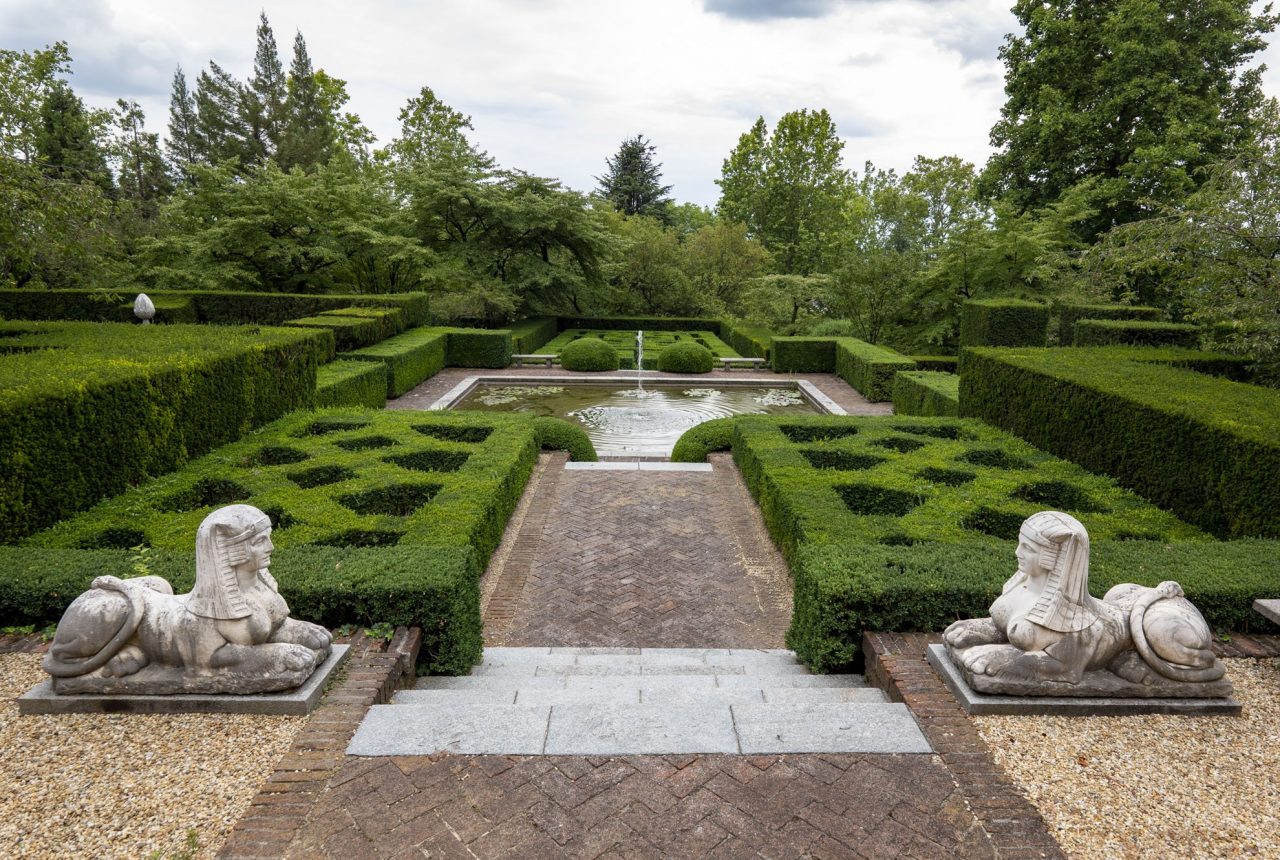
In twenty-second place is the Sacred Wood of Bomarzo, perhaps the most enigmatic of Italian gardens. Created in the 16th century by Pier Francesco Orsini, it is populated by grotesque sculptures that seem to have come out of a mythological dream or allegorical nightmare. The famous “Mouth of Hell,” with the inscription “Every thought flies,” is just one of the forty elements that make this garden a place out of time, capable of inspiring artists and visitors with its unsolved mystery. Closing the Italian selection is Villa Silvio Pellico, in the hills of Turin: a Franco-English garden transformed in the 20th century by Russell Page with a cruciform layout and paths nestled among boxwoods, cedars and old roses.
La “Bocca dell’Inferno” nel Sacro Bosco di Bomarzo | via Shutterstock
In the rest of the world, the list includes historic parks and contemporary landscape experiments. From New York’s High Line-a suspended linear park created on a disused railroad track-to Cranbourne’s Royal Botanic Gardens in Australia, which fuses architecture and botany, to South Africa’s Kirstenbosch, dedicated to native flora. Each selected garden tells a different vision, culture, and form of relationship with nature. In this global context, Italy confirms its centuries-old vocation to transform landscape into art.
The article Five Italian gardens are among the most beautiful in the world according to the New York Times comes from TheNewyorkese.
