
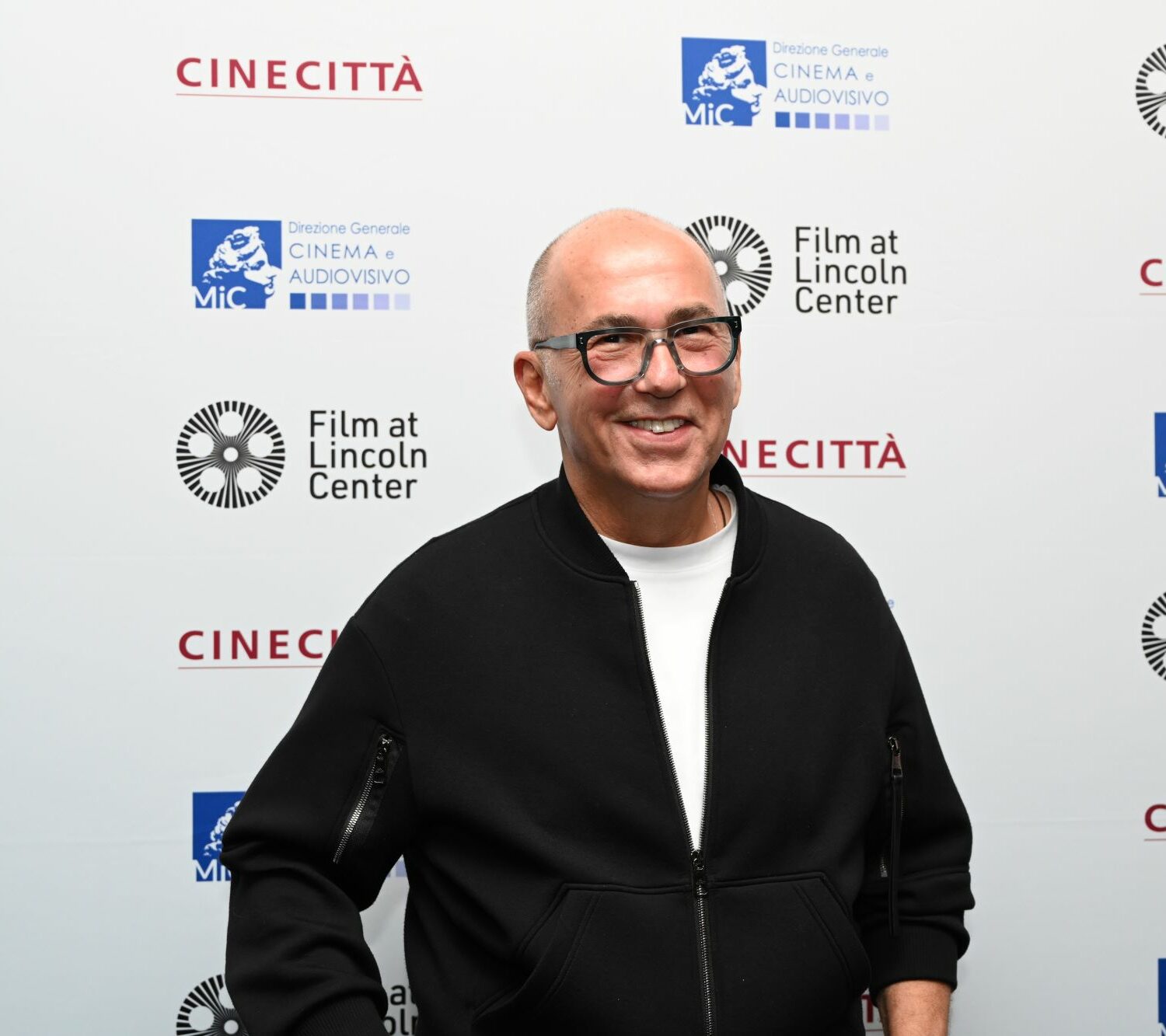
Ferzan Özpetek, Turkish director, screenwriter and writer naturalized Italian, is one of the most poetic and recognizable voices in contemporary cinema. With films such as Le fate ignoranti, La finestra di fronte and Mine vaganti, he has chronicled the intimacy of family ties, the complexity of feelings and the inexhaustible power of identity, winning over Italian and international audiences. His latest work, Diamonds, is perhaps the most personal work of his career but also a tribute to the female world, to those women who are not afraid to hide their fragility and turn it into strength. It is a film that springs from memory, crosses fiction, and feeds on real emotions. It is a choral love letter in which suffering, happiness, pain, and courage are intertwined and that always seems to be born from a very specific goal: to share emotions with the audience. We interviewed him for IlNewyorkese on the occasion of the Open Roads: New Italian Cinema festival, presented at New York’s Lincoln Center, where Diamanti was one of the protagonists representing Italian cinema.
Art has to be shared; if it is not shared, it is nothing anymore. Is that why you chose to show Ferzan in the first person in front of the camera, and not just the director? Did you feel the need to share a part of yourself as well?
I have always told what I know. And for that I have to say thank you to all the people who have come into my life and stayed. The film was born just like that: from a gesture that has always been with me. When I have a project in my head, the first thing I do is call the actors, tell them the story, and then write. Many of my films are born from the actors: I start with an outline, but it is the meeting with them that shapes the script. For me it is wonderful when life and fiction intertwine, blur together. This film was born from a place and a moment that I know intimately: the years of my youth, when I was taking my first steps as an assistant director. I often accompanied directors, costume designers and actresses to an extraordinary tailor’s shop in Rome, observing everything that was happening around me. It was at that time, working alongside Piero Tosi, that I really began to form myself. He was a fundamental figure for me. That tailor shop was a sacred space. There I learned how to look. I understood the importance of light, the power of detail, the power of color – capable of telling more than a dialogue. In tailoring you learn this in an excellent way: the art of observing, even before directing. With Diamonds I wanted to recreate that very atmosphere: the modesty, the delicacy, the beauty of touching the invisible. And I also wanted to do it to pay homage to Piero Tosi, Gabriella Pescucci, Maurizio Millenotti, extraordinary people who made the history of Italian cinema. Playing myself allowed me to guide the viewer inside this journey through time, offering a personal and authentic look at the world I wanted to tell.
Diamonds is a choral film with a cast of eighteen actresses. How did the idea for such an ambitious project come about?
The idea of making an all-female film had been with me for some time, but I had never had the courage to materialize it. I thought it was too complex. Then, talking with Luisa Ranieri, this shared desire emerged. I thought back to my years as assistant director, when I observed that world populated by extraordinary women. So I decided to tell that reality, celebrating female strength and resilience. Because women are superior. I’ve never had any doubt about that. They have a sensitivity that moves me, a capacity to listen, to endure, to struggle, that is extraordinary. In Diamonds there are mothers, daughters, friends, sisters: women who care for each other, who hurt each other, who mirror each other. The fact is that I have always felt that the feminine side, even the side that is in men, is the important side of life. On paper it seemed impossible to carry out such a story, but the truth is that I had no difficulty on the set. Everything worked with an almost miraculous naturalness. I think it depends on the climate: I take care of the people who work with me. And when the actors understand that, they trust me. They know that I protect them, that I look after them with affection. It was an extraordinary experience. The actresses brought a unique emotional charge and complicity to the set. Often, after the shoot, I would receive long voicemails in which they shared reflections and emotions. A real community was created, on and off the set.
This chemistry with actors is not always easy or natural, how do you manage to create such a strong relationship?
I don’t like rehearsals, overly structured mechanisms. I let them, the actors, take me into the story. With women, then, there is an immediate attunement. I’m not interested in the perfect performance, I’m interested in the soul. The rest is adjusted. With some actresses there is an almost telepathic relationship. I just have to see them enter the set to know whether or not there is that truth I am looking for. When that happens, it’s a powerful thing. And this time, more than the story, I wanted to tell about the understanding I have with the actresses, with the women. It is a different understanding than with men. It is deeper. Women have a sixth sense about things, you don’t need to talk or explain, you understand each other right away. They are precious, like Diamonds. Mina suggested this title to me. She told me one day, “Women are like diamonds, they resist everything.” She was right. They are strong, precious, they shine even in suffering. It seemed perfect to me to tell the story of these protagonists: women who face life with grace and determination. Diamonds is their story, but also mine.
And also the story of three women in particular to whom the film was dedicated: Monica Vitti, Virna Lisi and Mariangela Melato …
They are three icons of Italian cinema whom I have always admired. I would have liked to work with them, but I didn’t have the opportunity. I had met them all, and I had thought of writing characters for them in other films. I called Mariangela Melato: she seemed happy, interested. For her I had thought of a role in Magnifica presenza, but she answered me with a phrase that has stayed with me: “It’s too late now….” The same happened with Virna Lisi for Mine vaganti, the role of which I had given to Ilaria Occhini. When I called her back, it was late for her too. Monica Vitti, on the other hand, I met her when I picked up the Golden Globe for my first film, The Turkish Bath. She approached me, complimented me and said, “She will make many more beautiful films.” At that moment, the award no longer mattered to me. That meeting, brief but intense, was what really mattered. And how much I wanted her to have a follow-up. With Diamonds, I wanted to make them present, paying homage to their talent and artistic legacy.
And what do you have left of Diamonds?
A great gratitude. For cinema, for life, for the women I met who changed the way I look. This film is a gesture of love. A real diamond: not perfect, but shining. It is fragile, like everything that really matters. Sharing my emotions with the audience is all that matters to me. It is the reason why I make films. I don’t chase box office. The most beautiful prize for me comes from the viewer who is moved, who recognizes himself. When people tell me that I look at actors like no one else, I know that I have done my job well. And that look, especially at the women, is what binds me to them so deeply. It’s like winning an Oscar, but every day.
The article Ferzan Özpetek: “Sharing emotions is like winning an Oscar” comes from TheNewyorker.
