
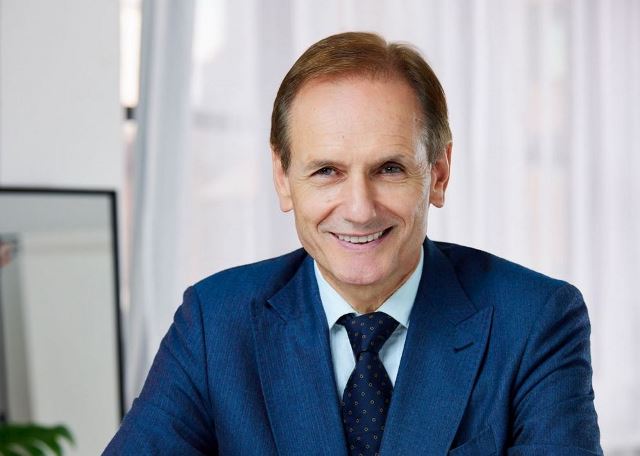
For more than twenty-five years Claudio Pagliara, recently appointed director of the Italian Cultural Institute in New York, has been reporting on the world for RAI, living as a correspondent in some of the most neuralgic points of the planet. “I have had the privilege, thanks to RAI, of reporting on at least three very important scenarios, which will also be so in the coming years: the Middle East, China and the United States.”
In his latest book The Emperor. Donald Trump: the beginning of a new era (PM Publisher), he analyzes the Trump phenomenon and the transformation America is going through.
According to Pagliara, “the public’s increasing attention to geopolitics is not necessarily a good sign. It is a bad sign; it means we are on the brink of an abyss, and the public, even the generalist public that has never dealt with international issues, is realizing this.”
Ten years in the Middle East, in Jerusalem, five years in China, mainly in Beijing, where he observed the rise of Xi Jinping and China’s technological challenge to the U.S., and finally since 2019 in the U.S., in New York and Washington: “In recent years I have followed two U.S. elections: the one won by Biden in 2020, in the midst of the pandemic, and the last one in 2024, which many have called ‘the Emperor’s revenge,’ a definition that inspired the title of my book.”
Pagliara explains how the American mogul has transformed the Republican Party and tapped into new segments of the electorate. “In my entire career as a journalist, I have never seen a politician draw such enthusiastic crowds to his rallies. He spoke in sub-zero temperatures during the primaries, as well as in scorching places, and there were always people of all ages willing to stand in line for hours, even in extreme weather conditions, just to see him.The MAGA movement, an acronym for Make America Great Again, is unprecedented in popularity. Trump has completely changed the Republican electoral base, building an unprecedented coalition: not only billionaires and big corporations interested in tax cuts, but also blue-collar workers, farmers in deep America and a part of the ethnic electorate that previously would not have voted for the Republican Party.This is also seen in some very concrete measures, such as the deduction of tips, which may seem marginal in Italy, but in the United States represents a significant share of income for millions of workers. To see them tax-free is extremely popular.”
Many were surprised by the recent rift between Trump and Elon Musk, which resulted in a full-blown social brawl between the two after Musk had been at the forefront alongside Trump throughout the campaign. “The friction point with Musk stems from multiple factors. Musk expected to have more influence on the Trump administration, especially on issues such as NASA leadership and big federal contracts for space and the internet. But Trump made good on his promise to put America first, saying no to Musk as well. When the balance of harms outweighed the benefits, Musk exploded-as is his character-and the conflict became inevitable.The interesting thing is that not only did the most powerful man and the richest man on earth face off, but probably also the two men with the most media power on the net, literally blowing up the internet.”
“The Emperor” is a provocative title, but one that is grounded in the very narrative Trump builds around himself: “One of Trump’s slogans is peace through strength-get peace through strength-and he believes that only by demonstrating strength and power, metaphorically those of an Emperor, can he achieve his goal: pacifying a world on the brink.Today, the West’s enemies have welded together as never before: China, North Korea, Russia, and Iran openly cooperate. Iran supplies drones to Russia for Ukraine; North Korean soldiers fight thanks to Beijing’s placet; China guarantees Russia economic support without which the war would have ended immediately. Trump wants to use all possible powers to counter this coalition.”
Regarding the conflict with Moscow, Pagliara points out that the one between Trump and Putin is “a very delicate poker game,” where the Russian leader pretends to have the trump cards, while Russia faces heavy economic and social difficulties: “Putin also needs an agreement, but he has to get there by accepting real compromises. Trump hopes to get him there. If he can’t, he has other cards at the ready, as the Musk case also shows: Trump quickly changes his attitude when needed.”
On the Middle East, finally, the journalist entrusts his analysis to a joke prevalent in the region, “The pessimist in the Middle East is an optimist with experience.”
Closing on the relationship between Italy and the U.S.: “It is a deep and very ancient relationship. From the drafting of the Constitution, to which an Italian, Filippo Mazzei, a friend of Jefferson, contributed, passing through the great wave of immigration, with millions of Italians who went to the U.S. managing to build, among a thousand difficulties, a successful future. Many became businessmen starting from scratch, with a cardboard suitcase. All this creates a visceral bond that can never be severed.
Besides, let’s not forget, Italy owes a lot to the American soldiers who contributed to its liberation.”
The article Claudio Pagliara: “This is how I tell the world between America, China and the Middle East” comes from TheNewyorker.
