
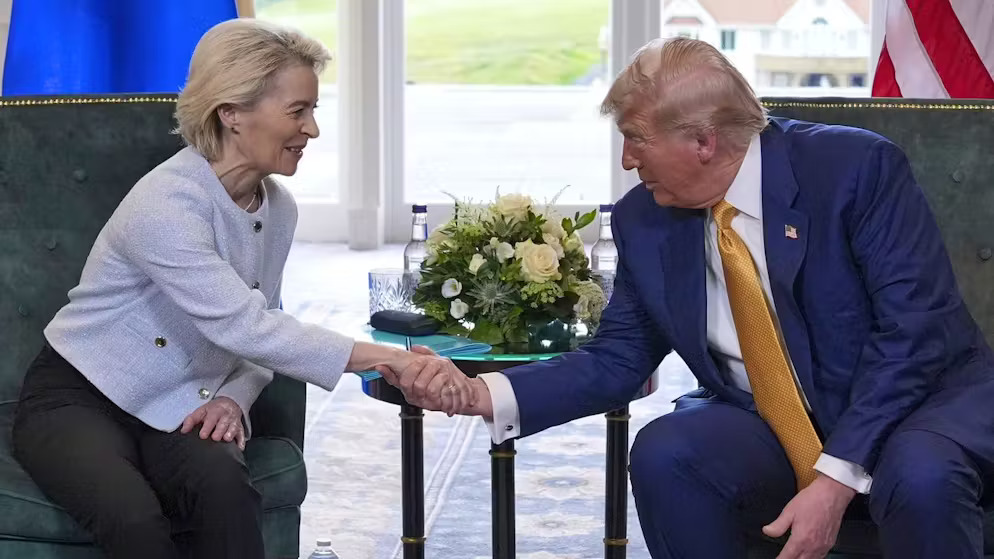
And the bar eventually stopped at 15. It is not a bingo number or a casino number. It is a number that sets the economic relations of the coming years between two giants of the West such as the United States and Europe, even though in the EU there was Brexit with the consequent exit of the United Kingdom. Of course, the 15% tariffs are better than the 30% that would have been triggered on August 1 (and even Lapalisse would have nothing to say about that), but they are still, for the old continent, three times what they were under the previous U.S. administration, we are talking about Grandpa Biden: 4.8%.
A Scottish shower for member economies, so many analysts headlined playing on the location of the agreement, the Scottish estate precisely of the tycoon. Ursula von der Leyen appeared publicly pleased to have averted greater (perhaps catastrophic) damage and offered a framework of stability for businesses. There was no shortage of criticism, however, too submissive a posture, from body language to political substance. Too soft, too much time lost earlier, too much reliance on the sirens heralding impending doom in the star-studded economy.
Yet she came with a unified mandate from all 27 member countries. The talk is zero, right now it could not be done otherwise. Indeed to get the rebate we gave Trump a lot of stuff, zero tariffs on U.S. imports, massive investment in his country and massive energy and arms purchases. And a fair amount of ambiguity about what we’re going to do with big tech in communications.
Oppositions clamor, even by us in Italy, but they do their (inconclusive) job. Instead, important now will be the work of governments and European institutions to help those supply chains that will go into difficulty, with the consequent risk of job losses. But neither will it be necessary to lose the material and, let’s say, immaterial inducement of our exports to the United States: a matter not only of goods, but of tradition and culture.
Individual dossiers will be seen, as Premier Meloni has already pointed out, and then specific action will be taken with various ad hoc measures that are not the usual linear but not structural incentives. New business ideas will be needed, without lightening the ethical commitment of politics for this, to prevent everything from resulting in unsustainable (even for many Americans) price increases. And Made in Italy does not lack creativity.
The article Duty is Drawn comes from TheNewyorker.
