
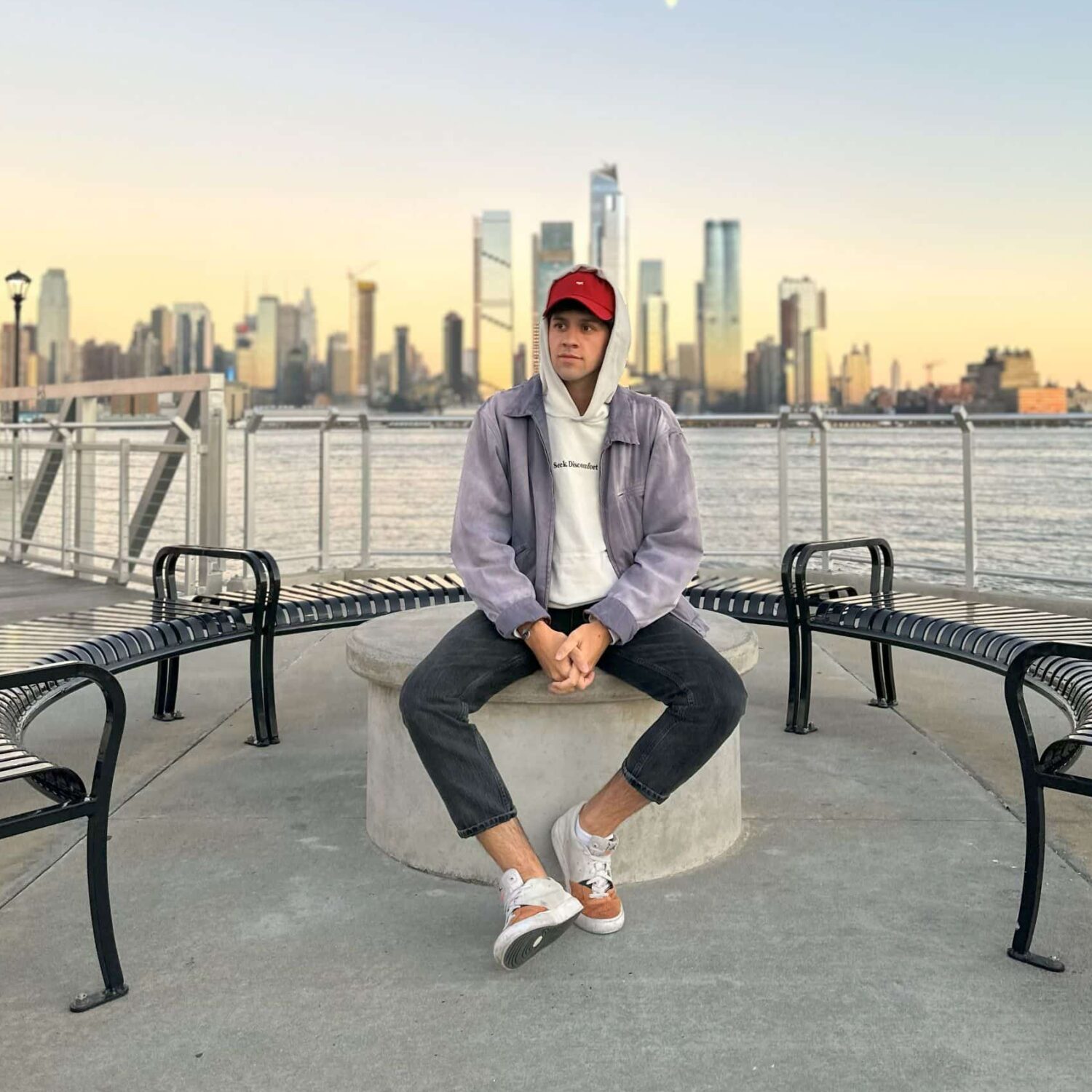
Efrem Lamesta, an Italian content creator transplanted to New York, is one of the most original voices on the contemporary digital scene. With a personal style and a strong connection to his cultural identity, he narrates the American metropolis on social media, creating new formats. We met with him to talk about his new life in New York, working as a creator, and the challenges and opportunities that this world holds today.
You are not new to New York: you have been going back and forth for years. How has your relationship with the city changed since you’ve been living there permanently? And what prompted you to take the plunge?
From the very first day I arrived in New York, I fell in love with it. I remember that first impact very well: I said to myself, “I guess I’m going to end up living here.” In New York everything runs so fast, a thousand things happen every day and you don’t even realize what is really happening. But every time I had to leave, I asked myself, “How can I stay here?”
After the first six months where I did a daily vlog-one video a day-I was totally focused on that. Then I started asking myself, “Do I really want to live here? How do you do it?” And so I started informing myself, figuring out how I could stay.
My relationship with the city, however, has basically not changed much. From the very beginning I felt at home and continue to feel that way. Today I got my visa and can stay for the long term, but I still haven’t fully realized that I really live here. Because I have been traveling so much in recent years, and “home” was constantly changing. Now, finally, my favorite place in the world is also my home, and it is an incredible feeling.
New York continues to give me the same energy, the same enthusiasm, the same desire to do extraordinary things. Only now I can do it continuously, because I live there.
How would you introduce yourself today to an American or Italian-American audience that doesn’t know you? A creator, an urban explorer, a filmmaker?
I simply call myself a content creator. I tell about my life in New York, but through my eyes. And so through my passions: film, music, everything that is part of me. What I offer is an authentic view of the city, that of someone who really lives it. I don’t tell New York as a tourist, but as a local. And that completely changes the perspective. And not only New York: a part of the United States also enters my content.
What are the places in New York to which you are most attached? In what ways do you think the city reflects a European influence?
Central Park is without a doubt my favorite place. My first apartment here, which is also the one I still live in today, is located next to the park on the Upper West Side. When I arrived I was confused, with many ideas but no clear direction. My walks through that urban forest, with the glimpses of the city, always gave me incredible strength.
I walked around listening to music and felt creative, inspired. Central Park is designed to show you New York in the right way, to get you away from the chaos and give you a moment to breathe. It is an amusement park for the soul. And that combination of urban energy and peaceful space makes it unique. It helped me to recharge my batteries, to get clarity, to start again each time with new ideas.
You started your journey with a daily vlog: one video a day. What has this experience taught you and what have been the biggest challenges in chronicling such a dynamic reality?
It taught me so much, both technically and narratively. In the beginning it took me six to seven hours to edit a video. After six months, it was taking me half that time. But it wasn’t just a matter of speed: you learn how to select the right moments, how to build a coherent and engaging story from an ordinary day.
Each video was a different story, although the structure remained more or less the same. I had to learn to choose what was really needed and what was not, to tell it in the most natural way possible. The goal was not just to show New York, but to convey something: an information, a lifestyle, a point of view.
I had a well-defined routine: wake up at 7 a.m., post the video, go out to shoot until the afternoon, come back, edit until 9 or 10 p.m. Each week was planned to have variety: two food videos, two lifestyle, one technology…there was always a balance. And even though I knew in advance what I was going to shoot, I never knew what was really going to happen-every day was an organized improvisation.
Has there never been a time when you felt the need to stop, to do nothing?
During those six months, no. The fatigue was there, but while you’re doing it, you don’t feel it all the way through. It was only later, when I stopped, that I realized how exhausted I was. And there were moments of loneliness, of difficulty. I was away from my family, in a new country, not knowing anyone.
Then I met incredible people, because New York is also that. But I’ve experienced hard times that I’ve tried to tell honestly, because they are part of life. And I think it’s important to share both the highs and the lows.
You are an Italian content creator who creates content for an Italian audience. What do you think is missing to enter an international scene? And how does your Italian-ness affect your aesthetic and narrative language?
To tell an American audience, you have to change your perspective. Our Italian roots are fascinating to people who don’t know them, but you have to be able to translate them. If I talk about a pizza here in New York complaining about the price or the ingredients, an American doesn’t really grasp the meaning. I have to find another way to tell the story.
My Italian-ness has helped me a lot in relating to the Italian audience: I act as a bridge between two cultures. I live here as an Italian, I understand the cultural differences and translate them for those watching from Italy. This is the added value.
As for aesthetics, I honestly couldn’t say exactly how Italian-ness influenced it. Maybe it’s more having grown up with a very strong exposure to American culture (movies, documentaries, series set in New York). That’s where my fascination with this city comes from. And then, what really gets to the audience is the emotion. If you’re passionate about what you’re telling, people feel it.
Have you created relationships with other local creators or professionals? Is there an idea of creative community in New York that appeals to you?
Absolutely. The thing that struck me the most is how open Americans are to collaborating if they see something interesting in you. Some American creators got to know me through comments from my followers under their videos. Then we got in touch and started collaborating.
Of course, it is difficult to build a deep friendship relationship with people who have a different lifestyle. But the community is there, and it is based on the principle of “let’s all win together.” Everyone provides their skills, we grow together. It is a continuous creative contamination. Sometimes it may look like opportunism, but it is not: it is collaboration.
What is the future shape of your content? Are you thinking about new formats, platforms, music projects?
There are several projects in the pipeline. I am working on content in English, to tell the story of my move to New York no longer to Italians, but to Americans. It is a market area that, in my opinion, is still underexplored.
I’m also getting back into music. One of the reasons I came to New York, in fact, was to launch my first song. It came out of a breakup and a desire to express myself in a different way than YouTube. I wanted to tell about myself in another format. And music was a new way.
I am also very passionate about film, and the idea of creating something in that world intrigues me so much. But you need time and structure, especially if you want to do everything right. But yes, that’s the idea: to fragment creative expression across multiple platforms.
If you could tell one aspect of New York that is little known or underrated, what would it be?
Everyone knows New York’s reputation as a fast-paced city, where everyone thinks for themselves, everyone runs, no one stops. That’s true, and it’s also why I like it so much. But there is another side, less told: spontaneous solidarity.
It happens very often that someone helps you on the street without you asking. A heavy suitcase up the subway stairs? There is always someone who stops to help. A lady with her dog caught in a scaffold? Someone arrives to help her, without hesitation. That’s one of the things I love most about New York: we’re a huge family, we each go our own way, but if you need a hand, we’re there.
Do you think your experience can inspire other young people to leave? What responsibility do you feel, and what advice would you give to those who dream of moving to New York or elsewhere?
Absolutely. Leaving Italy and going to a place where you don’t know anybody has been one of the hardest but also one of the most formative things in my life. And many people tell me, “I’m here because I saw your videos, and you gave me the courage to try.”
The advice I give is to start in stages, with small adventures. Test the ground. But if there is a chance, leaving for an experience abroad, even if it’s just for six months, is something I recommend to everyone. It changes your life, makes you grow, helps you really understand who you are and what you want to do.
Today, many companies are beginning to understand the value of content creators. But we may be close to a sea change. In what direction is this world going and what opportunities should companies seize?
The key thing is freedom. A company partnering with a creator has to know him or her thoroughly, understand his or her language, style, and vision. It is not enough to choose based on numbers or rely on an agency.
And then he has to trust. The value of the creator lies in his uniqueness, in his personal way of storytelling. If you constrain him too much, if you impose a preconstructed message on him, you take away all the value of collaboration.
The creator is not a billboard. He is a person who has built a relationship with his audience based on trust and authenticity. If you allow him to express himself, that message becomes most powerful. Otherwise, better to do traditional advertising.
The article New York, my home: the American vision of Efrem Lamesta comes from TheNewyorker.
