
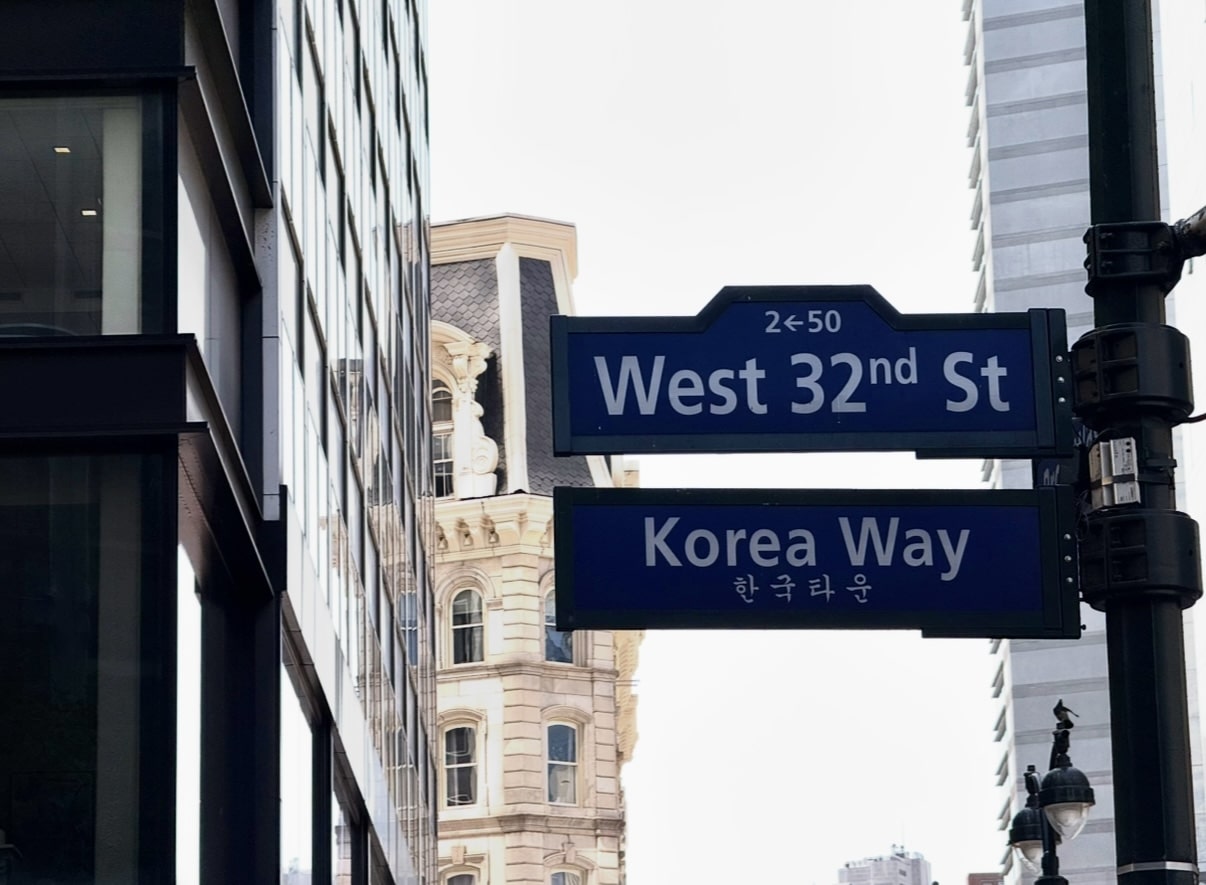
We must push into the heart of the city, right at the foot of the Empire State Building, to find another piece of our New York World Tour. Here, amid the double-decker buses loaded with tourists and office workers parading swiftly by in suits and ties, rows of somewhat lived-in buildings guard Manhattan’s Koreatown. At first glance, especially during the day, the stretch of 32nd Street between Fifth Avenue and Broadway can seem dull, almost neglected. A street sign, however, removes all doubt: this is Korea Way, the beating heart of Manhattan’s Koreatown neighborhood.
The history of Koreatown and its cultural institutions cannot be separated from the story of Korean immigration to the city. The first major waves of immigration came after 1965, thanks to the Immigration and Nationality Act (Hart-Celler Act), which abolished the old quotas based on national origin and opened up new entry possibilities for families who were often highly educated but eager to build a secure future. Many chose entrepreneurship as a path to redemption, opening restaurants, stores and laundries that soon became landmarks in Korean neighborhoods.
In the 1990s and 2000s the second generation consolidated this entrenchment, entering medical, technical and business professions, and establishing language schools, civic associations and churches that strengthened community life. Today, the Korean community is extremely dynamic and diverse: college students, young professionals, and creative people come to New York to study, work, or enter global cultural circuits.
Alongside the historic families, newcomers contribute to a community that blends tradition and cosmopolitanism, making the Korean presence more visible and influential than ever. Manhattan’s, in fact, is only the most compact and glitzy version of New York’s Korean community. The real “Koreatown”-in extent, density, and daily life-is in Queens, and more specifically in Flushing.
Here the streets teem with family-owned restaurants, traditional bakeries, supermarkets with endless shelves of products imported from Korea, and 24-hour health clubs. Flushing is now considered the Korean capital of the East Coast, a place where language and traditions are preserved intact and where the community has become deeply rooted by opening schools, places of worship and businesses that serve mostly local residents. If Koreatown in Manhattan is a glowing showcase for tourists, workers and the curious, Queens’ is a city within a city, where there is an everyday authenticity. Although the two have different characters, they have always been connected: many entrepreneurs and restaurateurs who have opened on 32nd Street in Midtown come right from Flushing, bringing with them recipes, products, and that sense of hospitality typical of Korean culture.
Let us then try to wander down Korea Way, at the foot of the Empire State Building, to discover this corner of Korea in New York. It is only a few blocks in size but dense with bright signs, spicy aromas and places that never sleep. As soon as you enter the heart of Koreatown, you immediately feel the unique energy of the neighborhood. Amid the bright signs and hangul signs towering over the establishments, the smell of Korean barbecue mingles with the spicy scents of Asian markets. Visiting the K-mart Asian Supermarket, one gets lost among shelves full of Asian ingredients and products: kimchi, noodles, spicy sauces, special teas. Not far away, barbecue restaurants entice with their aroma and the sound of sizzling grills. Miss Korea, open around the clock, is one of those places you won’t forget: the wide selection of traditional dishes and convivial atmosphere make every meal here an authentic experience. Meats are cooked directly at the table, on circular grills positioned under large metal hoods. Large menus with pictures of the food, accompanied by typical 3-D reproductions, help in formulating the order: the staff at these restaurants are strictly Korean, and kimchi is often “chewed” much better than English!!!
Korean BBQ is a real experience and offers an even cheaper alternative to the expensive American steakhouses in town. Vegan-only options, on the other hand, are offered at Hangawi, a fine dining restaurant that invites you to take off your shoes upon entering and enjoy dishes inspired by Korean Buddhist cuisine, including fermented vegetables, delicate soups and tofu dishes served in steaming stone bowls. Here you really forget you are in New York City!
Staying on the food theme, another must-see is Food Gallery 32, an indoor market that is almost a little world unto itself. Inside, several stands offer samplings of Korea from colorful bibimbaps to freshly made dumplings to sweet desserts.
Here it is impossible not to be tempted and try a little bit of everything, sampling the most authentic flavors in just one trip through the stalls! In addition to savory dishes, Manhattan’s Koreatown is an authentic destination for sweet tooths as well. Among the stalls at Food Gallery 32 are neat rows of tteok, soft and colorful rice cakes, and red bean-filled pastries. Not far away, bubble tea stalls, such as Tiger Sugar and Gong Cha, entice with their clear glasses filled with tapioca beads that crackle with every sip.
Also not to be missed is the new Seoul Sweets, at 308 5th Avenue. This bakery is a sweet tooth’s paradise: among shelves filled with pastel-colored confections and curated display cases, you can find kawaii-style decorated cookies and cakes, matcha and taro desserts, fluffy and fragrant roll cakes, and creative drinks. The atmosphere, with its minimal design, digital ordering totems, and Korean pop notes in the background, transports one to Seoul in an instant, on a true sensory journey.
Appetite satiated, we can now turn to shopping! Another good reason to explore Koreatown are the beauty stores: fabric masks, luminous creams, and curious cosmetics invite you to discover the Korean art of skincare, which in Korea is not just a beauty routine, but a real daily philosophy. Skincare is considered a gesture of self-respect, a time for calm and care, and a way to prevent aging and maintain balance and well-being. Along Korea Way are iconic brands such as Innisfree, Etude House, and Dr. Jart+, as well as small boutiques offering more exclusive and unusual products.
And for those who want to experience this philosophy in an even more immersive way, there is no shortage of Korean spas: true temples of relaxation where saunas, hot baths, and facial and body treatments combine in a rejuvenating experience capable of making you forget the hectic pace of Manhattan for a few hours.
Exploring Koreatown, another must stop is Koryo Books, perhaps my favorite destination on this trip. This is an independent bookstore that goes far beyond books in Korean. Among shelves full of novels, history and culture texts, there is also a passion for music and the global K-pop phenomenon here: posters, albums and merchandise of the most famous bands make the space a small temple for fans of contemporary Korean culture. Koryo Books thus becomes a bridge between tradition and modernity, a place to delve into Korean language and literature, but also to connect with the vibrant music scene that has conquered the world.
And when night falls, music seems to come out of the pages of books and star calendars to fill the streets of Koreatown-this is when the neighborhood really comes alive, especially on weekends. Between neon signs and inviting scents, the area becomes a hotspot for many young Koreans. Many restaurants stay open late, but the real heartbeat of the night are the noraebang (singing room) for karaoke, which are a veritable institution in Korea. These are private spaces where groups of friends gather to sing their hearts out, from K-pop hits to the great international classics, surrounded by colored lights and big screens with thousands of songs to choose from. Koreatown has no shortage of iconic addresses such as Gagopa Karaoke or Karaoke City, open from lunchtime until dawn with themed rooms and special effects.
The Korean presence in New York, however, extends far beyond the three blocks of Koreatown. Several of the city’s neighborhoods are home to institutions such as The Korea Society, which promotes conventions, exhibitions and cultural classes; the NY Korean Performing Arts Center, which specializes in traditional dance and music; and community centers such as MinKwon, which supports the daily lives of vulnerable communities. Religious facilities, such as the historic Korean Methodist Church and Institute, adjacent to Columbia University buildings, also have deep roots in the community. Finally, the recent opening of the Korean Cultural Center New York confirms the expansion of Korean culture in the city, offering library, theater, cooking classroom and exhibition space in a building dedicated to contemporary culture. As soon as one crosses the threshold of this ultra-modern space, one is immediately struck by the “Hangeul Wall – Things I Love to Talk About,” a massive 22-meter-long wall composed of 20,000 hand-painted tiles with messages sent by people from all over the world. It is a work that tells stories, dreams and passions and invites you to immerse yourself in the Korean spirit, between tradition and modernity.
The most fun way to get closer to New York’s Korean community is to participate in the cultural events that are organized every year and involve the whole city. Each fall, the Korean Parade parades down Sixth Avenue with traditional costumes, music, and dances celebrating the Korean community with great audience participation. Even better known is the Korean Harvest Festival, which brings together food booths, performances and family activities in Flushing, transforming Queens into a large open-air Korean village. These are the perfect opportunities to experience Korean culture in an authentic, community setting, beyond the restaurants and stores of Manhattan.
Thus ends our exploration of New York’s Koreatown: amidst typical cuisine, beauty stores and cultural institutions, the neighborhood reveals itself as a little world of its own, capable of transporting us for a moment to Seoul without leaving Manhattan. The World Tour in New York does not stop here, however: next month we are expecting another stop, a new corner of culture, flavors and stories to discover together. Stay with us to keep traveling, one neighborhood at a time!
The article Koreatown in New York: a journey through flavor, light and tradition comes from TheNewyorker.
