
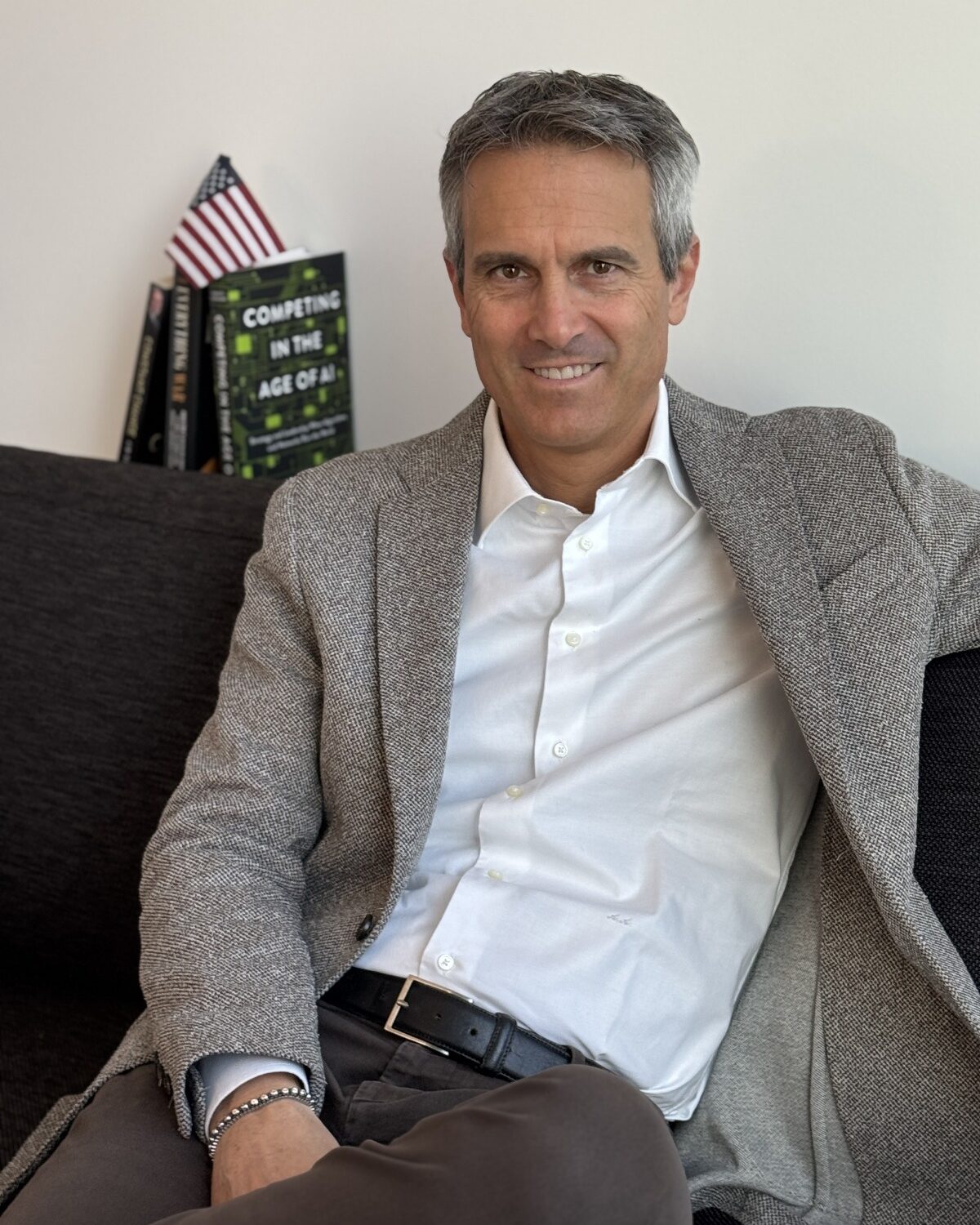
From Italy to the United States, via Europe and China: Andrea Albertini’s is the story of a manager who has made global vision his strong point. Today he leads Global Distribution and Technology at Henry Schein, the world’s largest provider of solutions for medical and dental practices. In this interview, he talks about the behind-the-scenes workings of a 12.7 billion revenue company, the challenges of an ever-evolving industry, and what it’s like to live (and work) in the city that never sleeps.
Dr. Albertini, what is your professional background?
I have been working at Henry Schein since 2013, but I have over 20 years of experience in the medical industry. Before joining the company I was responsible for the Medical Devices division of a major Italian manufacturer, and Henry Schein was among my biggest clients. I started my journey at Henry Schein as Vice President International Equipment based in the Frankfurt office. Over time, I took on roles of increasing responsibility: from coordinating offices in Southern Europe, to a project in China, to leading the entire European area. Before moving to the United States, I served as CEO of the International Distribution Business.
And then he arrived in New York, with a new role….
In 2023, I moved to New York, where the headquarters are located, and today I am CEO of Global Distribution and Technology, a role that includes oversight of worldwide distribution, software, and value-added services.
Henry Schein is the largest provider of healthcare solutions for private medical and dental practices. We are among the 500 largest companies in the United States, recognized for our ethics and commitment to social responsibility.
Henry Schein’s mission is to provide the largest assortment of products, services and solutions for practices, including financial services and management software. We help professionals with practice management while letting them focus on patient care.
How was your work structured during the pandemic and how much did it change afterwards?
The pandemic period was obviously very difficult from a professional and business management point of view. As you can imagine, the majority of clients initially closed their practices only to reopen slowly but with a huge demand for infection control devices. Despite the complexity of different rules and product regulations for each country, Henry Schein played a key role in helping medical and dental professionals reopen their practices by providing the necessary products to ensure the safety of practitioners and patients. When the emergency finally returned, we saw a surge in visits to the practices to recoup the lost months. Our clients at this point had become even more attentive and demanding on hygiene and personal protection issues, but also more “digitized” and focused on practice efficiency.
And is there anything left over from that experience?
Certainly, a more thorough evaluation in the selection of suppliers: the pandemic
brought to light how poor quality and often unapproved products sold by improvised suppliers could be found in the market. It has also accelerated even more the use of digital channels such as e-commerce for product sourcing. In addition, with rising inflation and costs, we are seeing an increasing search by customers for alternative products at a lower price, but still of high quality. Henry Schein also offers a full range of private label products precisely to meet these needs.
You operate in different markets, such as China and Southern Europe. Does the approach and strategy in distribution change between the U.S. and foreign markets?
The values we express as a company and with our offerings are similar everywhere, but the markets are very different. The differences are mainly dictated by the training system of doctors and dentists and the local health care system. For example, in some countries the costs of dental care are paid by the state, in others they are paid entirely by the patient, and in still others they are reimbursed by insurance companies. These differences have a direct impact on the choices of products to be purchased and investments in equipment in dental practices.
Clearly, a company like yours, which comes from America and is a benchmark in the medical industry, brings innovations that could transform the medical approach in Europe. Is there something you are working on that could be a game changer?
Ours is a globalized market; new products move fairly quickly from one country to another. Europe is a strong driver of innovation, on par with the United States, Japan, Korea and increasingly China. That said, the United States remains the world’s largest market, which is why every manufacturer, even if it develops an innovation outside the United States, immediately aims to enter the U.S. market.
One example that we can call a “game changer” is the adoption of artificial intelligence some support of the dentist in imaging and establishing treatment plans.
You said earlier that for Henry Schein, the medical market, unlike the dental market, is mainly tied to America. Why is this market not being penetrated significantly abroad?
It’s true. Our medical buisness is very big in the United States, where our company was born and raised. Henry Schein specializes in serving physicians who operate out of hospitals: private practices, outpatient clinics… It’s a very developed model in the United States, which aims to move the patient out of the hospital on as many occasions as possible. Serving physicians operating in private practices is closer to our historical business, dental.
What was your move to New York like?
In the United States – and in New York in particular – business is much more dynamic than in Europe. Everything moves faster here, the work culture is extremely competitive and productivity-oriented, and it is a very stimulating environment, but it is also tiring. New York is an incredibly exciting city, but it requires very high rhythms. It’s a lot of work, both because of the role I play and because of the American approach to business: it’s a 24/7 job. In Europe we tend to take more space outside of work, we have well-established vacation periods, and we use the weekend as a time to disconnect. Here it’s different.
And then, of course, there is also a personal aspect: leaving family and friends was a major change, and the new job absorbs a lot of time, but New York conveys a strong positive energy from which it is impossible not to be drawn in.
You were telling me earlier about Henry Schein as one of the most ethical companies in the world. What is your point of view?
For our part, there is a concrete commitment based on values and corporate culture. For years we have been recognized as one of the most ethical companies in the world by Ethisphere. Our core values such as transparency, ethics, inclusion and sustainability have always guided our behavior, which we are committed to upholding even in the face of different governments or with different market situations. Henry Schein’s corporate culture always remains a constant and a priority.
One thing you would like to introduce about Italian culture in America and vice versa?
I would bring in an element of our culture: the ability to combine business with the pleasure of sociability. A meal, for us, is not just work, but also sharing and informal conversations from which longer-lasting relationships are often born. It is an important part of our lives, and in America it is somewhat lacking. Instead, I would bring to Italy the speed with which Americans are able to turn ideas estrategies into concrete actions: less bureaucracy and more efficiency.
One piece of advice you would give to a young Italian manager who wants to come to the United States to work in this industry?
The Italian school, from a managerial point of view, is excellent. We have the ability to find solutions to problems, to be flexible and creative. If you combine our training and attitude with their competitive and pragmatic approach, you can achieve great results. Of course, you need willingness to work hard, with a lot of commitment here in America you can really do great things.
The article Andrea Albertini: the path of a successful Italian manager comes from TheNewyorker.
