
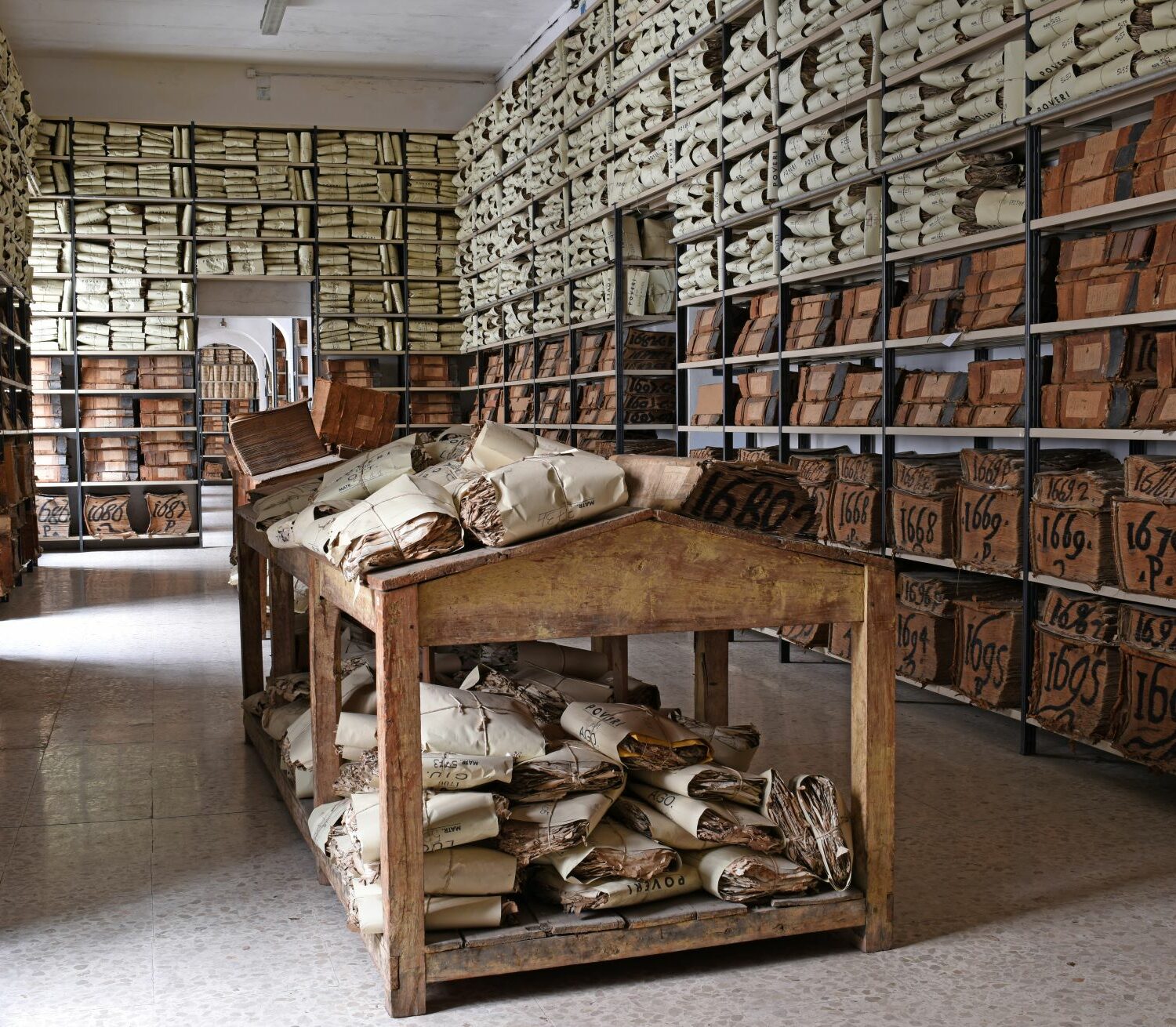
Whenever we approach an archive, we ideally immerse ourselves in a kind of poetry of time. Yellowed and worn folders over the years that whisper stories to us. The memory stored in an archive is a legacy we carry with us, a wealth of knowledge and emotions that helps us navigate the present and shape the future. Stories that are passed down from generation to generation.
We are in Naples, via dei Tribunali. Narrow alleys, open-air markets. A place that fully reflects the spirit of the city, known to the world for that charming atmosphere that has always smiled at life. Palazzo Ricca, is home to the Fondazione Banco di Napoli and its Historical Archives, which, from the 15th century to the present day, holds records of some 17 million customers. Since 1500, trade, marriages, travel, political intrigue and aspects of simple daily life are recounted. A heritage so unique that it has been included in the International Register of UNESCO’s “Memory of the World” program, a recognition that celebrates its value as a universal memory of humanity.
Entering the archive immediately puts you in touch with something extremely fascinating. Preserved and made available to the public while maintaining an aspect of mystery through soft lighting and environments that we could compare to a novel from another time. You enter and immediately have the desire to walk in slowly, observe the folders on display, the seals painted on the coast and carefully read the stories. Each document, each manuscript, each letter are pieces of a larger narrative, telling stories of people, of society, of emotions experienced. Looking inside and beyond each writing are faces, stories, human desires that, though faded by time, continue to speak. The people who take care of them with care and professionalism tell me that in the 1500s and in the years to follow, to withdraw or pay a sum it was necessary to describe the motivation. And that is how the history of that era could be reconstructed, from trade to parties and intrigue. Reading one finds illustrious figures such as Velázquez and Verdi, but also events related to San Gennaro or the passionate murder of Maria D’Avalos at the hands of the great musician Gesualdo da Venosa. The purchase of wine or food for feasts traced in the Bank’s books. Evidence of the pageantry and high society, of business deals.
Thus also read the correspondence and stories of Italian emigrants to America. The voyage of a lifetime, of the American dream, which ended, after many days of sailing, with the appearance of the Statue of Liberty and the cry “America.” In 1907, Giuseppe Apicella recounted his journey to his wife Ninnella through many letters still preserved in the archives. “Water, just water,” he wrote of that interminable journey. He left first, to explore that land that would bring salvation and opportunity. And America, to Joseph Apicella, brought freedom. He became the owner of New York’s largest fish market, at 82 Beyer Street. When Ninnella joins him, he will write to his grandmother about his successes in that America where the wheel of time turns fast. He will tell of the Procession of the Blessed Virgin of Mount Carmel and of Joseph, who has since become a correspondent of the Bank of Naples in America.
Historical archives are a record of our past. The present is the result of events of which we cherish the memory, emotions, struggles and achievements. They are like treasure chests of knowledge that allow us to shed light on who we are, where we come from and how our roots go back in time. For this reason, the historical archives of the Banco Napoli Foundation take on an inestimable value that goes beyond the concept of documentary collection. Borges said “Every story is a memory of the past, and every memory is a door that opens to the future.”
The article Lives Unveiled: memoirs from the Fondazione Banco Napoli Archives comes from TheNewyorker.
