
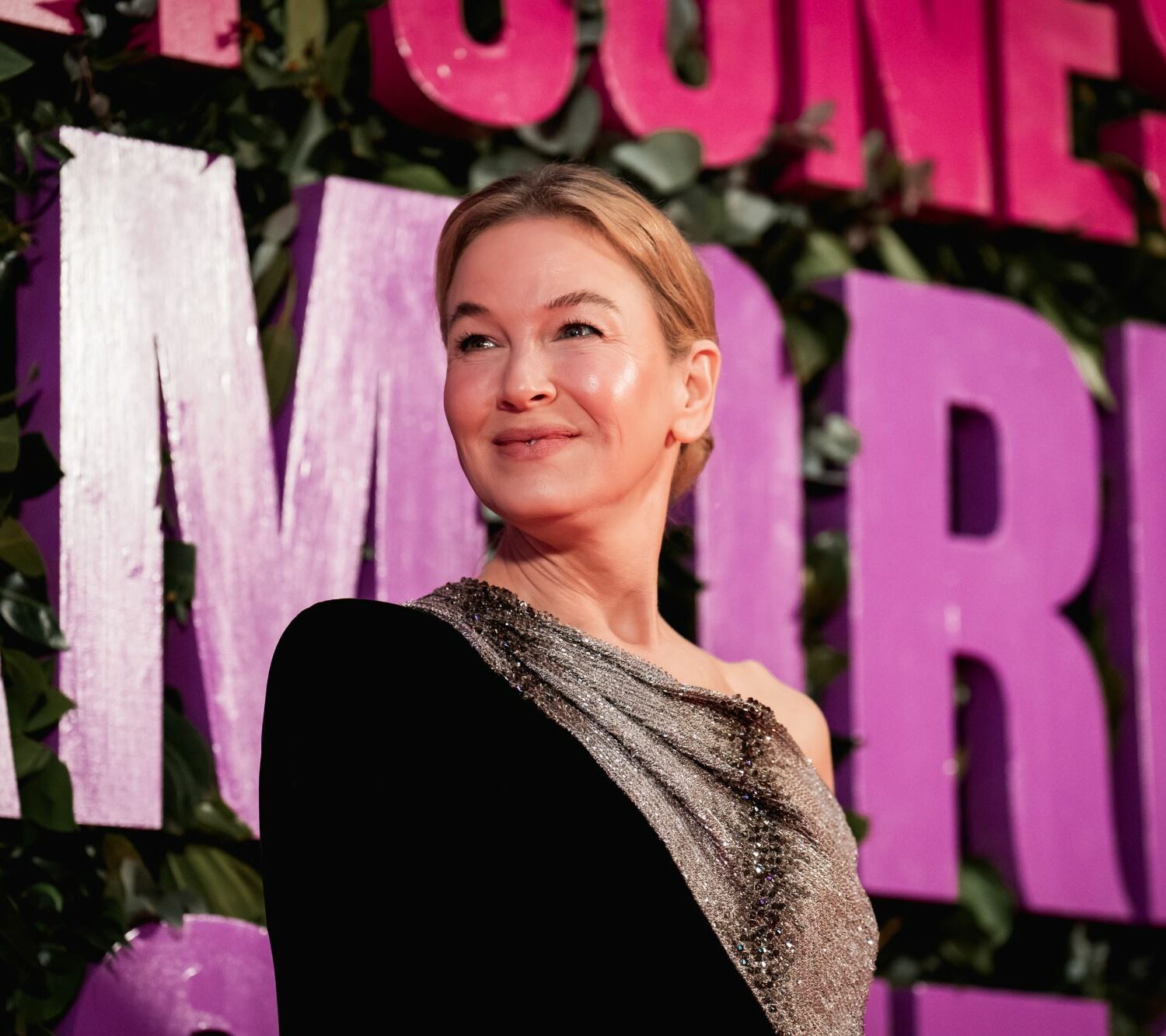
In person, Renée Zellweger looks nothing like Bridget Jones: she is petite, thin, almost slender, and certainly has no need for the famous restraining knickers she wore in the first film. With the character that made her iconic, however, she shares that almost British sense of irony (she’s from Texas), empathy, and sincere smile. “Yes, they still asked me to put on weight to reprise the role,” she tells me. “But it wasn’t too challenging: I stopped going to the gym and gained a few pounds.”
The latest installment in the saga dedicated to the single bungler who is the symbol of all of our romantic disasters, Bridget Jones: Mad About the Boy, debuted last Valentine’s Day on the Peacock platform. It is the fourth film, and follows the three released in theaters between 2001 and 2016 that made us fall in love with the anti-heroine created from the pen of Helen Fielding.
Bridget is a London producer who specializes in gaffes and is romantically torn between an incurably womanizing boss (he is Hugh Grant) and an all-around international cooperation lawyer (Colin Firth). She continually finds herself in the most absurd and embarrassing situations, such as when (in the first film) she shows up at a garden party dressed as a Playboy bunny only to discover that she is no longer in costume. However, she always manages to find her square. She also eventually manages to find love, and marries Firth.
Has Bridget now achieved the hard-earned serenity?
Macché: in Mad About the Boy we find her a widow of four years (her husband died in a bombing in Darfur, although Colin Firth appears here and there during the film as an evocation). She has two young children whom she drives to school in her pajamas, and she is single and depressed again, although she has remained friends with her former boss (again played by Grant) who babysits her offspring when necessary.
Pressured by her friends and her gynecologist – Emma Thompson, in a cameo in which she bestows a pearl of wisdom to make our own: that of the oxygen mask as a metaphor for life, which on an airplane should be worn before thinking about rescuing others, including her children – she tries to grieve. And he will again end up dividing himself between a young “toy boy” park ranger with sculpted abs (played by Leo Woodall) and his son’s more mature science teacher (Chiwetel Ejiofor, also not bad looking shirtless, by the way).
“We could not tell the same story, in the same way, after so many years: Bridget had to be recognizable, but also different,” Renée explained to me. For our chat, we met in Rome, in a magnificent hotel overlooking the Spanish Steps. She wears a low-cut dress that highlights the delicate line of her neck and arms, smiles and is in high spirits.
Bridget Jones (Renée Zellweger) in Bridget Jones: Mad About the Boy, directed by Michael Morris.
Twenty-five years have passed since the first film, and she is back to embody Bridget Jones. How does she feel?
“Actually, I’ve always felt that Bridget has never really gone away, because I talk about her almost every day when I’m out and about. People I meet always want to share some ‘Bridget Jones’ experience with me, and it’s a gift to be able to talk and laugh with people you may have never seen, but with whom you have something in common.”
What do you think is the secret of this character’s success?
“I think it lies in the fact that Bridget faces life with optimism and joy, even though she is always in the midst of chaos–a chaos that is very much like warmth, though, right? She is always kind, persevering, positive, and somehow communicates to viewers that they can be too. Her experiences are universally recognizable, and they become a source of inspiration for everyone. Because no matter how difficult it is, and no matter how imperfect she feels, or how big the gap she perceives between herself and the paradigm our society imposes on us in terms of beauty or success-she never gives up, and in the end she triumphs. And I think in that way she makes us feel understood and gives us hope.”
Has it helped women make peace with their imperfections?
“I think she has become a beacon on self-acceptance, and has encouraged every person, not just women, to recognize that they are beautiful no matter what. We all always find something to blame ourselves for, even when there is really nothing wrong. Bridget, on the other hand, goes beyond society’s standards; I myself immediately identified with her, and she is an inspiration to me as well.”
How much of you, personally, is in Bridget?
“It is difficult to answer, as I have already said I am very attached to the character, after all she accompanied me for half of my life. In the beginning to play her I made some choices, but I can’t say whether they were completely intentional or accidental. However, I can talk about the things I feel I have in common with her. For example: I understand her complicated relationship with the passing of time, and I understand her when she tries to do her best and instead finds herself in absurd circumstances at the least opportune times. I really like her irony, and I, like her, am also an incurable romantic.”
In this latest chapter Bridget has an affair with a guy who is quite a bit younger, do you think this is still a taboo for women?
“I don’t think so, and then relationships between people of different ages have more or less always existed. Certain stereotypes are disappearing, and above all we should not judge other people’s relationships, but rather be happy for any person who manages to find love. Fortunately, today our society is beginning to understand, and love relationships can no longer be pigeonholed into such rigid parameters.”
Personally, I found a vein of melancholy in the film: the main characters who were biting life twenty-five years ago have been tested by time, and although they retain their humor they have nevertheless aged, they are suffering. What are your thoughts on this?
“I believe the essence of Bridget Jones lies in her optimism, her warmth, her humanity, her cheerfulness. However, none of us gets to this age without experiencing grief or the loss of the people we love, and somehow that makes us different from the way we were. More mature, perhaps a little more melancholy. We still look for hope, though, and that is one of the things we can certainly find in the film.”
The article Bridget Jones? With her imperfection she gives us hope: interview with Renée Zellweger comes from TheNewyorker.
